
曾大发
2
Launches
0
Followers
12
Upvotes
🔥 1
Day streak
Achievements 2
All badgesBadge Bearer
First Launch
Products by 曾大发
2 total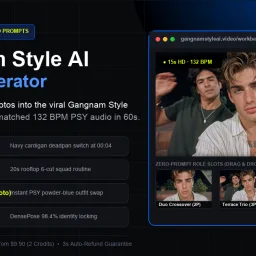
Gangnam Style AI Video Generator
Ai-generative-media
Viral dance videos have become a cultural phenomenon, but creating professional-quality versions requires technical skills most people lack. This AI video generator tackles that barrier by letting users transform 1-3 portrait photos into synced 15-second Gangnam Style dance videos without writing a single text prompt. The target audience spans casual creators who want shareable content quickly, social media enthusiasts looking for a novel way to feature photos, and anyone nostalgic for the 2012 phenomenon seeking to recreate it with modern faces. What distinguishes this tool is its singular focus. Rather than being a generalist video generator, it commits entirely to one dance and three preset choreography templates, eliminating decision paralysis. Users select between the Blue Tux Solo, Street Duo, or Terrace Trio formation, upload their photos to marked role slots, and receive an MP4 in under a minute. The 132 BPM audio syncing to PSY's original track happens automatically, and the platform claims 98.4% facial accuracy across fast-moving choreography, a technical claim that matters given how video synthesis typically fails on rapid motion. The product supports both landscape (16:9) and portrait (9:16) aspect ratios, accommodating TikTok creators alongside desktop viewers. Users can generate in either 720p or 1080p Full HD. Photo requirements are practical: clear, front-facing waist-up portraits with natural lighting, which aligns with smartphone capabilities. The business model prioritizes simplicity and trust. Pricing starts at $9.90 for a single 720p generation, with 1080p available through a credit system. There is no subscription; each generation is a one-time purchase. The platform offers a 3-second auto-refund guarantee and purges uploaded photos after 24 hours, directly addressing privacy concerns that plague photo-based AI tools. The core limitation doubles as the core strength: this solves a highly specific problem for a specific trend. It cannot serve users wanting unlimited choreography variety or custom music. For the narrow use case it addresses, however, the no-prompt interface, preset role system, and automatic audio syncing eliminate friction between idea and output. The one-time pricing without subscriptions positions it as a novelty purchase rather than a recurring service, which suits its entertainment-focused positioning.

Where Is This Place
Geo-tools
Finding a location from a photo should be straightforward, but current solutions disappoint. Google Lens returns visually similar but geographically wrong results, general chatbots confidently pinpoint places without revealing their reasoning, and once GPS data vanishes, the photo becomes a mystery. Where Is This Place addresses this friction by turning photo location identification into a transparent, verifiable process. The service accepts any image without requiring an account or signup. Users upload a photo, screenshot, or paste directly, and receive ranked candidate locations within approximately 30 seconds. The product's core differentiation lies in its commitment to reasoning transparency. Rather than offering a single confident answer, it displays the top three candidate places alongside the visual evidence that led to each ranking: architectural features, street signs, landscape characteristics, and infrastructure details. Each analysis includes a confidence label that acknowledges the limits of what the image can support, deliberately avoiding false GPS-level precision. The interface separates candidate locations from verified pins, making clear the distinction between the AI identifying a place as a likely match and having definitive evidence for an exact location. This distinction matters for users who need trustworthy answers rather than speculative ones. Users can inspect unedited model outputs, view source photos with their original licenses and documented coordinates, and verify conclusions independently on maps. The product publishes reproducible production runs rather than handwritten demos, with file hashes and independent ground-truth checks retained in reports. The platform extends beyond geolocation into privacy protection. A browser-based EXIF viewer allows users to inspect their own photo metadata before sharing, and a metadata removal tool addresses the flip side of the problem: preventing others from extracting location data from personal photos. On the free tier, users receive five analyses per week without cost. Uploaded photos are deleted within 24 hours and never used for model training. An optional paid tier unlocks deeper evidence such as exact pins and Street View comparisons when the underlying analysis supports that level of precision, though specific pricing is not disclosed. Where Is This Place targets photographers, travelers, researchers, and anyone with photos of unknown origin. The emphasis on explainable results and privacy protection positions it directly against generic AI image analysis tools, appealing to users who want to understand the reasoning behind answers, not just the answers themselves.