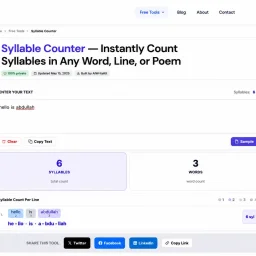
Syllable Counter
Productivity
Poetry and language instruction share a common friction point: the tedious, error-prone work of counting syllables by hand. Whether a student is drafting a haiku, a teacher constructing readability-checked lesson materials, or a language learner parsing the phonetic structure of unfamiliar words, syllable counting interrupts the creative or instructional workflow. This free, account-free tool addresses that gap directly, offering instantaneous syllable counts across single words, full passages, or structured verse without requiring registration or payment.
The product pairs a rule-based algorithm with a syllable dictionary, a deliberately hybrid approach that acknowledges a real linguistic problem: English orthography and pronunciation diverge sharply. Words like "comfortable" compress in natural speech; "poem" splits differently than its letters imply. By combining both methods rather than relying on pattern-matching alone, the tool targets reliability across standard vocabulary. The architecture is transparent about its constraints as well, noting that dialects, loanwords, and proper nouns may fall outside consistent coverage. That honesty distinguishes it from tools claiming universal accuracy.
The interface centers on per-line syllable counts, a feature the maker emphasizes as structural rather than decorative. For poets working in meter-dependent forms, this granularity is not incidental; one syllable out of place in a stanza breaks the rhythm. The tool displays per-word syllable breakdowns inline as users type, allowing real-time feedback without submission delays. It also surfaces word and line counts, useful context for both poetic form verification and readability assessment.
The target audience is broad: poets across formal verse traditions, students building English fluency, educators designing accessible materials, and content creators checking Flesch-Kincaid and similar readability formulas that hinge on syllable density. The makers position syllable counting as foundational for pronunciation intuition and grammar sense in language acquisition, a reasonable pedagogical claim.
Practically, the tool operates without friction. No sign-up, no storage of user text, no watermarks, and no cost remove friction from a frequent task. The interface is lean enough to load instantly and stay responsive. For academic or publishing contexts where formal precision matters, the makers wisely suggest cross-checking against phonetic references. For everyday writing, learning, and poetry composition, the output is positioned as reliable enough to use directly.
The result is a focused, no-nonsense utility that solves a specific problem well and acknowledges its limits candidly.