
Archlint
- No match
Machine translation — the English original is authoritative.
The Story
We built Archlint because AI agents can introduce architectural drift across dozens of tool-calls before anyone notices. Traditional static analysis runs after the damage is done. We needed a way to catch violations the instant they happen—still inside the agent's loop—so fixing is cheap and drift never accumulates.
AI Overview
AI-generatedArchitectural decay in AI-assisted coding happens fast. As code agents like Claude Code and Cursor generate multiple edits across dozens of tool-calls in a single session, violations of project structure can slip through undetected until they accumulate into technical debt. Archlint addresses this by moving architectural validation from the CI pipeline into the agent's editing loop, catching violations the moment they occur so corrections happen immediately rather than weeks later during code review.
The tool works by declaring a project's layer structure and dependency rules upfront—defining which components can import from which others—then validating every edit the agent makes against those rules in real time. It supports six languages: Python, TypeScript and JavaScript, Go, Rust, Java, and C#, with import resolution sophisticated enough to handle real-world complications like tsconfig path aliases, Python src/ layouts, and Go module paths. The system doesn't require an architectural blueprint; teams new to Archlint can run its initialization tool to generate rules from their existing directory structure and import patterns, then refine them in minutes.
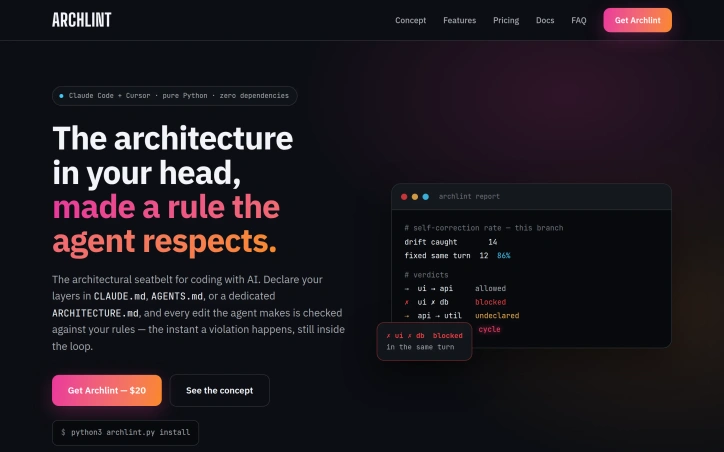
What distinguishes Archlint is its positioning as a guardrail for AI agents rather than a general architecture linter. The product's own telemetry shows an 86 percent self-correction rate—meaning the agent detects violations and fixes them within the same session 14 times out of roughly 16 when drift is introduced. This metric captures something important: the tool's value isn't primarily about stopping bad code but about catching it early enough that remediation is trivial.
The implementation is spare. Archlint is pure Python with no external dependencies, keeping deployment friction low and the attack surface minimal. It integrates with both Claude Code and Cursor, delivering per-edit feedback in Claude Code and end-of-turn summaries in Cursor. For teams adopting it into existing codebases with established architectural violations, the baseline mode allows rules to be adopted gradually—flagging only new drift rather than demanding immediate compliance with historical violations.
The product is sold at a flat $20 price, making it accessible to individual developers and teams. For organizations where architectural integrity matters—teams managing microservices, plugin architectures, or domain-driven designs where layer violations compound into significant problems—the cost justifies itself through prevented rework.
Founder Diary
DevlogThe maker hasn't posted a diary entry yet.
Key Features
Real-Time Validation
Catches architectural violations the moment agents make edits, enabling immediate correction within the same session
Multi-Language Support
Supports Python, TypeScript, JavaScript, Go, Rust, Java, and C# with sophisticated import resolution
Automatic Rule Generation
Generates dependency rules automatically from existing directory structure and import patterns
Agent Integration
Integrates directly with Claude Code and Cursor for per-edit and end-of-turn feedback
Gradual Adoption
Baseline mode flags only new drift, allowing rules to be adopted gradually without forcing historical compliance
Use Cases
-
1
AI-Assisted Development
Prevents architectural debt when code agents like Claude Code and Cursor generate multiple edits across dozens of tool-calls
-
2
Microservices Teams
Maintains layer integrity in microservice architectures where violations compound into significant technical debt
-
3
Plugin Architectures
Enforces dependency rules in plugin-based systems where architectural structure is critical
-
4
Domain-Driven Design
Ensures layer boundaries are maintained in systems using domain-driven design principles
FAQ
What programming languages does Archlint support? ▾
How do I set up Archlint for my existing codebase? ▾
How does Archlint integrate with AI code editors? ▾
Can I adopt Archlint gradually in a codebase with existing violations? ▾
Pricing
Flat pricing model makes the tool accessible to individual developers and teams
Tech Stack & Tags
Discussion
No comments yet — be the first!
Join the conversation — sign up to comment.
Sign up freeCommunity Support
Boost this project on Sell With boost