
BAGUNO AI AUTOMATION
- No match
Machine translation — the English original is authoritative.
The Story
It started as a raw vision in a local folder: a world where accountants didn't have to waste hours manually typing out line items from messy Arabic and English invoices. The early days were spent in the trenches, building the core engine from the ground up—stitching together Cloud, database, and writing the first lines of code to make AI actually understand complex financial documents.
Then came the momentum. A launch on Hacker News brought the tool out of the local terminal and into the public eye. The system rapidly grew smarter and more resilient. The architecture evolved to intelligently route documents through AI. Ingenious features like "Smart Clone" were born out of a founder's need to keep cloud costs lean, and the "Sentinel" agent was forged to catch fraud, math discrepancies, and new vendors in real-time.
Today, Baguno isn't just an MVP; it's a Fortune 500-grade Accounts Payable AI. It seamlessly connects with global ecosystems, surviving the strict gauntlet of Zapier's OAuth API review process and integrating with major platforms like Zoho. It hunts down zombie SaaS subscriptions, securely processes email webhooks, and flawlessly handles complex, multi-language data extraction without breaking a sweat.
The journey went from debugging early server logs to orchestrating a fully automated, global accounting workflow.
AI Overview
AI-generatedAutomating invoice processing and financial data entry remains a persistent pain point across organizations of all sizes. BAGUNO tackles this challenge by acting as an AI-powered intermediary between document sources and accounting software, eliminating manual transcription work that typically consumes significant finance team capacity.
The platform targets a broad spectrum of users—from freelancers drowning in expense tracking to enterprise consulting firms managing multiple client books, to SMEs running on accounting software like QuickBooks or Tally. This range reflects the founder's stated mission to remove manual data entry from finance workflows entirely.
What distinguishes BAGUNO is its layered intelligence approach. The core Neural Invoice Engine handles document parsing with claimed 99.8% accuracy, but the platform extends beyond simple data extraction. Lia, its AI copilot, allows users to interact with financial data through natural language commands rather than traditional form entry—asking "Who is my most expensive vendor?" or approving purchase orders through conversational prompts. The system reportedly executes these actions directly in connected ERPs without human intervention on individual forms.
Sentinel AI adds fraud prevention capabilities, algorithmically auditing documents before they reach the ledger, matching invoice line items to purchase orders, and flagging price anomalies. The platform also includes predictive liquidity forecasting, offering thirty-day cashflow visibility and alerting users to potential gaps.
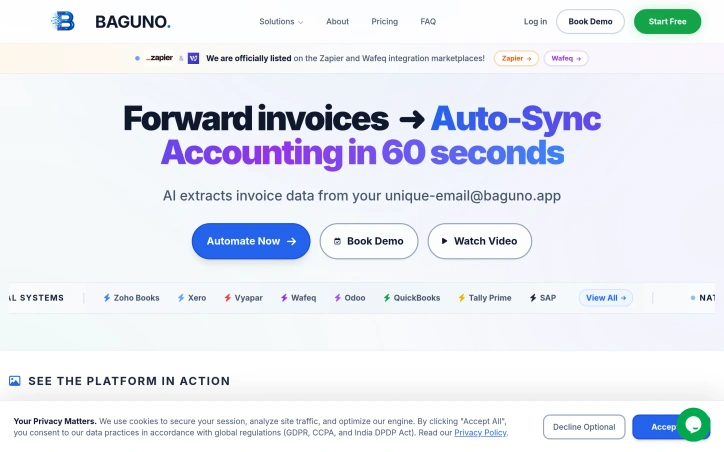
Integration is positioned as comprehensive, supporting Zoho Books, Odoo, QuickBooks, and Tally Prime, with the system functioning as a centralized ingestion point for quotes, purchase orders, invoices, and related documents. The platform accepts invoice submissions via email or upload, reducing the friction of onboarding financial documents.
Pricing follows a freemium model with a Basic free tier capped at twenty documents monthly and supporting a single user seat, including core extraction and automated three-way matching. Paid tiers exist, with annual subscriptions discounted to the equivalent of two free months. Specific pricing for higher-tier plans isn't fully detailed in available materials, though this structure makes the product accessible to freelancers and smaller operations while remaining viable for larger teams.
The platform's viability ultimately rests on the reliability of its AI models and the practical execution of automated workflows across diverse ERP systems—areas where real-world performance may diverge from stated capabilities.
Founder Diary
DevlogThe maker hasn't posted a diary entry yet.
Key Features
Neural Invoice Engine
Parses documents with claimed 99.8% accuracy and handles automated three-way matching.
Lia AI Copilot
Enables natural language interaction with financial data and executes actions in connected ERPs without manual form entry.
Sentinel AI
Provides fraud prevention through algorithmic document auditing, PO matching, and price anomaly detection.
Predictive Liquidity Forecasting
Offers thirty-day cashflow visibility and alerts users to potential financial gaps.
Multi-ERP Integration
Supports Zoho Books, Odoo, QuickBooks, and Tally Prime with email and upload submission options.
Use Cases
-
1
Freelancers
Eliminates expense tracking and manual financial data entry work.
-
2
Enterprise Consulting Firms
Manages multiple client books without manual transcription across diverse accounting systems.
-
3
SMEs on Accounting Software
Removes manual data entry from entire finance workflows for teams running QuickBooks or Tally.
-
4
Finance Teams
Reduces significant team capacity consumed by manual invoice and expense processing.
FAQ
How accurate is BAGUNO at invoice processing? ▾
What accounting software does BAGUNO work with? ▾
Is there a free version? ▾
How do I submit invoices to BAGUNO? ▾
Pricing
Basic free tier capped at 20 documents monthly; paid tiers available with annual subscriptions discounted to equivalent of two free months.
Discussion
No comments yet — be the first!
Join the conversation — sign up to comment.
Sign up freeCommunity Support
Boost this project on Sell With boost