conduitfill tool
- No match
Machine translation — the English original is authoritative.
The Story
Conduit Fill Tool was created to make conduit fill calculations easier and more accessible for electricians, contractors, engineers, apprentices, and students. The idea is simple: provide a free online tool that helps users quickly check conduit fill while also offering clear NEC-based reference information, charts, and educational guides.
The goal is to reduce the time spent on repetitive calculations and make conduit fill requirements easier to understand, especially when working with different conductor sizes and conduit types such as EMT, PVC, RMC, and IMC.
AI Overview
AI-generatedElectrical contractors and their teams often face a repetitive but critical task: verifying that the conductors installed in a given raceway comply with National Electrical Code fill restrictions. The Conduit Fill Tool addresses this calculation burden head-on, offering a free online calculator designed specifically for electricians, engineers, apprentices, and students who need quick, accurate conduit fill compliance checks.
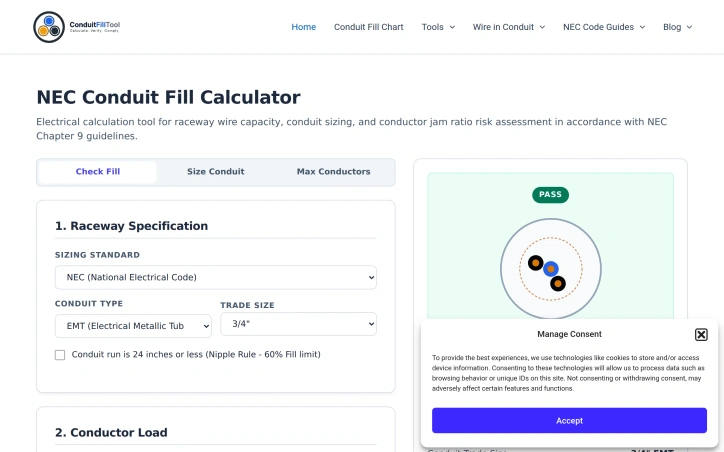
The core value proposition is simplicity and speed. Rather than manually cross-referencing NEC Chapter 9 tables or wrestling with spreadsheets, users input their conduit type (choosing from EMT, IMC, RMC, PVC Schedule 40/80, FMC, LFMC, or ENT), trade size, conductor material and gauge, and the tool instantly calculates whether their installation meets code. The interface walks users through each variable systematically, then displays both the raw calculation and a compliance verdict, complete with a percentage breakdown showing how much of the raceway's cross-sectional area the conductors actually occupy.
What distinguishes this tool is its alignment with current NEC standards and its educational scaffolding. The calculator enforces the correct fill percentages for different scenarios—53 percent for single conductors, 31 percent for two, 40 percent for three or more, and up to 60 percent under the 24-inch nipple rule—ensuring users stay within code. The tool does not simply return a yes-or-no answer; it explains the underlying geometry, citing the specific NEC tables that govern the calculations. For users new to conduit sizing, the site includes reference guides on why fill limits exist, primarily to prevent conductor shearing during installation and to allow heat dissipation under load, along with step-by-step walkthroughs of the mathematics itself.
The sizing engine pulls wire dimensions from official NEC sources rather than relying on estimates or lookup tables that may drift from the standard. This commitment to source accuracy matters in an industry where code compliance carries legal weight.
Pricing is not mentioned in the available content, though the tool is described as free, suggesting a bootstrapped service rather than a subscription model. For a narrow but important use case, the tool eliminates friction from a recurring professional task while strengthening the user's understanding of the underlying code. It demonstrates how focused software can serve skilled trades without requiring deep platform overhead.
Founder Diary
DevlogThe maker hasn't posted a diary entry yet.
Key Features
NEC Compliance Calculator
Instantly determines whether conductor installations meet code fill restrictions.
Multiple Raceway Types
Supports EMT, IMC, RMC, PVC Schedule 40/80, FMC, LFMC, and ENT.
Fill Percentage Breakdown
Displays how much of the raceway's cross-sectional area conductors occupy.
Code References
Cites specific NEC tables and explains the underlying mathematics.
Official Wire Dimensions
Uses data pulled from official NEC sources for accuracy.
Nipple Rule Support
Enforces the 24-inch nipple rule allowing up to 60 percent fill.
Use Cases
-
1
Electrical Contractors
Need rapid verification that conductor installations comply with NEC fill restrictions.
-
2
Engineers and Apprentices
Require accurate calculations and systematic guidance for professional work.
-
3
Students
Learn from reference guides on fill limit rationale and step-by-step mathematical walkthroughs.
FAQ
What conduit types does the tool support? ▾
How much of a conduit can be filled with conductors? ▾
Why do conduit fill limits exist? ▾
How accurate is the calculator? ▾
Pricing
The tool is free and appears to be a bootstrapped service.
Discussion
No comments yet — be the first!
Join the conversation — sign up to comment.
Sign up freeCommunity Support
Boost this project on Sell With boost