Ecommerce Data API
- No match
Machine translation — the English original is authoritative.
The Story
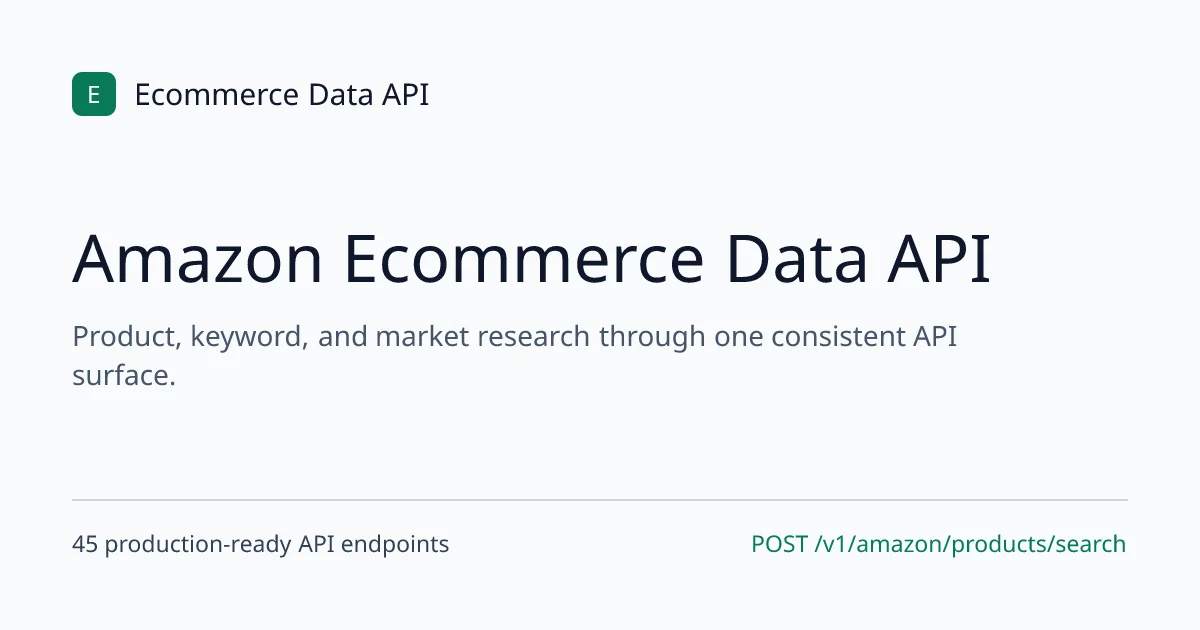
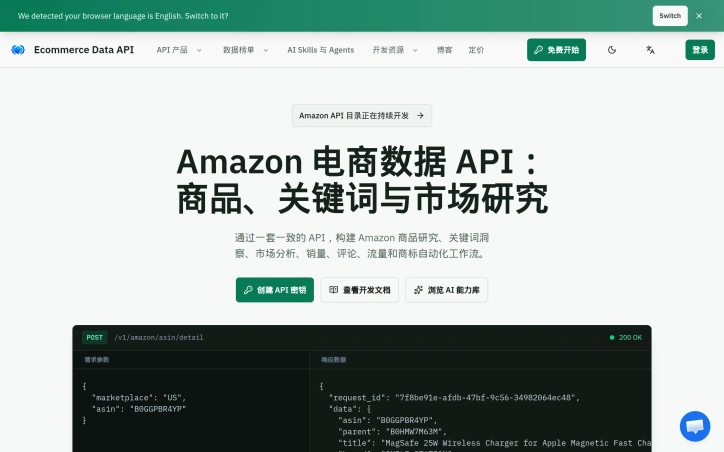
Ecommerce Data API provides structured Amazon product, keyword, market, sales estimate, review and traffic data for developers, sellers and AI agents. Build research workflows with REST APIs, a remote MCP server or Agent Skill. Public documentation includes request examples, and the dashboard supports API key and usage management. Coverage varies by operation; sales figures are estimates.
AI Overview
AI-generatedUnderstanding Amazon's competitive landscape requires access to reliable product, keyword, and market data that most sellers can't gather manually. Ecommerce Data API addresses this gap by providing developers, Amazon sellers, and AI agents with structured access to product listings, search trends, sales estimates, customer reviews, and traffic patterns through a unified REST API and alternative integration methods.
The platform organizes 45 distinct API endpoints across six functional categories, each designed to support specific business workflows. The product research suite enables ASIN lookups with detailed specifications, seller information, pricing, ratings, and competitive variant data. The keyword research set targets search volume analysis, traffic attribution, and ranking metrics. Market analysis tools quantify category size, product concentration, and demand trends. Traffic analysis reveals keyword sources and related product associations. The trademark module covers global intellectual property searches across multiple countries and registering bodies. A text recognition API rounds out the offering, handling optical character recognition for both Chinese and Latin scripts across image URLs, Base64, and file uploads.
The architecture reflects thoughtful product design. API endpoints are grouped by business scenario rather than alphabetical listing, making navigation intuitive for users building specific research workflows. Request examples in the documentation include actual ASIN values and response payloads, reducing friction between signup and first API call. The platform supports not just traditional REST integration but also deployment as a remote Model Context Protocol server and as a reusable Agent Skill for AI-driven automation, broadening accessibility to non-traditional development environments.
Transparency emerges as another distinguishing characteristic. The documentation explicitly acknowledges that coverage varies by operation and that sales figures represent estimates rather than confirmed data. This honesty about data quality limitations distinguishes the product from competitors that oversell accuracy.
The user experience centers on self-service. Customers register independently, generate API keys through a secure dashboard, and monitor consumption metrics and error rates in real time. The platform supports key rotation for security management.
For Amazon sellers building competitive intelligence workflows, cross-border sellers executing market research at scale, or developers integrating ecommerce research into larger applications, the breadth of accessible data points and flexible deployment options position this as a compelling alternative to building custom scraping infrastructure. The explicit acknowledgment of data limitations separates it from vendors making assured-accuracy claims they can't defend.
Founder Diary
DevlogThe maker hasn't posted a diary entry yet.
Key Features
Product Research Suite
Provides ASIN lookups with detailed specifications, seller information, pricing, ratings, and competitive variant data.
Keyword Research Tools
Enables search volume analysis, traffic attribution, and ranking metrics.
Market Analysis
Quantifies category size, product concentration, and demand trends.
Trademark Module
Covers global intellectual property searches across multiple countries and registering bodies.
Text Recognition API
Handles optical character recognition for Chinese and Latin scripts across image URLs, Base64, and file uploads.
Multiple Integration Methods
Supports REST API, Model Context Protocol server deployment, and AI-driven Agent Skill automation.
Use Cases
-
1
Amazon Sellers
Build competitive intelligence workflows to understand market positioning and competitors.
-
2
Cross-Border Sellers
Execute market research at scale across different regions with structured data access.
-
3
Developers
Integrate ecommerce research into larger applications using flexible deployment options.
-
4
AI Agents
Automate research tasks through Agent Skill and Model Context Protocol integrations.
FAQ
What data does Ecommerce Data API provide? ▾
How accurate are the sales estimates? ▾
What integration methods are supported? ▾
How do I manage API keys and security? ▾
Discussion
No comments yet — be the first!
Join the conversation — sign up to comment.
Sign up freeCommunity Support
Boost this project on Sell With boost