
Exolio
- No match
Machine translation — the English original is authoritative.
The Story
I built Exolio after seeing how big the AI cheating problem has become in UK schools and universities. Teachers were telling me they could see students submitting AI generated work but had no affordable way to prove it. Existing tools like Turnitin cost hundreds of pounds per year and were out of reach for individual teachers. I wanted to build something free, instant and genuinely useful no sign-up needed for your three checks, just paste any text and get a result in seconds. The biggest problem with most detectors is false positives and humaniser bypass. Exolio tackles both users can correct mistakes so the model learns over time, and can flag text run through an AI humaniser so it gets better at catching it.
AI Overview
AI-generatedDetecting artificially generated text has become a critical concern in academic and educational settings, where verifying authorship helps maintain integrity and fairness. Exolio addresses this need with a detection tool designed specifically for educators, offering both automated scanning and human-backed analysis.
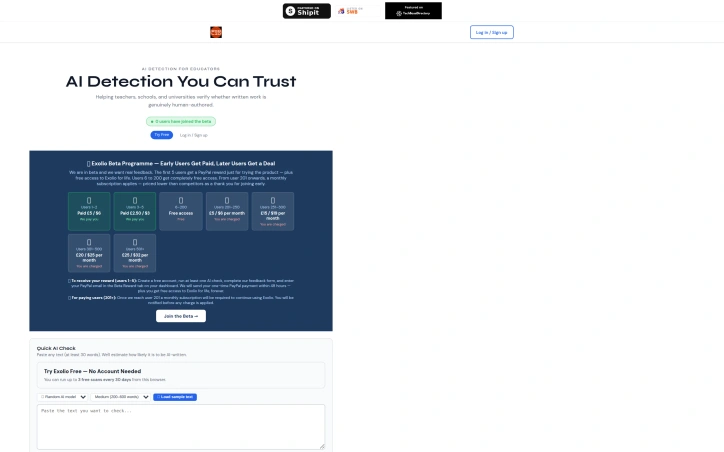
The product combines two distinct approaches. The Quick AI Check provides immediate feedback, letting users paste text and receive an instant likelihood score for AI authorship, broken down sentence by sentence. For higher-stakes decisions, the Document Upload service pairs automated analysis with expert human review, handling PDF and Word documents and delivering detailed written assessments within one to seven days. This dual offering reflects a pragmatic understanding that different use cases demand different levels of rigor.
The company takes transparency seriously about its limitations. Rather than claiming comprehensive accuracy, Exolio explicitly acknowledges that no AI detection system is foolproof and positions its scores as a starting signal rather than definitive proof. This restraint—unusual in a category prone to marketing overstatement—signals that the founders understand the stakes in educational contexts where false accusations carry real consequences.
The business model is straightforward and friction-minimized. New users get three free checks monthly without needing a credit card, letting them evaluate the tool without commitment. Premium access costs £3 monthly for unlimited checks, positioned as cheaper than a coffee. The pricing avoids long-term contracts and allows cancellation through the dashboard or Stripe portal directly.
What limits the appeal is the modest feature set. The Quick AI Check remains rudimentary—text pasting with an overall score lacks the granular reporting some educators demand. The Document Upload service, while more thorough, lacks published pricing and timeline specificity; the cited range of "24 hours to 1 week" creates ambiguity for time-sensitive academic decisions.
The reliance on a single founder email for support indicates an early-stage operation with obvious scaling constraints as user volume grows.
Exolio occupies a defensible position in the emerging AI detection space for academic institutions. Its clarity about capabilities, accessible pricing, and dual-tier approach create differentiation in a crowded market. The core question is whether the product develops the sophistication and support infrastructure to keep pace as AI-generated text becomes more convincing and detection demands grow more rigorous.
Founder Diary
DevlogThe maker hasn't posted a diary entry yet.
Key Features
Quick AI Check
Paste text and instantly receive a likelihood score for AI authorship, broken down sentence by sentence.
Expert Document Review
Upload PDFs or Word documents for paired automated and human analysis, delivered within one to seven days.
Transparent About Limits
Explicitly acknowledges that no AI detection is foolproof and frames scores as starting signals, not proof.
Free Trial Access
Three free checks monthly for new users without requiring a credit card.
Flexible Pricing
Premium access at £3 monthly for unlimited checks, cancelable anytime via dashboard or Stripe.
Use Cases
-
1
Educators
Need quick feedback on student submissions to detect potential AI authorship in written work.
-
2
Academic Institutions
Require higher-rigor analysis with human expert review for consequential educational decisions.
-
3
Budget-Conscious Schools
Can test the tool with three free monthly checks before committing to premium access.
FAQ
Is Exolio accurate at detecting AI-generated text? ▾
What file formats can I upload? ▾
What does Exolio cost? ▾
How long does expert review take? ▾
Pricing
Free tier with 3 monthly checks, or unlimited checks for £3/month with flexible cancellation via dashboard or Stripe.
Tech Stack & Tags
Discussion
No comments yet — be the first!
Join the conversation — sign up to comment.
Sign up freeCommunity Support
Boost this project on Sell With boost
