Gap-trip

- No match
Machine translation — the English original is authoritative.
The Story
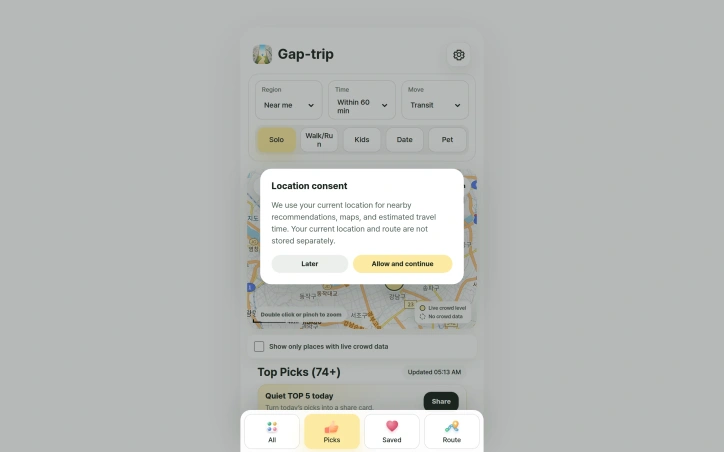
I built Gap-trip because choosing an outing in Korea often meant opening crowd, weather, map, and facility information separately. The Android app brings the available signals into one comparison: crowd data where supported, weather, travel time, and facilities near the chosen destination. After choosing a place, users can check the nearest station and nearby context before leaving. Live crowd and facility information appears only where the underlying source provides it, so the app is a planning aid rather than a guarantee. Gap-trip is free with ads.
AI Overview
AI-generatedPlanning casual daytips across South Korea typically requires juggling multiple applications—checking crowd conditions, weather forecasts, transit maps, and facility details separately before committing to a destination. Gap-trip consolidates these signals into a single Android app designed to streamline the outing selection process.
The app targets local travelers and commuters looking to escape to nearby attractions without the planning friction. It covers all Korean regions and allows users to filter destinations by proximity (within 30, 60, or 90 minutes of travel), mode of transport (public transit, car, or walking focus), and destination type. The interface emphasizes real-time crowd congestion data where municipal sources provide it, supplemented by facility information, weather conditions, and estimated travel times.
What distinguishes Gap-trip is its pragmatic approach to data integration. Rather than promising comprehensive information, the app surfaces only the signals available for each location, positioning itself as a planning aid rather than an authoritative source. Users can save favorite locations, build light courses for connected recommendations, and receive notifications when previously crowded spots become feasible to visit. The app also flags the nearest transit stations and surrounding context before users leave home, addressing a common friction point in Korean commuting.
The feature set reflects a hyperlocal focus. The app provides real-time congestion indicators only in regions where public data supports them, avoiding the false precision that plagues many travel planning tools. Filtering by travel method rather than just distance acknowledges that a 30-minute walk, car ride, or train journey present fundamentally different use cases. Saved courses and notification triggers for low-congestion periods add friction-reduction for frequent users.
Gap-trip operates on a freemium model. The base app is free and ad-supported. A paid option called Gap-trip Pass, priced at 2,900 won monthly, removes advertising and enhances notification and course functionality. This positioning targets budget-conscious users while capturing revenue from power users who plan frequent outings. The app remains in active development, with recent updates addressing stability and interface improvements.
Founder Diary
DevlogThe maker hasn't posted a diary entry yet.
Key Features
Real-Time Crowd Data
Shows congestion indicators for destinations in regions with municipal data.
Multi-Method Filtering
Filter destinations by travel time, transport mode, and attraction type.
Unified Planning Dashboard
Consolidates crowd data, weather, transit info, and facility details.
Saved Locations
Save favorite destinations and build connected course recommendations.
Low-Congestion Notifications
Get alerts when previously crowded spots become feasible to visit.
Transit Station Info
Displays nearest transit stations and surrounding context before departure.
Use Cases
-
1
Local Travelers
Consolidates multiple planning apps into one to streamline daytrip selection.
-
2
Regular Commuters
Quickly find nearby attractions accessible during breaks without planning friction.
-
3
Frequent Planners
Save favorite locations and use notifications to visit popular spots at optimal times.
-
4
Public Transit Users
Filter destinations by specific transport methods to find accessible attractions.
FAQ
How is Gap-trip different from other travel planning apps? ▾
Does Gap-trip work throughout Korea? ▾
What's included in the paid version? ▾
Can I save my favorite places? ▾
Pricing
Free version is ad-supported; paid Pass removes ads and enhances features for power users.
Tech Stack & Tags
Discussion
No comments yet — be the first!
Join the conversation — sign up to comment.
Sign up freeCommunity Support
Boost this project on Sell With boost