
LumaEcho
- No match
Machine translation — the English original is authoritative.
The Story
Hi, I'm Martin — a solo developer from Germany.
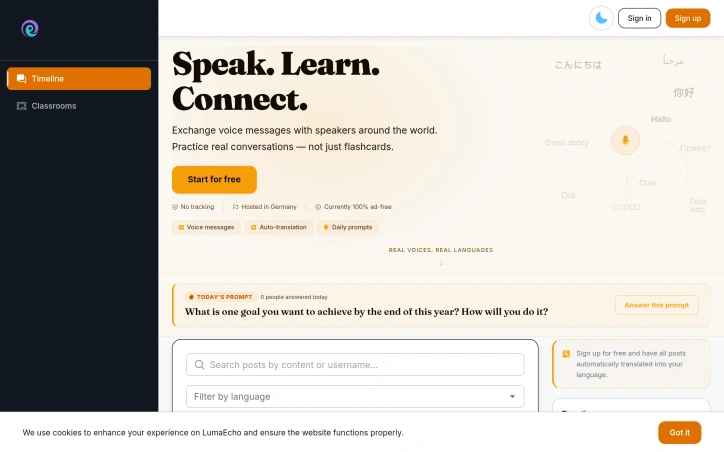
I built LumaEcho because I believe the best way to learn a language is through real conversations with real people. Not flashcards. Not AI chatbots. Actual humans.
The idea is simple: record or type a voice message, and everyone can understand it — instantly translated into their language. You practice speaking, they understand you, and they reply. That's it.
LumaEcho has two ways to connect: a public feed where you post and reply to others, and classrooms where small groups practice together.
AI Overview
AI-generatedLanguage learning has long suffered from a fundamental disconnect: most tools prioritize convenience over authenticity. Flashcard apps, AI tutors, and traditional courses optimize for completion rates, not for the messy, rewarding experience of actually communicating with another human being. LumaEcho inverts this priority entirely.
The premise is deceptively straightforward. Users record or type messages in their target language, which are instantly translated for readers. Replies flow back in the same transparent way—native speakers or fellow learners responding in real time. What emerges is genuine exchange: someone practices speaking, someone else understands them immediately, and the conversation unfolds naturally. This sidesteps the performative awkwardness of most language learning platforms.
The product targets anyone genuinely motivated to improve through conversation rather than isolated study. This excludes absolute beginners with zero foundation, but suits learners at intermediate stages seeking context and engagement. Solo learners benefit from the public feed model, which surfaces new conversation partners; structured group learners have classrooms where small cohorts practice together. The dual-mode approach accommodates both spontaneity and accountability.
What sets LumaEcho apart is its rejection of the AI-as-tutor trend. Instead of pairing users with chatbots that simulate conversation, it bets on actual human interaction—messier, less responsive, but infinitely more motivating for most people. The instant translation layer is the enabling technology; it removes language barriers without inserting an intermediary to sanitize the exchange. You are conversing with a real person, not a language engine.
The classroom feature suggests recognition that unstructured practice has limits. Some learners benefit from guided progression and peer accountability. Others thrive in the open-ended social discovery of a public feed. This flexibility is valuable, though the success of either mode depends entirely on community health and active membership.
The business model remains unspecified in the available information, leaving questions about sustainability and monetization unanswered. For a solo founder scaling a two-sided network, that matters—community platforms live or die based on unit economics and retention.
LumaEcho makes a coherent bet: that language learners will choose genuine human connection over algorithmic convenience. Whether that bet succeeds depends less on the product itself and more on whether its founder can build and retain the community to make that connection possible at scale.
Founder Diary
DevlogThe maker hasn't posted a diary entry yet.
Key Features
Instant Translation
Users record or type messages in their target language which are instantly translated for readers
Real-Time Human Conversation
Native speakers and fellow learners respond in real time creating genuine exchange
Public Feed Discovery
Solo learners can find and connect with new conversation partners through a public feed
Classroom Mode
Structured groups practice together in small cohorts with guided progression and peer accountability
No AI Intermediary
The platform uses actual human interaction instead of pairing users with language learning chatbots
Use Cases
-
1
Intermediate Language Learners
Those seeking authentic conversation practice beyond isolated study and flashcard apps
-
2
Motivated Self-Studiers
Individuals wanting genuine human connection and real exchange without language barriers
-
3
Structured Group Learners
Students in cohorts who benefit from guided progression and peer accountability
-
4
Solo Practitioners
Learners who thrive in open-ended social discovery through spontaneous conversation
FAQ
How does LumaEcho differ from other language learning apps? ▾
Who is LumaEcho for? ▾
Does LumaEcho have group learning options? ▾
Why does LumaEcho use humans instead of AI tutors? ▾
Tech Stack & Tags
Founder's Resources
Discussion
No comments yet — be the first!
Join the conversation — sign up to comment.
Sign up freeCommunity Support
Boost this project on Sell With boost
Meet the Founder

"LumaEcho is a voice-first social platform for language learners. Post audio messages, get replies fr..."