
MoneyFlow: No bank login
- No match
Machine translation — the English original is authoritative.
The Story
I built MoneyFlow after realizing that most budgeting apps either require bank connections or make you micromanage every transaction. I wanted something simpler: tell me what I can safely spend after accounting for my bills, debts, subscriptions, and goals without giving an app access to my bank. So I built MoneyFlow for myself, and now I’m sharing it with the Product Hunt community to see if it can help others manage their money with less stress and more clarity.
AI Overview
AI-generatedMost budgeting apps promise to simplify your finances by connecting to your bank, then promptly frustrate you with failed syncs, security concerns, and endless transaction categorization. MoneyFlow takes the opposite approach entirely. Rather than chasing bank connectivity as a requirement, it treats manual entry as a feature, positioning itself for users who value privacy, simplicity, and control over the false promise of frictionless automation.
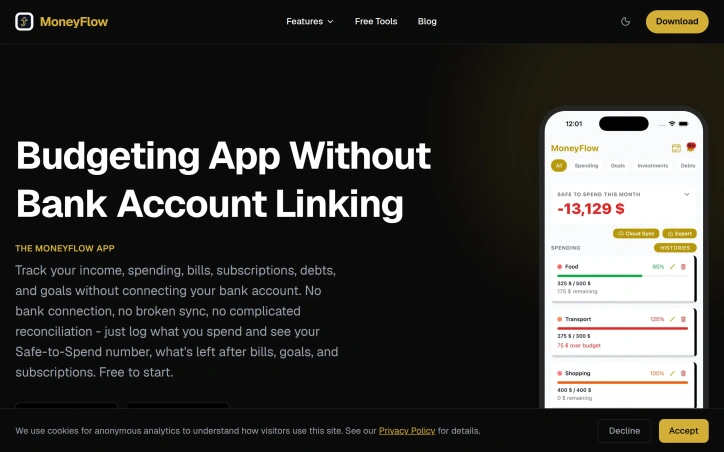
The core tension the app addresses is real: people end each month with no savings despite earning enough money, not because they lack income but because they cannot clearly see where their money actually goes. MoneyFlow answers this through a deliberate constraint. By requiring users to log transactions manually, it forces intentionality without the bloat that plagues competing products. The app then calculates a single number designed to answer the most practical question users face: how much can I safely spend right now after accounting for bills, debts, subscriptions, and goals?
The product organizes finances into seven distinct categories that cover the major ways money moves through a person's life. Beyond basic spending tracking, it handles goals with deadlines, tracks investments across stocks and crypto by total contributed amount rather than market value, monitors debt payoff dates with precise math, alerts users before subscription renewals, logs variable bills separately from fixed ones, and consolidates income in one place. This modular approach avoids the false comprehensiveness that leaves users more confused than when they started.
What distinguishes MoneyFlow philosophically is honesty about its constraints. The app does not pretend manual tracking is as effortless as bank sync; it argues the tradeoff is worth it. No broken connections mean no wasted time troubleshooting, no reconciliation required, no surprise duplicates. Data stays on the user's device. The feature set itself is clean and uncluttered, with no ads and no paywall on core tools. The business model depends on Pro subscribers, not user attention, which aligns incentives toward genuine product utility rather than engagement metrics.
The app positions itself for a specific user: someone who prioritizes control and clarity over perceived convenience, who doesn't trust banks to handle their financial data safely, and who can sustain a habit of logging their own spending. For that audience, MoneyFlow offers something increasingly rare in this category—a tool designed to be simpler than reality rather than more complicated.
Founder Diary
DevlogThe maker hasn't posted a diary entry yet.
Key Features
Manual Transaction Logging
Users manually log spending to maintain intentionality and privacy while eliminating failed syncs
Spendable Amount Calculator
Calculates how much money can be safely spent after accounting for bills, debts, subscriptions, and goals
Seven Category System
Organizes finances into seven distinct categories covering major ways money moves through a person's life
Investment Tracking
Tracks investments across stocks and crypto by total contributed amount rather than market value
Debt and Subscription Management
Monitors debt payoff dates with precise math and alerts users before subscription renewals
Device-Local Storage
All financial data stays on the user's device with no ads and no paywall on core tools
Use Cases
-
1
Privacy-focused individuals
Users who prioritize privacy and don't trust banks to handle their financial data safely
-
2
Intentional spenders
People struggling to see where money goes who want to increase savings through forced transaction logging
-
3
Control-oriented users
Those who prefer having direct control over their finances rather than relying on automated bank connections
-
4
Goal-driven savers
People with specific financial goals and deadlines who need to track investments, debt payoff, and multiple bill types
FAQ
Does MoneyFlow connect to my bank? ▾
How does manual entry help me save more money? ▾
What types of accounts can MoneyFlow track? ▾
Is there a cost to use MoneyFlow? ▾
Pricing
Core tools are free with no ads or paywall; Pro subscriptions available
Discussion
No comments yet — be the first!
Join the conversation — sign up to comment.
Sign up freeCommunity Support
Boost this project on Sell With boost
Meet the Founder

More in Financial planning

AutoCalcHub
I built AutoCalcHub because car buying decisions...

MoneyDecoded
I built MoneyDecoded to solve a frustration I ha...

CoopTrack
CoopTrack helps cooperatives track loans, paymen...

Cyprus Tax Life
Cyprus Tax Life is a free resource for entrepren...
HomeCalcPro
HomeCalcPro gives homeowners free, instant calcu...

My Insurance Calc
We built My Insurance Calc to make insurance sim...