
Musician Learner
The Story
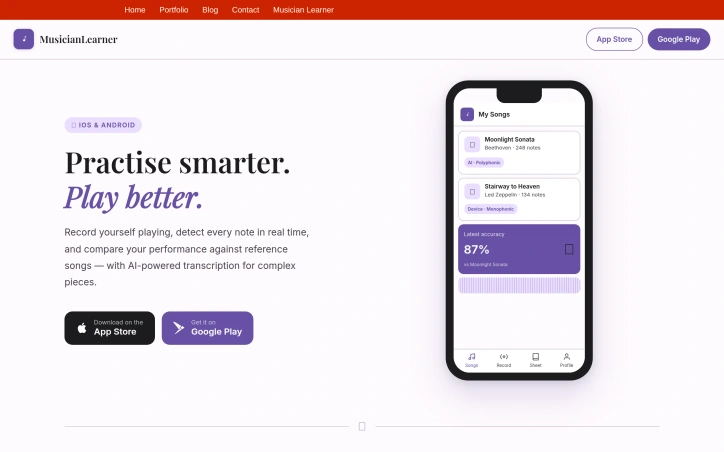
This app will help the musicians practice smarter in order to play better so that it will enhance their musical playing skills
AI Overview
AI-generatedPractice routines have long suffered from a fundamental problem: musicians rarely receive accurate feedback on what they're actually playing. MusicianLearner addresses this gap by bringing real-time note detection and AI-powered comparison to mobile devices, helping instrumentalists of all levels understand their performance with precision.
The app targets musicians who want concrete data about their practice sessions rather than guesswork or subjective impressions. Whether learning piano, guitar, or other instruments, users can record themselves playing alongside reference songs and receive an accuracy score that accounts for tempo variations. This addresses a real need in music education—immediate, measurable feedback that would otherwise require a private instructor.
Several technical choices set MusicianLearner apart from simpler recording apps. It performs pitch detection entirely on-device using YIN and FFT algorithms, meaning musicians can practice without internet connectivity. For more complex pieces, particularly those with multiple notes played simultaneously, the app leverages Spotify's Basic Pitch neural network to extract full transcriptions. The comparison itself uses Dynamic Time Warping, an algorithm specifically designed to handle timing variations between recordings, producing accuracy scores that reflect musical performance rather than punishing tempo inconsistencies.
The feature set extends beyond raw comparison metrics. Users can visualize their recordings as sheet music and export PDFs, making it easy to review their work with instructors. The app also gamifies practice through a challenge system where musicians can compete on shared songs and track rankings against peers. This competitive element, while optional, introduces accountability and motivation for users inclined toward it.
The ability to upload any audio file as a reference song—whether a professional recording or a teacher's demonstration—adds flexibility to how musicians approach practice. The distinction between monophonic and polyphonic extraction modes shows thoughtful product design, acknowledging that single-note instruments like flute require different processing than piano or guitar.
MusicianLearner positions itself as a practical tool for deliberate practice, using established music-processing algorithms and AI transcription to replace intuition with data. For musicians serious about measurable improvement, the combination of real-time feedback, detailed comparison metrics, and offline capability represents a thoughtful approach to turning practice sessions into measurable progress.
Key Features
Real-Time Note Detection
Uses YIN and FFT algorithms to analyze what musicians play without requiring internet connectivity.
Dynamic Time Warping Scoring
Accounts for tempo variations to produce accurate performance metrics rather than punishing timing inconsistencies.
Sheet Music Visualization
Converts recordings into visual sheet music and exportable PDFs for easy review with instructors.
Challenge System
Gamifies practice through competitive rankings where musicians can compete on shared songs and track progress against peers.
Multiple Extraction Modes
Supports both monophonic instruments like flute and polyphonic instruments like piano with appropriate processing.
Use Cases
-
1
Beginner instrumentalists
Musicians learning piano, guitar, or other instruments who need concrete data about their performance instead of guesswork.
-
2
Serious practice enthusiasts
Intermediate and advanced musicians seeking deliberate practice with measurable improvement and real-time feedback.
-
3
Music students
Learners who want to review their recordings with instructors and track progress over time.
-
4
Competitive musicians
Players motivated by gamification who enjoy competing on shared songs and comparing rankings with peers.
FAQ
Does MusicianLearner work without internet? ▾
How does the app handle tempo differences between my playing and the reference? ▾
What instruments can I use with MusicianLearner? ▾
Can I upload my own practice tracks as reference songs? ▾
Discussion
No comments yet — be the first!
Join the conversation — sign up to comment.
Sign up freeCommunity Support
Boost this project on Sell With boost
Meet the Founder

More by Pascal Daher

More in Music Generation
MemoTune
We created MemoTune because people have incredib...
TonesMatch
TonesMatch helps guitarists and bass players rec...
Seed Music
Seed Music is a free AI music generator that tur...
MixMaster Pro
We built MixMaster Pro because music producers w...

TonesMatch
TonesMatch is an AI guitar tone matcher and amp...