Open source alternatives tools
- No match
Machine translation — the English original is authoritative.
The Story
A few months ago, I opened a tool I'd been using for years and found it had quietly pushed an update that took over 2 GB of disk space — for a program that did the same thing it did five years ago. Then the subscription went up. Again.
That's when I started paying attention to how many "free" products we rely on actually cost us more than money. They track usage. They phone home. They get slower with every "improvement." And the ones we pay for? The price only ever goes up.
I'm not a privacy absolutist, and I'm not against paying for good software. I'm against paying more and getting less — bloated, sluggish, data-hungry tools that make me feel like a product instead of a customer.
So I started doing what any annoyed developer would do: I looked for the alternatives.
AI Overview
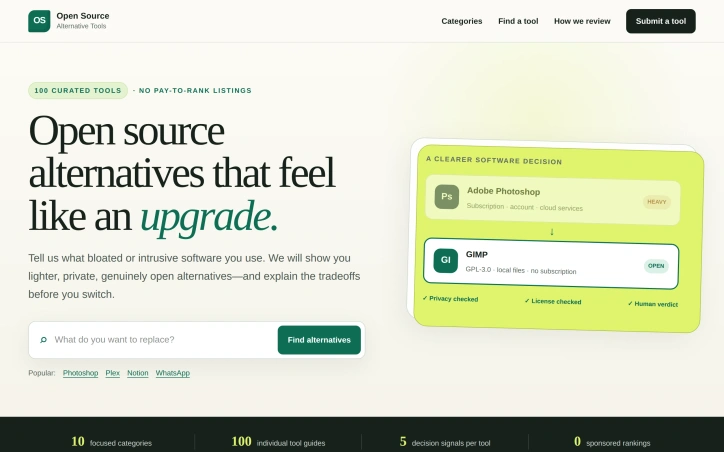
AI-generatedFinding the right open source software can be frustrating when most recommendation sites are cluttered with sponsored listings and marketing noise. Open Source Alternative Tools takes a different approach by curating a focused directory of 100 lightweight alternatives to commercial software, organized around practical use cases rather than brand names.
The platform addresses a real problem: popular software often becomes heavier and more intrusive over time, while costs steadily increase. Users deal with unwanted tracking, unnecessary features, subscription escalations, and bloated updates that consume resources without adding value. Open Source Alternative Tools helps people escape this cycle by providing a structured way to discover lighter, more privacy-respecting alternatives.
What distinguishes this directory is its commitment to objectivity and transparency. Each tool listing includes three verification layers: a privacy check, a license check, and a human verdict. The directory explicitly rejects pay-to-rank listings, which removes financial incentives from the curation process. Tools are organized into ten focused categories spanning Browsers, Communication, Office & Notes, Design & Creative, Media, Productivity, Developer Tools, Privacy & Security, Operating Systems, and Cloud & Self-hosting.
The interface recognizes that users don't necessarily know the name of their replacement software—they know what they're trying to replace. The search function works in both directions: you can search for a specific tool, or you can input the commercial software you currently use and receive open source alternatives. This decision-first approach, combined with clear explanations of tradeoffs, sets it apart from generic recommendation lists.
Each tool receives comparable treatment through five decision signals per listing, allowing users to evaluate alternatives against consistent criteria rather than inconsistent reviews. The site positions itself as written for general users first, rather than assuming technical expertise.
The business model remains implicit in the content provided. The absence of subscription mentions or advertising suggests a clean, user-focused approach to discovery, though the specific sustainability model isn't detailed. For users fatigued by the endless cycle of expensive, resource-hungry software, this directory offers a structured exit path rather than random searching through GitHub repositories.
Founder Diary
DevlogThe maker hasn't posted a diary entry yet.
Key Features
Curated Directory
100 lightweight open source alternatives organized by practical use case rather than brand name
Verification Layers
Privacy check, license check, and human verdict for each tool listing
Bidirectional Search
Find open source tools by name or search by commercial software you want to replace
Consistent Evaluation
Five decision signals per listing enabling comparable assessment across alternatives
No Pay-to-Rank
Explicitly rejects sponsored listings to remove financial incentives from curation
General User Focus
Designed for users without assuming technical expertise
Use Cases
-
1
Privacy-conscious users
Escape unwanted tracking and data collection in commercial software
-
2
Cost-conscious users
Reduce expenses by replacing expensive subscription software with free alternatives
-
3
Performance-focused users
Find lighter alternatives to resource-hungry, bloated commercial applications
-
4
General users
Discover structured software recommendations without requiring technical knowledge
FAQ
How do I find an open source alternative to software I already use? ▾
Are the tool listings unbiased? ▾
What software categories does it cover? ▾
Do I need to be technical to use this? ▾
Discussion
No comments yet — be the first!
Join the conversation — sign up to comment.
Sign up freeCommunity Support
Boost this project on Sell With boost
