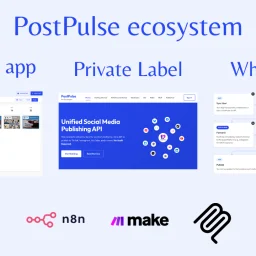
PostPulse for Developers
- No match
Machine translation — the English original is authoritative.
The Story
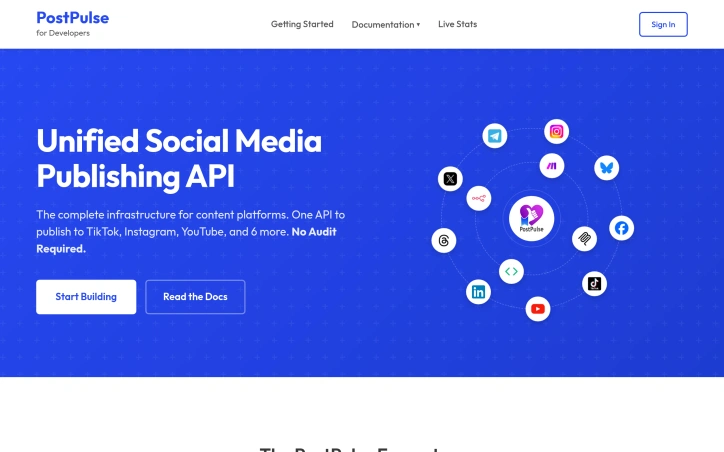
PostPulse is a unified API and integration suite that handles the complexity of social media publishing. Instead of managing individual platform audits and breaking tokens, developers use PostPulse as their outsourced social-connectivity team.
Building social integrations manually is a major resource drain:
- Complexity: Reading 9+ sets of disparate, often conflicting API documentation.
- Audit Hurdles: Passing "Developer App" reviews for Meta, TikTok, and Google (can take months).
- Maintenance: Managing token refreshes, rate limits, and constant API version changes.
- PostPulse Solution: We handle all of the above. You integrate once; we maintain it forever.
AI Overview
AI-generatedDevelopers managing social media integrations across multiple platforms face a fragmented ecosystem. Each service—Meta, TikTok, Google, and others—maintains separate API documentation, authentication flows, and platform-specific requirements. Beyond the technical complexity, integrating these services requires passing individual developer app reviews, a process that can consume months. Once integrated, the maintenance burden proves equally taxing: token refreshes, rate limits, API version changes, and deprecations demand ongoing attention.
PostPulse addresses this consolidation problem by positioning itself as a centralized integration layer. Rather than building direct connections to nine or more social platforms individually, developers can route their publishing logic through a single API, delegating the platform-specific work to PostPulse's infrastructure. The company handles the full compliance and operational overhead: managing developer app approvals, maintaining authentication tokens, absorbing API changes, and monitoring rate limits across platforms.
This shift from custom integration to outsourced connectivity appeals primarily to companies building social features—whether publishing tools, content management platforms, or marketing applications—without dedicated platform engineering resources. For smaller teams or bootstrapped startups, the appeal is clear: avoid months of parallel integration work and redirect engineering capacity toward core product features.
The core value proposition rests on complexity reduction and maintenance economics. Instead of a team member tracking Meta's latest API deprecations or managing token lifecycle across platforms, that responsibility becomes PostPulse's. The unit economics improve when integration work—particularly the audit phase—would otherwise stall shipping or require hiring specialized expertise.
The company positions itself as solving a genuine infrastructure gap. While social platforms have published APIs for years, the friction surrounding them remains high enough that many developers prefer to pay for abstraction. The degree to which PostPulse successfully executes that abstraction—covering not just happy-path publishing but edge cases, rate limiting, and versioning—will determine whether the product becomes table stakes or remains a worthwhile optimization.
Pricing and business model details were not provided in available materials.
Founder Diary
DevlogThe maker hasn't posted a diary entry yet.
Key Features
Centralized Integration Layer
Routes publishing logic through a single API instead of building individual connections to multiple social platforms
Compliance Management
Handles developer app approvals, authentication flows, and platform-specific requirements across all integrated services
Token & Rate Limit Handling
Manages token refreshes, rate limits, API version changes, and deprecations automatically
Reduces Integration Overhead
Eliminates months of parallel integration work by delegating platform-specific complexity
Maintenance Abstraction
Shifts operational responsibility for API changes and platform updates away from development teams
Use Cases
-
1
Publishing Tools
Companies building social publishing platforms can consolidate multi-platform connectivity without dedicated integration work
-
2
Content Management Platforms
CMS products need multi-platform distribution without individual API integrations for each service
-
3
Marketing Applications
Marketing tools require consolidated social platform connectivity for customer campaigns
-
4
Small Teams & Startups
Bootstrapped or resource-constrained teams redirect engineering capacity from integration work to core product features
FAQ
How does PostPulse simplify social media integrations? ▾
What platforms does PostPulse support? ▾
Who benefits most from using PostPulse? ▾
Discussion
No comments yet — be the first!
Join the conversation — sign up to comment.
Sign up freeCommunity Support
Boost this project on Sell With boost
