
ReliabilityBench
- No match
Machine translation — the English original is authoritative.
The Story
We built ReliabilityBench to solve a critical problem we saw repeatedly: industrial teams had mountains of failure and maintenance data but couldn't turn it into clear decisions. Our platform connects reliability metrics, maintenance records, and financial impact into one transparent workbench. Now reliability engineers can trace every decision from raw failure data to actionable next steps.
AI Overview
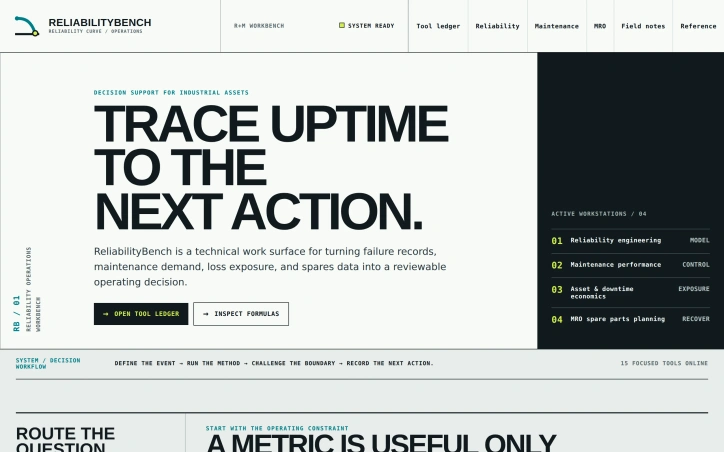
AI-generatedIndustrial operations teams sit on vast repositories of failure data and maintenance records but struggle to convert them into concrete decisions. ReliabilityBench addresses this disconnect by creating a transparent calculation surface that links reliability metrics, maintenance performance, equipment economics, and spare parts planning into a single workbench.
The platform targets reliability engineers, maintenance supervisors, production leaders, and asset management teams who need rapid calculations during active work. Rather than attempting to replace comprehensive CMMS systems or detailed engineering studies, ReliabilityBench positions itself as a decision-support layer that lives alongside existing tools.
What distinguishes the product is its deliberate focus on decision-making rather than data collection. The interface organizes work around a clear problem-solving sequence: define the failure event, apply a specified calculation method, validate the result against operational reality, and route the output into concrete work assignments or planning. This workflow frames the calculator not as an isolated number-generator but as the middle step in a larger decision chain.
The platform offers fifteen focused calculators distributed across four workstations. The Reliability Engineering station includes tools for normalizing failure history into operating intervals. Maintenance Performance handles availability, performance, and quality loss tracking. Asset & Downtime Economics exposes cost contribution and recovery expenses. MRO Spare Parts Planning connects lead-time demand with safety buffers. Specific tools include MTBF calculators, OEE tracking, downtime cost analysis, repair-versus-replace comparisons, and reorder point calculations.
A striking design choice is the open tool ledger—each calculation displays its inputs, methodology, worked examples, interpretation guidance, and stated limitations directly adjacent to the result. This transparency invites teams to audit assumptions before treating a number as operational truth, surfacing where a calculation may diverge from actual site conditions.
The platform records a complete operational chain through five stages: failure definition, response documentation, consequence quantification, recovery readiness, and review for the next action. This evidence trail preserves context across decisions, helping teams validate whether repeated comparisons remain consistent.
ReliabilityBench addresses a genuine operational need—turning data into decisions—with a deliberately scoped tool that complements rather than displaces existing infrastructure. Its emphasis on formula transparency and decision context distinguishes it from pure data collection systems.
Founder Diary
DevlogThe maker hasn't posted a diary entry yet.
Key Features
Decision-Support Layer
Complements existing CMMS and engineering systems without replacing them.
Transparent Tool Ledger
Each calculation displays inputs, methodology, worked examples, interpretation guidance, and stated limitations.
Specialized Calculators
Offers fifteen focused calculators across reliability engineering, maintenance performance, asset economics, and spare parts planning.
Operational Evidence Trail
Records complete workflow through five stages from failure definition to next-action review.
Cost Analysis Tools
Includes MTBF calculation, OEE tracking, downtime cost analysis, and repair-versus-replace comparisons.
Use Cases
-
1
Reliability Engineers
Need rapid calculations during active work to analyze failure history and normalize operating intervals.
-
2
Maintenance Supervisors
Track availability, performance, and quality loss with dedicated performance calculation tools.
-
3
Production Leaders and Asset Teams
Convert failure data and maintenance records into concrete work assignments and planning decisions.
-
4
MRO Planning Teams
Connect lead-time demand with safety buffers for spare parts reorder point optimization.
FAQ
Does ReliabilityBench replace my CMMS system? ▾
What calculations does ReliabilityBench include? ▾
How transparent are the calculations? ▾
Can I track decisions over time? ▾
Tech Stack & Tags
Discussion
No comments yet — be the first!
Join the conversation — sign up to comment.
Sign up freeCommunity Support
Boost this project on Sell With boost
Meet the Founder

More by canghun13




More in Business intelligence software

YouTube Thumbnail Downloader
Download YouTube video & Shorts thumbnails in HD...

GripeRadar
I started GripeRadar after repeatedly seeing pol...

ToolTrim
We built ToolTrim to solve the decision paralysi...

DataScrapify
DataScrapify - all in one automation and data sc...

Rival Radar
We built Rival Radar because tracking competitor...