
Seedance
- No match
Machine translation — the English original is authoritative.
The Story
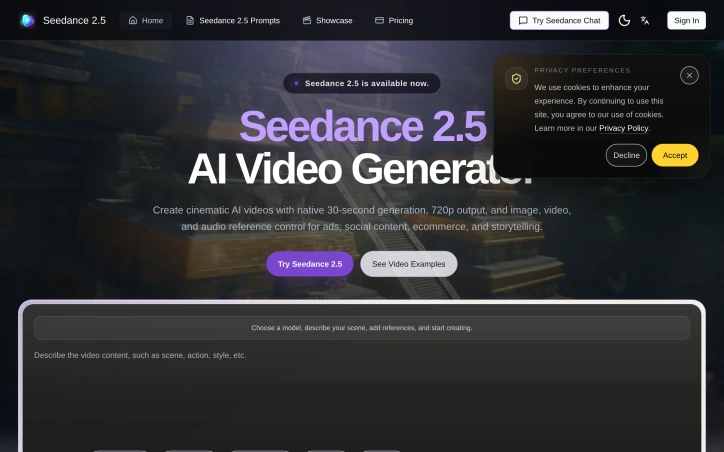
Seedance 2.5 was created for teams who need cinematic, 30‑second videos but don’t have the time, budget, or people to run a full traditional production. Most AI video tools either struggle with continuity, break characters between shots, or turn every idea into a random clip. This makes them hard to use for real campaigns, product films, or story‑driven content.
Seedance 2.5 solves this by treating AI video like directing a short scene. You can describe the story in beats, add reference photos, videos, audio, and style frames, and let the model keep characters, lighting, and motion consistent across a full 30‑second sequence. When something is off, you can edit just that region instead of regenerating the whole video.
We built Seedance 2.5 because we kept seeing creators and marketers spend days stitching together short AI clips that never quite matched. We wanted a tool that understands planning and references, not just prompts — something you can use to design product launch films, social ads, fashion cuts, explainers, and narrative moments with more control, fewer hacks, and a workflow that actually feels like modern video production.
AI Overview
AI-generatedCinematic video production without the traditional overhead is increasingly central to marketing and storytelling, and this AI-powered tool addresses a specific friction point: existing generators excel at short clips but struggle to maintain coherence across longer narratives. Seedance 2.5 targets creators, marketers, and production teams who need polished 30-second videos for ads, product launches, fashion content, and social media but lack the time or budget for conventional shoots.
The product's core distinction is its approach to reference-based generation. Rather than relying solely on text prompts, it lets users provide images for style consistency, video references for motion guidance, audio tracks, and character references to maintain visual continuity throughout a 30-second sequence. This transforms the workflow from typing a description into something closer to traditional directorial planning—laying out beats, establishing visual anchors, and letting the model respect those choices across the full output.
Beyond multimodal input, the technical architecture treats video as a joint audio-video generation task rather than post-processing sound into separately-generated footage. The 30-second native generation is mechanically significant; most competing tools max out at shorter segments and require stitching multiple clips together, a process the founder describes as tedious and prone to continuity breaks. Seedance 2.5 promises to render complete scenes with smoother narrative flow in one pass.
The editing capabilities merit attention as well. Rather than forcing a full regeneration when details need refinement, the tool supports local region edits that preserve the composition, motion, lighting, and character identity of the broader scene. This substantially reduces iteration time for creators making small adjustments.
The showcase examples span film, advertising, fashion, music, and educational content, demonstrating breadth in output quality and style versatility. Scenes range from surreal fantasy (floating storm battlefields, mechanical creatures) to grounded urban and commercial setups, suggesting the model generalizes reasonably well across visual genres.
The platform does apply content screening, blocking requests involving sexual content, violence, hate speech, illegal activity, and rights-infringing material—a standard safety measure that may constrain some creative use cases.
Pricing is not disclosed in the available materials, though the interface mentions a credit system. For teams evaluating the tool, transparency on cost-per-minute, subscription tiers, or per-generation pricing would be necessary for a practical procurement decision. The product positions itself as solving a real production problem with capabilities that distinguish it from simpler prompt-based generators, though buyers will need to validate consistency and edit speed against their specific workflow requirements.
Founder Diary
DevlogThe maker hasn't posted a diary entry yet.
Key Features
Reference-Based Generation
Users provide images, video references, and character references for consistent style and motion guidance across videos.
Native 30-Second Generation
Renders complete 30-second scenes in one pass, avoiding continuity issues from stitching multiple clips.
Local Region Editing
Refine specific areas without full regeneration, preserving composition, motion, lighting, and character identity.
Joint Audio-Video Generation
Treats audio and video as unified generation rather than post-processing sound into separate footage.
Content Safety Screening
Blocks sexual content, violence, hate speech, illegal activity, and rights-infringing material requests.
Use Cases
-
1
Product Marketing
Create polished 30-second promotional videos for product launches and advertising campaigns without expensive traditional production.
-
2
Social Media Content
Generate fashion, lifestyle, and promotional content for social platforms quickly without time or budget constraints.
-
3
Production Teams
Rapid iteration on video concepts using local edits and reference-based guidance instead of full regenerations.
-
4
Creative Directors
Plan video scenes visually using directorial tools like image and character references for narrative consistency.
FAQ
What video length does Seedance generate? ▾
Can I edit videos after generation? ▾
How is audio handled in video generation? ▾
What content is blocked? ▾
Tech Stack & Tags
Discussion
No comments yet — be the first!
Join the conversation — sign up to comment.
Sign up freeCommunity Support
Boost this project on Sell With boost
Meet the Founder

More by Zheng Li



More in AI Generative Media

AI Mixer - AI Photo | AI Video | AI Voice. All AI tools in one app!
AI Mixer was built to solve a simple but frustra...
FacelessGenie
We built FacelessGenie to solve the biggest bott...

GeniusAI
We built GeniusAI to make professional AI image...

MyRaxAI
I built MyRaxAI to help creators generate stunni...

Berrioo
We built Berrioo to democratize professional vis...

Seedance
We built Seedance to make cinematic video creati...