Sensecast
- No match
Machine translation — the English original is authoritative.
The Story
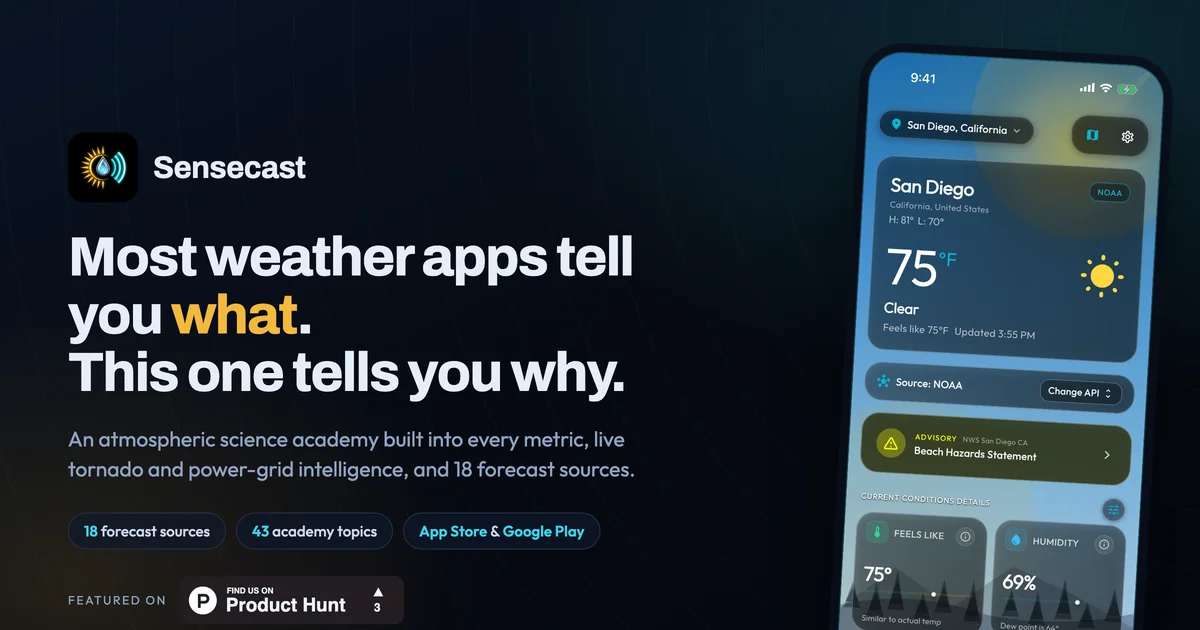
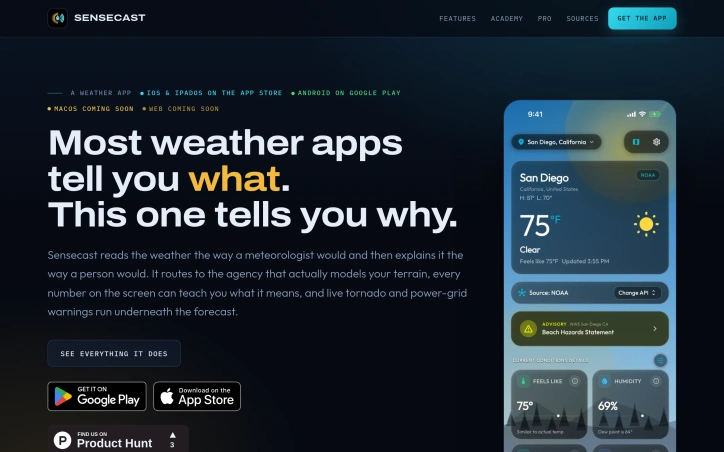
We built Sensecast because existing weather apps just tell you what's happening — not why. Our app combines an atmospheric science academy with real-time storm tracking and power-grid intelligence across 18 forecast sources. Sensecast reads weather like a meteorologist and explains it in plain language, from sensation analogies to advanced physics.
AI Overview
AI-generatedMost weather apps serve as simple forecast delivery systems, displaying numbers without context. Sensecast inverts this formula by treating meteorology education as the core product, positioning itself for anyone from casual weather enthusiasts to people in storm-prone regions who depend on accurate, context-rich forecasting.
The product's defining feature is its educational architecture. Rather than displaying isolated data points, each metric connects to an information layer that progresses from sensation analogies to scientific details, letting users build understanding at their own pace. A 43-topic glossary spans weather phenomena, atmospheric science, solar activity, and radar systems, all accessible through the dashboard. This approach means learning happens naturally during everyday use rather than requiring external research.
Beyond academics, Sensecast addresses a critical gap in consumer weather tools: meaningful hazard tracking. The app integrates live tornado reports from the Storm Prediction Center, real-time power outages tracked at the county level, earthquake and wildfire trackers, and a weather risk score based on wind, ice, and temperature extremes. These hazards appear on a unified map instead of scattered across multiple apps or notification channels. Users also access a local utility directory with one-tap outage hotlines, a practical detail that bridges forecast and action.
The forecast engine reflects technical depth. Sensecast uses 15 different weather models and automatically routes forecasts to regional services best suited for each location—NOAA for the continental US, MET Norway for fjords, Japan's model for typhoons, and others. This regional targeting beats the one-size-fits-all approach of most competitors. Users can override automatic selection to manually compare forecasts side by side when seeking a second opinion.
The app runs on iOS and Android with macOS and web versions planned. It operates completely free with no account requirement and no advertising, pulling data from established scientific sources including NOAA, USGS, NASA's fire database, and the Department of Energy. A Pro version adds additional forecast sources, though specific features remain undetailed.
The positioning works cleanly: Sensecast treats users as people who want to understand weather, not just passively receive it. For anyone fatigued by generic weather apps that optimize for simplicity over insight, this alternative delivers atmospheric literacy and hazard intelligence in a single tool.
Founder Diary
DevlogThe maker hasn't posted a diary entry yet.
Key Features
Educational Architecture
Weather metrics connect to progressive information layers from sensation analogies to scientific details
Comprehensive Hazard Tracking
Integrates live tornado reports, power outages, earthquakes, wildfires, and weather risk scores on one map
Multi-Model Forecasting
Uses 15 different weather models with automatic regional routing to specialized services
43-Topic Glossary
Accessible reference covering weather phenomena, atmospheric science, solar activity, and radar systems
Local Utility Directory
One-tap access to outage hotlines bridging forecast information to practical action
Use Cases
-
1
Weather enthusiasts
Learn atmospheric science naturally during everyday app use without external research
-
2
Storm-prone region residents
Access context-rich forecasting and real-time hazard alerts for critical safety decisions
-
3
Users seeking hazard intelligence
Track multiple environmental threats including tornadoes, power outages, earthquakes, and wildfires centrally
-
4
People fatigued by generic weather apps
Access atmospheric literacy and meaningful hazard tracking instead of isolated data points
FAQ
Does Sensecast cost money or require an account? ▾
What weather data sources does Sensecast use? ▾
Can I get tornado warnings and power outage alerts? ▾
What devices can I use Sensecast on? ▾
Pricing
Completely free with no ads or account required, with optional Pro version for additional forecast sources.
Tech Stack & Tags
Discussion
No comments yet — be the first!
Join the conversation — sign up to comment.
Sign up freeCommunity Support
Boost this project on Sell With boost
