
Subtext
- No match
Machine translation — the English original is authoritative.
The Story
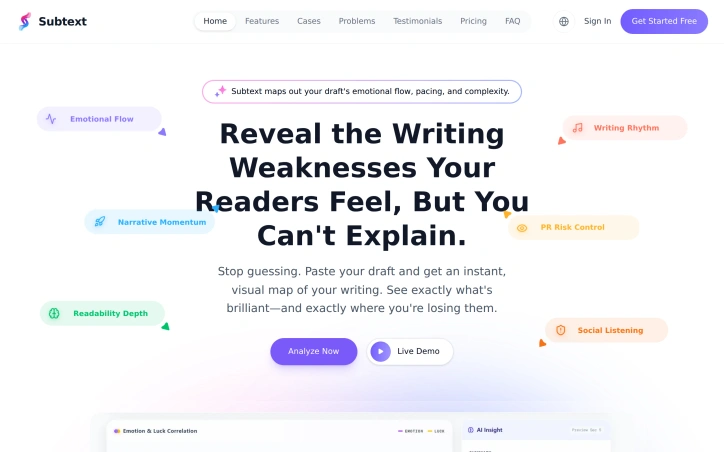
We built Subtext because writers struggle to identify structural flaws that readers feel but can't articulate. Our AI analyzes the cognitive depth of your writing—emotional flow, narrative tension, readability—using science-backed methods. Now any writer can get objective data to refine their work with confidence.
AI Overview
AI-generatedWriters often hit a wall when editing: after multiple passes, something still feels wrong, but identifying the problem remains elusive. Subtext addresses this gap by applying cognitive science to structural writing analysis, providing objective feedback on emotional pacing, narrative momentum, and readability that traditional editing tools overlook.
The platform targets any writer wrestling with clarity and impact—novelists, screenwriters, content creators, technical writers, and marketing professionals. It works by generating a visual map of a text's emotional flow and cognitive demands, revealing where prose loses momentum, where rhythm becomes monotonous, and where readers face mental exhaustion due to complexity.
What distinguishes Subtext from conventional grammar and style checkers is its structural focus. The tool analyzes narrative tension, checking whether stakes and emotional resonance exist beneath the surface. It measures whether readers emotionally connect with material or feel lectured to. It identifies pacing problems that re-reading alone cannot expose. This aligns with a core truth: readers sense issues intuitively—"something feels off"—without articulating why. Subtext translates that intuition into concrete data.
The feature set spans multiple writing dimensions. Emotional flow tracking highlights flat paragraphs before publication. Narrative momentum analysis pinpoints which sections pull readers forward and which lose them. Readability depth measures cognitive strain at different points. Writing rhythm detection surfaces pacing stumbles and monotony. The platform extends beyond editorial analysis into PR risk assessment, simulating public reactions to catch tone-deaf language before publication. Social listening features identify tired vocabulary and repetitive structures that weaken messaging.
Subtext grounds its methodology in neuroscience and academic research, positioning itself as a science-backed alternative to intuition-driven feedback. The tool accommodates diverse writing types—from long-form prose to social media content across Facebook, Instagram, Twitter, TikTok, YouTube, and Reddit.
For writers tired of circular editing cycles, Subtext offers a legitimate tool by making writing's invisible architecture visible. The core premise—that failures hide in rhythm, tension, and emotional structure rather than word choice—cuts at a real problem. Whether the specific metrics fully deliver on ambitious science-based claims depends on implementation, but the underlying diagnosis is sound.
Founder Diary
DevlogThe maker hasn't posted a diary entry yet.
Key Features
Emotional Flow Tracking
highlights flat paragraphs before publication
Narrative Momentum Analysis
pinpoints sections that pull readers forward and which lose them
Readability Depth
measures cognitive strain at different points
Writing Rhythm Detection
surfaces pacing stumbles and monotony
PR Risk Assessment
simulates public reactions to catch tone-deaf language before publication
Use Cases
-
1
Novelists
helps identify pacing problems that re-reading alone cannot expose
-
2
Content creators and marketing professionals
identifies tired vocabulary and repetitive structures that weaken messaging
-
3
Technical writers
provides objective feedback on emotional pacing, narrative momentum, and readability
-
4
Screenwriters
analyzes narrative tension and emotional resonance
FAQ
Is Subtext just a grammar and style checker? ▾
What types of writing does Subtext support? ▾
How does Subtext analyze writing? ▾
Tech Stack & Tags
Discussion
No comments yet — be the first!
Join the conversation — sign up to comment.
Sign up freeCommunity Support
Boost this project on Sell With boost
Meet the Founder

More in Writing assistants

Spit Notes
For songwriters who juggle voice memos and notes...

LinkedIn Speak Translator
I created LinkedIn Speak Translator to solve the...
AI Story Writer
I struggled to write stories, so I built an AI t...

Font Generator
I built Font Generator to solve a simple problem...
Verbia
I built Verbia to remove language friction from...

PSFutureMail
I created PSFutureMail after realizing how easy...