AI Animal Identifier
- No match
Machine translation — the English original is authoritative.
The Story
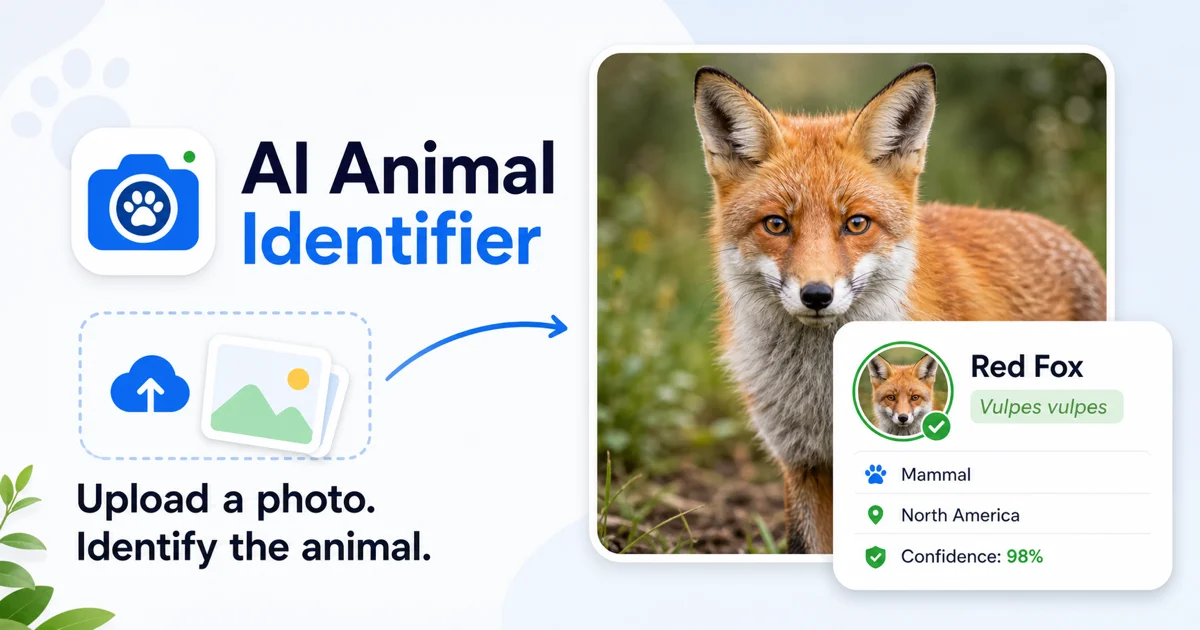
AI Animal Identifier helps users identify animals from photos with AI-powered visual recognition. A user can upload an animal image and receive species suggestions and helpful context based on what the model detects. The product is useful for students, parents, nature enthusiasts, pet owners, and anyone who wants a quick animal-identification starting point in the browser.
AI Overview
AI-generatedFor anyone curious about an animal spotted in nature, a wildlife photo found online, or simply wondering about a creature in their yard, this browser-based identification tool fills a straightforward need. The product targets a broad audience spanning students researching wildlife, parents answering children's questions about animals, nature enthusiasts documenting sightings, and pet owners identifying unfamiliar creatures.
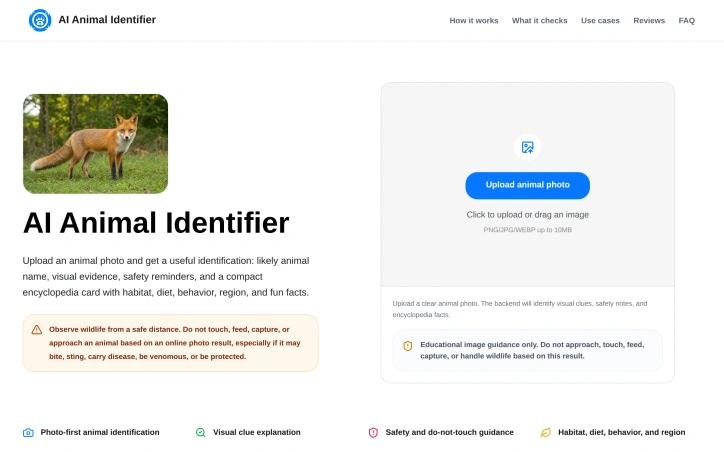
The distinctive angle here centers on responsible wildlife interaction. Rather than simply naming animals, the platform pairs identification results with explicit safety guidance, reminding users not to approach, touch, feed, or capture animals based on photo recognition alone. This emphasis recurs throughout the interface and represents a thoughtful addition in an educational context where misidentification could lead to dangerous behavior.
The core workflow is straightforward: upload an image in PNG, JPG, or WEBP format and receive the likely species identification along with supporting visual evidence. Beyond the name, users get habitat information, diet details, behavioral characteristics, regional context, and interesting facts. The platform indicates confidence levels in its guesses, an important transparency feature when stakes involve human safety around wildlife.
The product addresses a common search behavior by organizing around specific user questions: "What animal is this," "Identify an animal by picture," and "What kind of animal is this." Rather than forcing all queries into a single form, these focused pages acknowledge how people actually ask these questions while maintaining the same upload-based identification mechanism. This mirrors how real search behavior works and makes the tool feel aligned with user intent rather than rigid.
The decision to operate entirely in the browser eliminates friction present in traditional app-based identification tools, removing download requirements and installation steps. This approach democratizes access and positions the platform as a quick reference rather than a commitment download.
The emphasis on visual explanation distinguishes this from simpler name-guessing alternatives. By showing what clues the model detected, the tool educates alongside identifying, useful for learning-focused users. The safety guidance strips away the novelty of AI identification and anchors the interaction to practical, responsible behavior.
Pricing or monetization strategy receives no mention in available materials, leaving the business model unclear. The feature set and positioning suggest education and wildlife safety as core values, which shapes how the product positions itself even if commercial viability remains unstated.
Founder Diary
DevlogThe maker hasn't posted a diary entry yet.
Key Features
Image-Based Identification
Upload photos in PNG, JPG, or WEBP format to receive species identification with supporting visual evidence.
Safety Guidance Integration
Pairs identification results with explicit safety reminders about not approaching, touching, feeding, or capturing animals.
Detailed Species Information
Provides habitat information, diet details, behavioral characteristics, regional context, and interesting facts for each identification.
Browser-Based Access
No download or installation required, operates entirely in the browser for immediate access.
Visual Evidence Explanation
Shows the visual clues the model detected to educate users alongside identification.
Confidence Level Transparency
Indicates confidence levels in identification guesses to support safety-critical decisions.
Use Cases
-
1
Students and Researchers
Wildlife research and educational projects requiring reliable species identification.
-
2
Parents and Educators
Answering children's questions about animals they encounter in educational contexts.
-
3
Nature Enthusiasts
Documenting and identifying wildlife sightings during outdoor activities.
-
4
Pet Owners
Identifying unfamiliar creatures encountered in their yard or neighborhood.
FAQ
Can I identify an animal from a photo? ▾
Is it safe to approach an animal I identify with this tool? ▾
What information comes with an animal identification? ▾
Do I need to download anything to use this tool? ▾
Discussion
No comments yet — be the first!
Join the conversation — sign up to comment.
Sign up freeCommunity Support
Boost this project on Sell With boost
Meet the Founder

More by 王二狗

More in AI Generative Media

AI Mixer - AI Photo | AI Video | AI Voice. All AI tools in one app!
AI Mixer was built to solve a simple but frustra...
FacelessGenie
We built FacelessGenie to solve the biggest bott...

GeniusAI
We built GeniusAI to make professional AI image...

MyRaxAI
I built MyRaxAI to help creators generate stunni...

Berrioo
We built Berrioo to democratize professional vis...

Seedance
We built Seedance to make cinematic video creati...