
Build or Skip
- No match
Machine translation — the English original is authoritative.
The Story
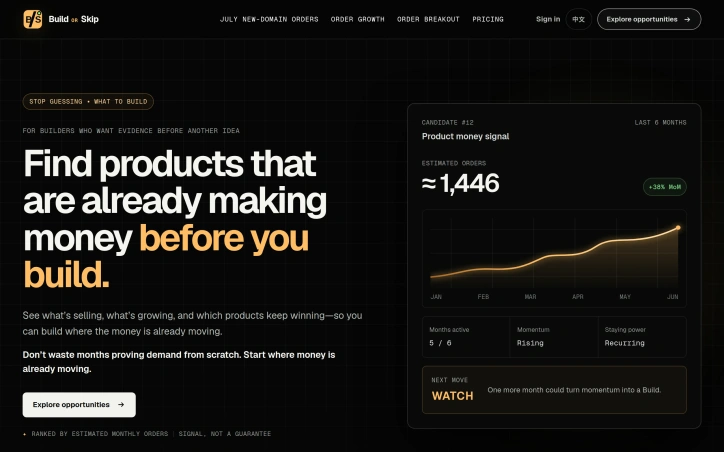
Build or Skip is a product research and market validation tool for builders, indie hackers, and SaaS teams. It ranks candidate products by estimated monthly orders, growth, and repeat activity so users can decide what to build, what to watch, and what to skip before investing months into an unproven idea. It helps founders research startup ideas, compare product momentum, and make faster market validation decisions before committing months of engineering time.
AI Overview
AI-generatedFinding a viable product idea requires more than intuition. Build or Skip addresses a core challenge for independent builders and early-stage SaaS teams: deciding which opportunity merits months of engineering effort versus which should be abandoned. Rather than building in isolation and hoping customers appear, the platform inverts the validation process by identifying products already generating commercial traction.
The product works by tracking observable market signals across candidate products, using these indicators to estimate monthly order volume and compare growth patterns over time. This approach acknowledges a fundamental truth: money leaves a trail. Instead of surveying potential users or conducting customer interviews from scratch, builders can tap into real purchasing behavior to validate demand before committing significant resources.
The platform's decision framework is its most useful component. Products are categorized into three buckets: Build for opportunities showing strong order volume, accelerating growth, and recurring signals across multiple months; Watch for products with momentum but insufficient baseline data or observation history; and Skip for weak, fading, or inconsistent signals. This three-tier system removes ambiguity and forces prioritization.
What distinguishes Build or Skip is its transparency about limitations. The platform explicitly states that estimated orders represent model outputs, not verified revenue or private transaction data. It acknowledges the difference between identifying where payment intent may be building and proving actual revenue and product-market fit. This intellectual honesty is rare in tools claiming to solve discovery problems and suggests realistic expectations.
The ranking methodology weighs three dimensions: meaningful order scale, momentum as both percentage and absolute growth, and staying power measured by recurring monthly signals. Rather than chasing one-month spikes, the platform rewards products that demonstrate consistent commercial activity across multiple observation windows. This reduces noise from temporary trends.
The core value proposition centers on founders who feel paralyzed by option overload or skeptical of their own market intuition. By showing what money is already moving, the platform shifts validation from pure guesswork to evidence-informed decision making. It won't prove that a specific idea will succeed, but it can redirect energy toward opportunities with demonstrated demand rather than speculative ones.
The tool serves a specific audience: builders operating under time and resource constraints who prioritize speed and evidence over certainty. For this group, reducing the number of failed bets matters more than achieving perfect conviction before starting.
Founder Diary
DevlogThe maker hasn't posted a diary entry yet.
Key Features
Market Signal Tracking
Monitors observable market signals and purchasing behavior across candidate products to identify commercial traction
Order Volume Estimation
Estimates monthly order volume by analyzing payment intent patterns to validate demand without customer interviews
Growth Pattern Analysis
Compares growth momentum across multiple observation windows to identify products with consistent commercial activity
Three-Tier Decision Framework
Categorizes products into Build, Watch, or Skip based on order volume, growth acceleration, and recurring signal consistency
Transparency on Data Limitations
Explicitly discloses that estimates represent model outputs, not verified revenue or private transaction data
Use Cases
-
1
Independent builders paralyzed by option overload
Shifts validation from guesswork to evidence-informed prioritization of product ideas
-
2
Early-stage SaaS teams
Identifies opportunities with demonstrated demand before committing months of engineering effort
-
3
Resource-constrained founders
Reduces failed bets by redirecting energy toward products showing real purchasing signals rather than speculative ideas
-
4
Skeptical builders
Validates market intuition using observable commercial activity instead of relying on customer surveys or interviews
FAQ
Does Build or Skip show real revenue or estimates? ▾
What's the difference between Build and Watch categories? ▾
How does Build or Skip validate demand? ▾
Who should use Build or Skip? ▾
Discussion
No comments yet — be the first!
Join the conversation — sign up to comment.
Sign up freeCommunity Support
Boost this project on Sell With boost