
AOPX

- No match
Machine translation — the English original is authoritative.
The Story
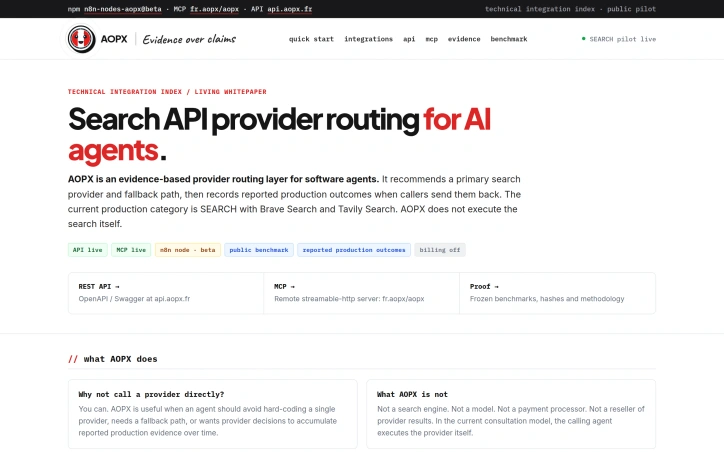
We built AOPX because AI agents shouldn't be locked into a single search provider. Our platform routes search requests to the best provider for each use case, tracks real-world performance, and provides fallback paths—all without agents hardcoding dependencies or managing provider APIs themselves.
AI Overview
AI-generatedRouting decisions for AI agents don't need to be baked into code. AOPX offers a consultation layer that sits between agent applications and search providers, recommending which provider to use for each request and supplying fallback paths when the primary choice becomes unavailable.
The platform targets developers of AI agents and workflow systems that currently hardcode single search provider dependencies. By introducing a routing decision point, AOPX lets agents defer provider selection to a policy layer, avoiding the brittleness that comes from fixed integrations. The core insight is straightforward: when agents need reliable search capabilities, flexibility and fallback resilience should not be sacrificed for simplicity.
What distinguishes AOPX is its feedback mechanism. After an agent executes a recommended provider and receives results, it can report back on what actually happened in production. AOPX ingests these reported outcomes and incorporates them into its routing policies, creating a system that evolves based on real-world performance rather than operating solely on frozen benchmarks. This design pattern is notably different from static provider comparison tools that offer one-time recommendations with no learning loop.
The service operates as pure consultation. AOPX receives a category and mode parameter, returns a recommendation_id along with a primary and fallback provider, and agents handle the actual API calls themselves. This architecture sidesteps the need to become a proxy layer or payment processor and keeps operational complexity minimal.
Currently, the platform covers one category: SEARCH, with integrations to Brave Search and Tavily Search. A third candidate, Serper, sits under evaluation. Three integration surfaces exist: a REST API available live, an MCP protocol implementation for agent clients, and a beta n8n connector. Discovery metadata appears in both the MCP Registry and Glama.ai.
Pricing remains undefined during the public pilot phase. Documentation explicitly states that billing is disabled, suggesting that commercial terms either have not yet solidified or await a future phase.
The service positions itself around an opinionated view of agent architecture: providers should be swappable, selection decisions should track evidence, and failure should have structured fallbacks. Whether this routing abstraction justifies the additional latency and API call in practice depends on individual deployment requirements and tolerance for added complexity.
Founder Diary
DevlogThe maker hasn't posted a diary entry yet.
Key Features
Dynamic Provider Routing
Recommends the optimal search provider for each request based on configurable policies
Feedback-Based Learning
Incorporates real-world performance outcomes to continuously evolve routing decisions
Fallback Resilience
Supplies backup providers when the primary choice becomes unavailable
Lightweight Architecture
Returns routing recommendations without proxying API calls or acting as a payment processor
Multi-Integration Support
Available via REST API, MCP protocol implementation, and beta n8n connector
Use Cases
-
1
AI Agent Developers
Eliminate hardcoded search provider dependencies and gain flexibility to switch providers
-
2
Production Workflows
Optimize search reliability and performance based on real-world operational data
-
3
Distributed Systems
Implement structured routing logic and fallback paths for agent search capabilities
FAQ
What search providers does AOPX support? ▾
Does AOPX proxy my API calls? ▾
How does AOPX improve its routing decisions over time? ▾
Is there a cost to use AOPX? ▾
Tech Stack & Tags
Discussion
No comments yet — be the first!
Join the conversation — sign up to comment.
Sign up freeCommunity Support
Boost this project on Sell With boost
Meet the Founder

More in Search

Drivium
We built Drivium to help people confidently buy...
StackLedge
We created StackLedge to solve fragmentation in...

amaze.directory
I was tired of AI tool directories filled with u...

Package Pal
Hey everyone! 👋 I’m Sagar, the creator of Packa...
Tools Network
I built Tools Network to solve the overwhelming...

KAR AI
I built KAR to fix how people buy cars in Europe...