Daemon OS
- No match
Machine translation — the English original is authoritative.
The Story
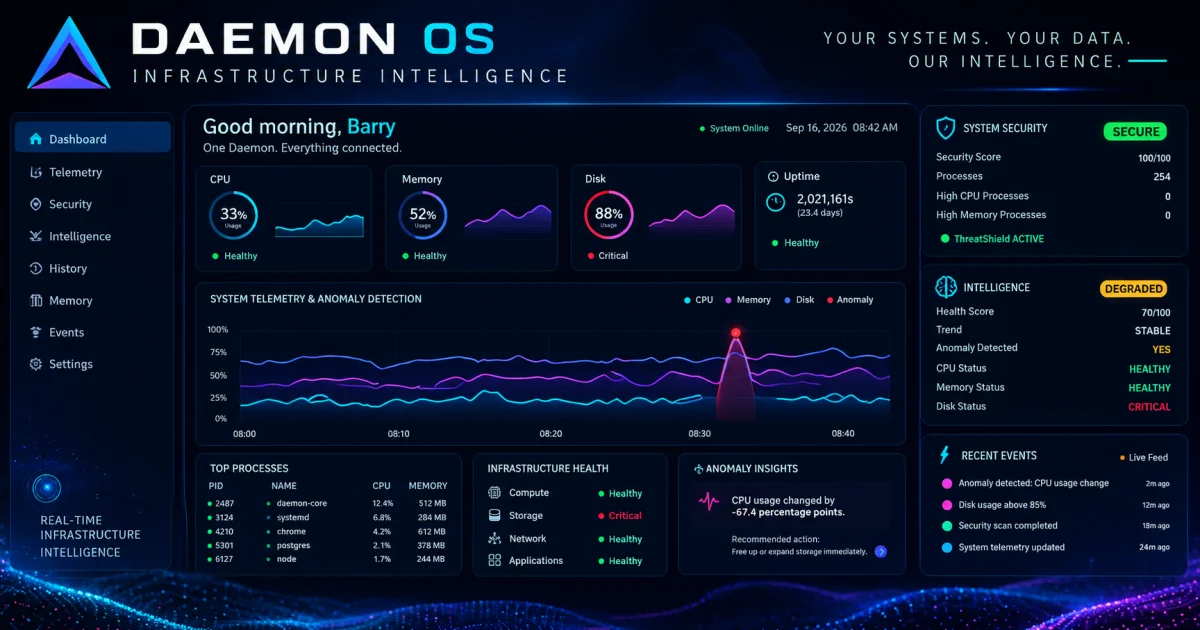
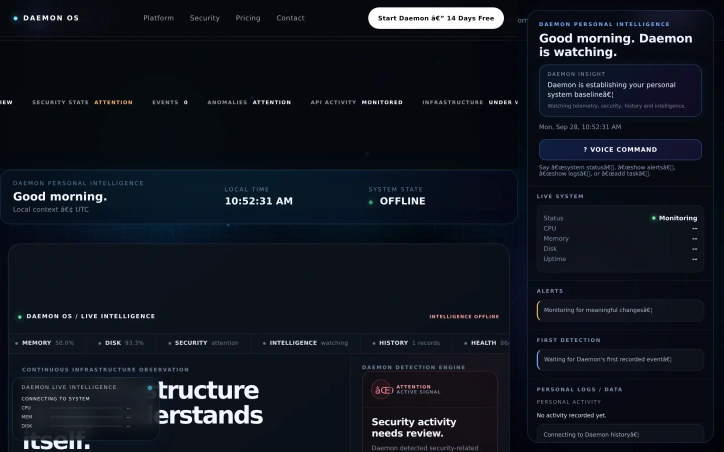
Daemon OS is an AI-powered infrastructure intelligence platform built for developers, SREs, DevOps, and platform engineers. It brings telemetry, system health, security signals, memory, and AI-powered intelligence into one command center. Instead of forcing engineers to constantly watch dashboards, Daemon OS helps turn infrastructure signals into useful context and understanding. Built around a local-first philosophy, Daemon OS is designed to make modern infrastructure easier to observe, understand, and operate.
AI Overview
AI-generatedInfrastructure visibility remains fragmented across dashboards, logs, and scattered monitoring tools. Daemon OS consolidates this problem by delivering infrastructure intelligence that transforms raw telemetry into contextual understanding rather than endless data streams.
The platform targets developers, SREs, and platform engineers who spend too much time piecing together system health signals manually. Instead of forcing users to interpret graphs and alerts, Daemon OS uses AI to connect dots between CPU behavior, memory consumption, security events, and system history to surface what actually matters.
What distinguishes Daemon OS is its tiered approach to infrastructure watching. The Personal tier at $4.99 monthly monitors up to five personal devices and home networks, providing health summaries and performance insights for non-technical users. The Pro tier at $9.99 monthly scales to personal infrastructure with trend detection and anomaly analysis. The Business tier at $29.99 monthly handles production systems, offering Kubernetes cluster visibility, pod health tracking, and blast-radius analysis for teams running containerized workloads.
The product embeds security monitoring alongside performance tracking, continuously comparing live signals against infrastructure state. The detection engine identifies anomalies and infrastructure degradation automatically rather than requiring engineers to set custom thresholds or maintain alert rules. This reduces operational toil for teams managing complex systems.
The company emphasizes a local-first philosophy, meaning intelligence happens close to where systems run rather than centralizing all data to external services. This matters for security-conscious organizations and teams with data residency requirements. The platform also surfaces automation-ready output, suggesting it integrates findings into workflow tools and incident response processes.
The pricing structure is notably accessible. Starting at $4.99 monthly for personal use makes infrastructure intelligence available to individual engineers, not just enterprises. The progression through tiers suggests the product can grow with users, from side projects to full production clusters.
What remains unclear from available information is the depth of AI analysis, specific anomaly detection capabilities, and how the platform handles multi-cloud or hybrid infrastructure. The focus on Kubernetes in the Business tier may narrow appeal for teams not yet containerized.
Daemon OS positions itself around intelligence and contextual understanding rather than raw data collection. For teams tired of dashboard fatigue and wanting AI to simplify infrastructure operations, it offers a direct alternative in a crowded observability space.
Founder Diary
DevlogThe maker hasn't posted a diary entry yet.
Key Features
Infrastructure Consolidation
Consolidates fragmented monitoring across dashboards and tools into a single platform
AI-Powered Analysis
Uses AI to connect system signals and surface actionable infrastructure intelligence
Automated Anomaly Detection
Identifies anomalies and infrastructure degradation without requiring custom alert thresholds
Security Integration
Embeds security monitoring alongside performance tracking with continuous signal comparison
Local-First Processing
Processes intelligence close to systems rather than centralizing data to external services
Kubernetes Visibility
Provides cluster visibility, pod health tracking, and blast-radius analysis for containerized workloads
Use Cases
-
1
Developers and SREs
Reduces time manually piecing together system health signals from multiple sources
-
2
Platform Engineers
Automates monitoring and anomaly detection for complex production systems
-
3
Individual Engineers
Monitors personal devices and home networks with health summaries and performance insights
-
4
Teams with Data Residency Requirements
Processes infrastructure intelligence locally rather than sending data to external services
FAQ
How much does Daemon OS cost? ▾
Does Daemon OS work with Kubernetes? ▾
Where is my infrastructure data stored? ▾
Do I need to set up custom alerts? ▾
Pricing
Three-tier pricing structure for Personal, Pro, and Business tiers with no free option mentioned.
Tech Stack & Tags
Discussion
No comments yet — be the first!
Join the conversation — sign up to comment.
Sign up freeCommunity Support
Boost this project on Sell With boost