
Daybreaker.ai
- No match
Machine translation — the English original is authoritative.
The Story
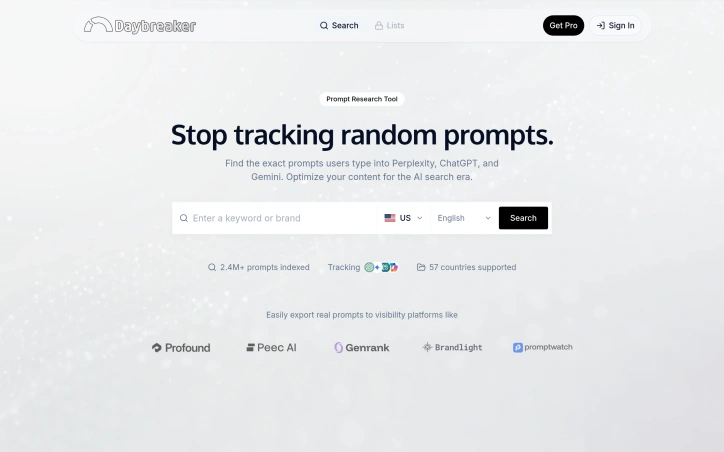
Stop tracking random prompts. Find the exact prompts users type into Perplexity, ChatGPT, and Gemini. Optimize your content for the AI search era.
AI Overview
AI-generatedUnderstanding what users ask AI search engines is becoming critical for content creators and businesses navigating the rise of conversational AI. Daybreaker tackles this problem directly by aggregating and analyzing the actual prompts people enter into Perplexity, ChatGPT, and Gemini—providing visibility into search behavior that was previously hidden from most organizations.
The core insight is straightforward but valuable: if content and products are to be discoverable in an AI-first world, creators need to know how people phrase their searches in these new interfaces. Traditional search engine optimization focused on keyword analysis and ranking factors. Daybreaker shifts that lens to conversational queries, revealing the natural language patterns that drive AI search results. This data becomes particularly useful for companies trying to optimize their content strategy for discovery within AI systems rather than just traditional search rankings.
The target audience is content marketing teams, SEOs transitioning to AI search optimization, product teams, and publishers seeking to understand how their audience formulates questions. Rather than guessing how to position content, these users can work from actual user behavior data. The tool addresses a real gap: while keyword research tools have long served traditional search, few solutions exist for understanding the conversational dynamics of AI search engines.
What distinguishes Daybreaker is its specificity. Rather than offering a generalized analytics platform, it concentrates narrowly on a single, increasingly important problem—prompt discovery. This focus is both its strength and its limitation. The tool doesn't claim to optimize AI search results or rank content; it provides the foundational data for doing so. Users will need to synthesize these insights themselves.
The product arrives at a logical inflection point in internet history. As Perplexity, ChatGPT, and Gemini capture an increasing share of informational queries that once went to Google, understanding that shift becomes essential for anyone trying to reach audiences through search. Daybreaker essentially provides the research layer for the AI search era—allowing organizations to move beyond assumption-based content strategy to one grounded in actual user behavior.
Founder Diary
DevlogThe maker hasn't posted a diary entry yet.
Key Features
Prompt Aggregation
Collects search queries from Perplexity, ChatGPT, and Gemini in one platform
Query Pattern Analysis
Reveals natural language patterns that drive AI search results
Conversational Search Data
Shows how users actually phrase questions in AI search interfaces
Audience Behavior Insights
Demonstrates how target audiences formulate questions across AI platforms
AI Search Foundation
Provides data to ground content strategy in actual user behavior rather than assumptions
Use Cases
-
1
Content Marketing Teams
Optimize content discovery by understanding actual user search behavior in AI engines
-
2
SEO Professionals
Transition from traditional keyword research to conversational query optimization for AI search
-
3
Publishers
Understand how audiences phrase questions to improve content visibility in AI systems
-
4
Product Teams
Make data-driven decisions about content positioning for AI search discovery
FAQ
What AI search engines does Daybreaker track? ▾
How is Daybreaker different from traditional SEO tools? ▾
Does Daybreaker help rank content higher? ▾
Who should use this tool? ▾
Tech Stack & Tags
Discussion
No comments yet — be the first!
Join the conversation — sign up to comment.
Sign up freeCommunity Support
Boost this project on Sell With boost
Meet the Founder

More in SEO tools

LinkNest
I noticed SEO professionals and independent blog...

EnjoySEOS
I built EnjoySEOS because SEO professionals were...

Ai Visibility Audit
Businesses increasingly appear in AI-powered sea...

SubmitMap
I kept losing evenings to directory forms that w...

LaunchRadar
LaunchRadar is a growth tool that helps indie an...
Productivity tools
Toolvio is a modern platform of fast and useful...