dFrame
- No match
Machine translation — the English original is authoritative.
The Story
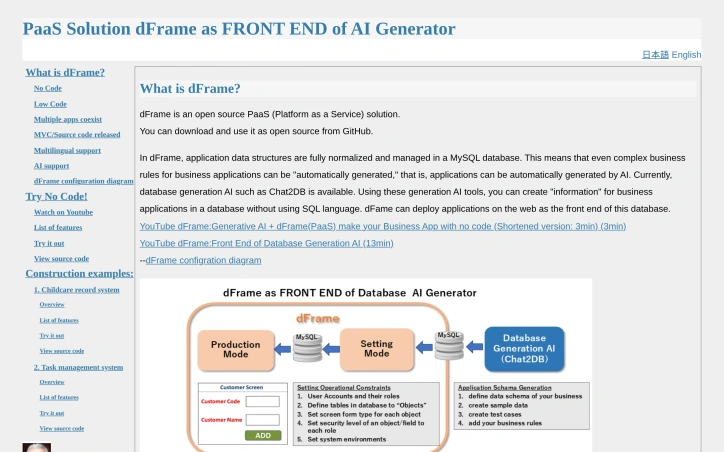
We built dFrame to eliminate complex programming for business applications. It's an open-source PaaS that automatically generates web applications from normalized MySQL databases, powered by AI database generation tools. Simply define your data structure and dFrame creates fully functional no-code applications.
AI Overview
AI-generatedOpen-source platforms that eliminate the need for custom programming have gained traction in recent years, but most still require at least some technical knowledge. dFrame tackles a specific problem: automating the creation of business applications directly from normalized database schemas, without requiring developers to write frontend code.
The platform targets organizations that want to deploy operational applications quickly, particularly those working alongside AI database generation tools like Chat2DB. Rather than starting from scratch, users can leverage AI to generate database structures, then have dFrame automatically produce the web interface layer. This workflow removes two major friction points: SQL expertise and frontend development.
What distinguishes dFrame from generic no-code platforms is its architectural approach. Applications generated through dFrame run against fully normalized MySQL databases, with each application stored in its own database schema. This encapsulation creates clear boundaries between applications, improving maintainability and making it feasible to host multiple applications on a single instance. For teams that need custom logic beyond basic data operations, the platform offers a low-code path through MySQL procedures, views, functions, and triggers, avoiding the need to rewrite entire application layers.
The feature set covers typical business application needs: data entry, searching, editing, and list views with pagination. Export capabilities include PDF and CSV formats. The workflow follows a natural progression—users define objects and fields in a settings mode, then switch to an application mode for actual data operations. Existing database schemas can be imported directly, eliminating setup friction for teams migrating from legacy systems.
The platform is available as open source through GitHub, removing licensing barriers to adoption. No explicit pricing model appears in available materials, suggesting this is positioned as a community-driven project rather than a commercial offering.
The documentation positions dFrame primarily around AI integration and no-code workflows, though the practical limitations of purely no-code systems deserve consideration. The platform works best for applications with standard CRUD operations and normalized data structures. More specialized requirements would require stepping into the low-code layer, which increases complexity accordingly.
dFrame positions itself as infrastructure for a specific workflow: leveraging AI to generate database structures, then exposing them through automatically generated web interfaces. Organizations with this exact need have a working solution. Those building more complex applications or requiring deep customization would need to evaluate whether the low-code extensions or hand-coding alternatives better serve their timeline and capability constraints.
Founder Diary
DevlogThe maker hasn't posted a diary entry yet.
Key Features
Automatic Code Generation
Web interfaces are generated directly from database schemas without manual coding
No Frontend Development
Applications run on normalized MySQL databases eliminating the need for frontend code
CRUD Operations
Built-in data entry, search, editing, and list views with pagination and export to PDF or CSV
Schema Encapsulation
Multiple applications can be hosted on a single instance with clear boundaries between schemas
Existing Schema Import
Database schemas can be imported directly, eliminating setup friction for legacy systems
Low-Code Extensions
Custom logic can be added through MySQL procedures, views, functions, and triggers
Use Cases
-
1
Rapid Deployment
Organizations that need to deploy operational applications quickly without building from scratch
-
2
AI-Database Workflows
Teams combining AI database generation tools like Chat2DB with automatic UI generation
-
3
Legacy Migration
Teams migrating existing normalized databases to modern web interfaces without recoding
-
4
Standard CRUD Applications
Organizations building applications with standard data operations and normalized structures
FAQ
Does dFrame require programming skills? ▾
What databases does dFrame support? ▾
Can I import my existing database? ▾
How much does dFrame cost? ▾
Pricing
Open source project available on GitHub with no licensing fees
Tech Stack & Tags
Discussion (1)

Why is New AI-Driven Development Scheme needed? Because it offers a powerful antithesis (solution) to the recent problems of AI generating massive amounts of code, leading to a collapse of source code management (the "spaghetti code" problem). It is clear that the key to solving those challenges lies in two things: • Increasing the "granularity" of prompts to the generative AI • Minimizing, or eliminating, the context for the generative AI The following scheme provide the key to solving these two problems: • MVC Model: The application's structural design should not be left to AI. That is, the structure of Model (business rules), Visual (UI), and Control (internal control) is assumed to be given. • Chat2DB: Automatically generates SQL statements that constitute the "M (Model)" of the MVC model. Prompts are spent on generating information for the database structure and set operations. • dFrame: An MVC model implementation PaaS. A no-code Agile tool.
Join the conversation — sign up to comment.
Sign up freeCommunity Support
Boost this project on Sell With boost