
Guitar Setup Lab
- No match
Machine translation — the English original is authoritative.
The Story
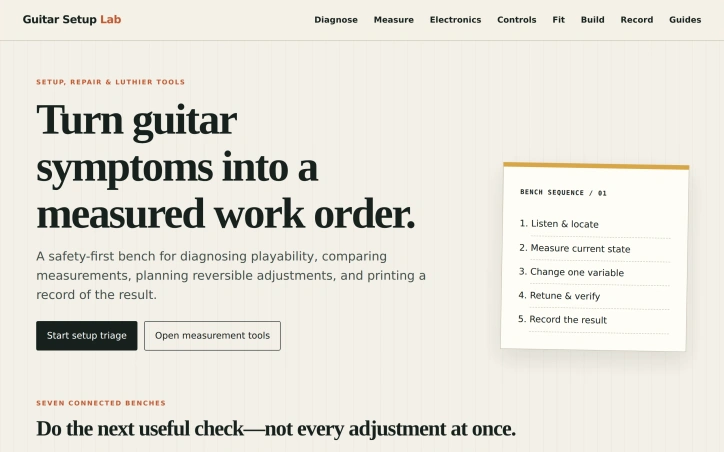
I built Guitar Setup Lab because guitar setup is too often guesswork—small mistakes during repair can damage an instrument permanently. I created this tool to make setup systematic and safe, with interactive diagnostics, precise measurements, and printable records so guitarists and luthiers can plan every adjustment with confidence.
AI Overview
AI-generatedDiagnosing and repairing guitar problems systematically has long been the domain of experienced technicians working from intuition and acquired knowledge. Guitar Setup Lab transforms setup and repair work by replacing guesswork with measurement-based diagnostics, structured workflows, and documented records that reduce the risk of permanent damage to instruments.
The platform organizes work around logical dependencies: stable strings and tuning come before adjusting neck relief; relief settings precede bridge action; pickup clearance follows the determined string path. This sequenced approach prevents the common mistake of adjusting multiple variables simultaneously, which obscures cause and effect. Seven interconnected diagnostic benches guide users through measurement, adjustment planning, and documentation according to this dependency chain rather than attempting every possible fix at once.
The tool excels in breadth. Beyond basic playability diagnostics like fret buzz and action height, it handles specialized measurements for pickup compatibility, control hardware fit, electronics troubleshooting, and geometry planning for instrument builders. Built-in guides interpret measurements in context—converting between units, explaining what values mean for playability, and suggesting appropriate next steps. For professionals, the software generates shop-ready intake forms, quotes, job records, and condition documentation that create accountability and improve client communication.
A standout feature is the geometry bench for instrument building, which calculates fret coordinates, spacing, multiscale layouts, and tremolo balance from measured physical datums. This bridges the gap between design intent and fabrication, eliminating the import errors and label misreadings that plague aftermarket component sourcing. Users can project string spread to verify pickup compatibility before ordering parts, or check control cavity geometry against manufacturer specifications.
The product targets both independent guitarists managing their own instruments and professional luthiers running repair shops. Guitarists gain confidence in basic setup decisions; luthiers gain structured workflows that reduce liability and improve shop efficiency through systematic documentation.
One notable aspect is the emphasis on reversibility—setup is framed as a series of measured checks and isolated adjustments rather than permanent modifications. This philosophy permeates the tool's design, from the diagnostic flow to the printed records that serve as before-and-after evidence of work completed.
The offering sits at the intersection of professional tooling and accessibility, assuming users lack formal training but care about precision and process. It provides the measurement guidance, conversion logic, and decision frameworks that separate confident adjustment from guesswork.
Founder Diary
DevlogThe maker hasn't posted a diary entry yet.
Key Features
Measurement-Based Diagnostics
Replaces guesswork with precise measurement-based diagnostics and structured workflows.
Sequential Diagnostic Benches
Seven interconnected diagnostic benches guide users through measurements and adjustments following logical dependencies.
Geometry Bench for Building
Calculates fret coordinates, multiscale layouts, and tremolo balance for instrument builders.
Professional Documentation
Generates shop-ready intake forms, quotes, job records, and condition documentation for accountability.
Built-In Measurement Guides
Interprets measurements in context with unit conversion and playability explanations.
Pickup Compatibility Verification
Projects string spread to verify pickup compatibility before ordering parts.
Use Cases
-
1
Independent Guitarists
Gain confidence in basic setup decisions and manage their own instrument maintenance.
-
2
Professional Luthiers
Reduce liability and improve shop efficiency through systematic documentation and structured workflows.
-
3
Instrument Builders
Plan geometry and verify component compatibility before fabrication using calculated fret coordinates and spacing.
-
4
Guitar Repair Shops
Create standardized intake forms, quotes, and job records that improve client communication.
FAQ
How does Guitar Setup Lab prevent common setup mistakes? ▾
Can this tool help with building guitars? ▾
What documentation can professionals generate? ▾
Do I need formal training to use this? ▾
Tech Stack & Tags
Discussion
No comments yet — be the first!
Join the conversation — sign up to comment.
Sign up freeCommunity Support
Boost this project on Sell With boost
Meet the Founder

More by canghun13




More in Knowledge base software

ekstrakt
We built ekstrakt because people spend hundreds...

SetupScore
I kept losing evenings to the same ritual. Want...

CheatGrid
I kept hitting the same annoying moment: needing...

iHateReading
I built iHateReading to break down complex topic...

Water Systems Bench
I built Water Systems Bench because water-system...
Dutton Legacy
As a fan of the Yellowstone universe, I created...