
SetupScore
- No match
Machine translation — the English original is authoritative.
The Story
I kept losing evenings to the same ritual. Want a new monitor? Open 15 tabs. One review says 4.5/5, another says 7.8/10. A YouTube video catches backlight bleed nobody wrote about. Reddit says the USB-C doesn't charge a MacBook. An hour later, more confused than when I started.
The problem was never finding reviews. It was cross-referencing them. Does "vivid colors" from one reviewer mean the same as "excellent color reproduction" from another when one watches movies and the other edits photos?
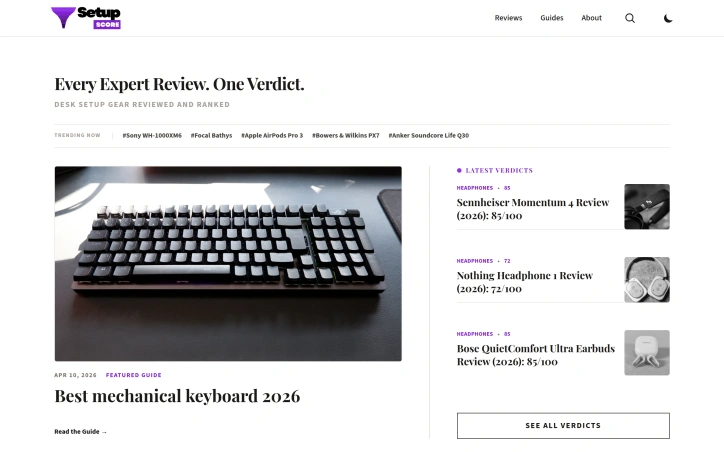
So I built SetupScore. It cross-references 20-50 independent sources per product, expert reviews, YouTube analyses, Reddit discussions, Amazon customer data, and produces a scored breakdown showing where reviewers agree, where they clash, and what matters for your specific use case.
No editorial opinions. No pay-for-placement. Scores are algorithmic. Limitations get published. If the data says a product has problems, that shows up too.
Monitors, keyboards, and headphones right now. Built it for myself, turns out other people were doing the same 15-tab thing.
AI Overview
AI-generatedComparison fatigue in home office equipment shopping has a new antidote. The fundamental challenge isn't locating reviews—it's reconciling them. When one reviewer praises a monitor's "vivid colors" and another lauds its "excellent color reproduction," these might describe the same attribute or entirely different aspects. Add conflicting scores across different scales, YouTube videos revealing issues nobody documented, and Reddit threads flagging compatibility problems, and a simple purchase decision becomes time-consuming detective work.
SetupScore addresses this by aggregating and cross-referencing 20 to 50 independent sources per product, including expert reviews, YouTube analyses, Reddit discussions, and Amazon customer feedback. Rather than asking users to synthesize conflicting opinions, the platform produces an algorithmic score that surfaces where reviewers actually agree, where they diverge, and what trade-offs exist. The scoring is explicit about limitations and doesn't hide negative findings just because they complicate the narrative.
The current catalog focuses on keyboards, monitors, and headphones—the most frequently reviewed categories in home office setups. Each product listing includes a numerical verdict alongside a breakdown showing category-specific performance and how different sources evaluated particular attributes. This matters for anyone choosing equipment for specific work like photo editing versus video production, where "good color accuracy" means different things.
What distinguishes SetupScore from existing review aggregators is its stated commitment to algorithmic scoring without editorial bias or pay-for-placement arrangements. The founder built it out of personal frustration with the 15-tab review process, and the product's scope reflects that origin—narrow enough to do the cross-referencing thoroughly, broad enough to cover the most-reviewed categories. There's no pretense of completeness; instead, it acknowledges what it covers and what it doesn't.
For knowledge workers who value consolidated data over editorial guidance, the value proposition is straightforward: systematized comparison without the editorial noise. SetupScore's strength lies in acknowledging a genuine pain point—not finding information, but untangling contradictory information—and building a tool explicitly designed around that problem.
Founder Diary
DevlogThe maker hasn't posted a diary entry yet.
Key Features
Multi-Source Aggregation
aggregates 20-50 independent sources per product including expert reviews, YouTube analyses, Reddit discussions, and Amazon feedback
Algorithmic Scoring
produces an algorithmic score that surfaces where reviewers agree, diverge, and what trade-offs exist
Attribute Breakdown
shows category-specific performance and how different sources evaluated particular attributes
Bias-Free Methodology
uses algorithmic scoring without editorial bias or pay-for-placement arrangements
Focused Catalog
specializes in keyboards, monitors, and headphones for home office setups
Use Cases
-
1
Home Office Workers
eliminates comparison fatigue by consolidating contradictory reviews into systematic equipment comparisons
-
2
Photo Editors and Video Producers
helps choose equipment for specific work where performance attributes have different meanings
-
3
Data-Driven Shoppers
appeals to knowledge workers who value consolidated data over editorial guidance
-
4
Comparison Researchers
replaces the 15-tab review process by cross-referencing conflicting opinions in one place
FAQ
How many sources does SetupScore analyze per product? ▾
What products does SetupScore cover? ▾
How is SetupScore different from other review aggregators? ▾
Are negative reviews shown on SetupScore? ▾
Tech Stack & Tags
Discussion
No comments yet — be the first!
Join the conversation — sign up to comment.
Sign up freeCommunity Support
Boost this project on Sell With boost
Meet the Founder

More in Knowledge base software

ekstrakt
We built ekstrakt because people spend hundreds...
CapyDB
I created CapyDB because existing game wikis are...

CheatGrid
I kept hitting the same annoying moment: needing...

iHateReading
I built iHateReading to break down complex topic...

Water Systems Bench
I built Water Systems Bench because water-system...
Dutton Legacy
As a fan of the Yellowstone universe, I created...