
HtmlToWebsite
- No match
Machine translation — the English original is authoritative.
The Story
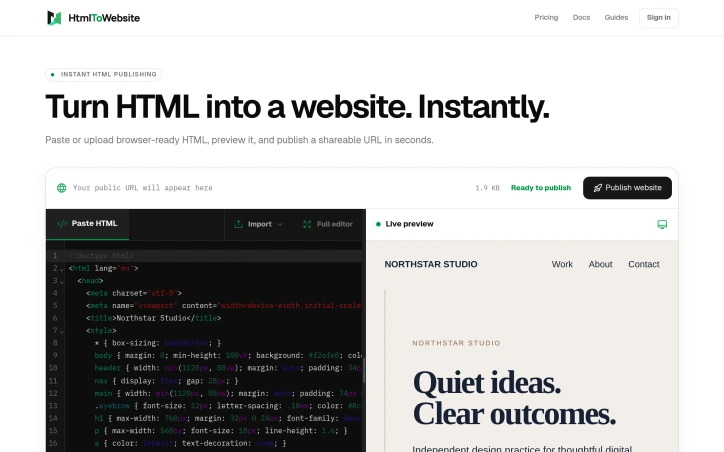
We built HtmlToWebsite to eliminate the friction between writing HTML and sharing it live. Developers and creators need a fast way to turn code into a public URL without managing hosting or deployment—whether it's a single file or a full project with assets. Our platform instantly converts your HTML into a shareable website, perfect for demos, prototypes, and rapid iteration.
AI Overview
AI-generatedThe friction point this solves is clear: developers who write HTML need a way to share their work publicly without wrestling with hosting infrastructure, deployment pipelines, or server management. HtmlToWebsite targets this gap by offering instant publication—paste your code and get a live URL, no deployment configuration required.
The core value proposition centers on speed and simplicity. Rather than choosing between shared hosting platforms, containerization tools, or static site generators, users can move directly from editor to shareable link. This streamlines the typical workflow for prototyping, building demos, and iterating rapidly without backend complexity.
The product handles projects of varying scope. Whether developers are publishing single HTML files or complex projects with accompanying assets, the platform manages the technical details transparently. This breadth is significant because many similar tools force users into either-or constraints—support for simple files OR full project structures, but rarely both seamlessly.
Who benefits most? The platform appeals to developers building quick proof-of-concepts, designers prototyping interactive mockups, and educators demonstrating code concepts. It's also useful for teams collaborating on frontend-heavy features or anyone who needs to share executable code without asking collaborators to run a local environment.
The strategic positioning is revealing. By eliminating hosting and deployment as friction points, HtmlToWebsite competes less with traditional web hosts and more with in-browser IDEs and pastebin services that now need distribution. It occupies the specific moment between code written and code running live, addressing a real bottleneck in development workflows.
The product design is deliberately minimal—paste HTML, get a website—which works as both mechanic and marketing. There's no mention of pricing or business model in the available information, making it unclear how sustainable or commercially viable this approach is. Nonetheless, the core insight is sound: developers absolutely encounter this friction point, and removing it has genuine value for rapid iteration cycles and collaborative prototyping.
Founder Diary
DevlogThe maker hasn't posted a diary entry yet.
Key Features
Instant Publication
Paste HTML code and get a live URL immediately without deployment configuration
Asset Management
Handle complex projects with accompanying assets seamlessly
No Infrastructure Required
Eliminates hosting infrastructure, deployment pipelines, and server management
Simple Interface
Deliberately minimal design requiring only paste HTML to get a website
Rapid Iteration
Streamlines workflow for prototyping and building demos without backend complexity
Use Cases
-
1
Developers Building Proof-of-Concepts
Share executable code without requiring collaborators to run local environments
-
2
Designers Prototyping Mockups
Create and share interactive prototypes for feedback instantly
-
3
Educators Demonstrating Code
Show code concepts in action through live shareable URLs
-
4
Frontend Teams Collaborating
Share frontend-heavy features without complex setup
FAQ
How do I publish HTML without hosting? ▾
Can I upload multiple files and assets? ▾
Who should use HtmlToWebsite? ▾
Tech Stack & Tags
Discussion
No comments yet — be the first!
Join the conversation — sign up to comment.
Sign up freeCommunity Support
Boost this project on Sell With boost
Meet the Founder

More in Web hosting services

DomRegus
DomRegus is a modern domain registration platfor...

uploadthefile.com
We built uploadthefile to eliminate friction whe...
OpenClaw Direct
OpenClaw.Direct lets your team run a private AI...

VavaHost
VavaHost was built to make fast, reliable web ho...

Shipvela
You built a website in Codex, Claude Code or Cur...