
Shipvela
- No match
Machine translation — the English original is authoritative.
The Story
You built a website in Codex, Claude Code or Cursor. Publishing it should not turn into another infrastructure project. I built Shipvela to give developers and independent makers a clear path from their code to a live URL.
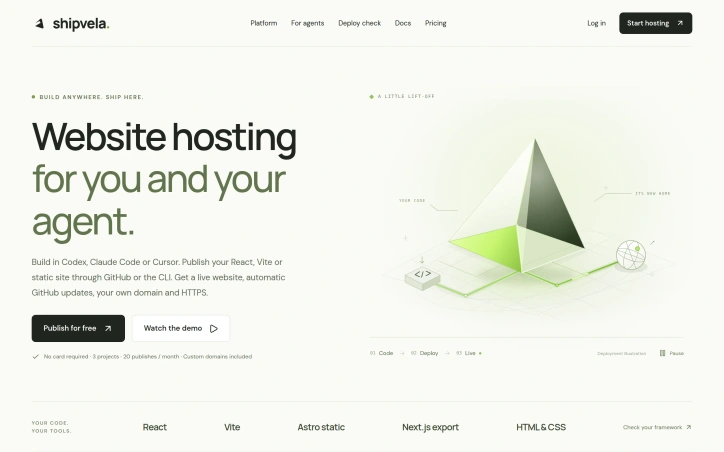
Import a supported GitHub repository or publish a prebuilt React, Vite or static site with the Shipvela CLI. Connect your own domain with managed HTTPS on every plan. GitHub updates can publish automatically after selected repository access and a first successful publish. The OAuth MCP connector also lets supported coding agents request publishing with owner confirmation and inspect deployment status and logs.
Hobby is free with 3 projects and 20 publishes per month. Pro is $29/month and Studio is $99/month; paid plans add capacity, compatible Next.js SSR and saved Lighthouse lab reports. Database presets use your existing Supabase, Neon, Prisma or Upstash service credentials; those accounts and charges remain separate.
Built by Stefan Mitrovic at Content Petit LLC. Bring your code. Give it a home.
AI Overview
AI-generatedDeployment infrastructure remains a friction point for developers building with modern tools. Shipvela directly addresses this by positioning itself as a deployment layer for developers and independent makers who use AI-powered coding environments like Codex, Claude Code, and Cursor. The service removes the extra operational burden of learning another deployment system by letting users publish directly from their development workflow.
The product centers on a straightforward promise: take code built locally or in an AI agent, connect it to Shipvela, and have a live website with a custom domain and HTTPS, no infrastructure configuration required. It accepts multiple entry points for deployment—importing a GitHub repository for continuous updates, uploading prebuilt output from frameworks like React and Vite, or using the command-line interface directly. This flexibility acknowledges that developers' workflows vary significantly, particularly those working with AI agents where the deployment path may be less predictable than traditional development.
What differentiates Shipvela is its native integration with coding agents themselves. Rather than shipping code and then switching context to deploy elsewhere, developers can connect an MCP server within their agent and publish through the same interface where they built the project. For users of GitHub, automatic deployments to production are available after an initial publish, meaning code changes can flow through without additional manual steps.
The platform layers features deliberately by pricing tier. The free hobby plan offers 3 projects and 20 monthly publishes, along with custom domains and HTTPS—essentials that many competitors require payment to access. Professional users pay $29 monthly for increased capacity and access to Speed Insights, which provides Lighthouse reports for performance measurement. The Studio tier at $99 monthly adds further capacity alongside Next.js server-side rendering support. This structure gives developers a genuine free option while creating clear upgrade paths for growing needs.
Database integration represents another practical touch point. Shipvela supports connections to existing services including Supabase, Neon, Prisma, and Upstash, meaning developers handle their own account management and billing separately rather than becoming locked into a bundled vendor. The service stays focused on deployment rather than expanding into adjacent infrastructure.
Built by Stefan Mitrovic, Shipvela reflects a specific problem the creator experienced firsthand: the gap between completing a project and publishing it live should not require becoming an infrastructure engineer. For developers prioritizing shipping over operations, particularly those working within AI coding environments, it removes a meaningful friction point in the development-to-deployment pipeline.
Founder Diary
DevlogThe maker hasn't posted a diary entry yet.
Key Features
Direct Agent Integration
Connect an MCP server within coding agents to deploy without changing context.
Multiple Deployment Paths
Import GitHub repos, upload prebuilt output, or use the CLI.
Custom Domains and HTTPS
Available even on the free plan.
Automatic GitHub Deployments
Changes flow to production automatically after initial publish.
Database Integrations
Connect existing services like Supabase, Neon, Prisma, and Upstash.
Use Cases
-
1
AI-powered developers
Those using Codex, Claude Code, or Cursor who want to publish without leaving their coding environment.
-
2
Independent makers
Solo developers building and deploying projects with minimal operational overhead.
-
3
GitHub-focused teams
Projects that benefit from continuous deployment tied to repository changes.
-
4
AI agent workflows
Deployments where code generation and publishing happen within the same interface.
FAQ
What's included in Shipvela's free plan? ▾
Can I use Shipvela with my existing database? ▾
Does Shipvela integrate with GitHub? ▾
What are the paid plans? ▾
Pricing
Free hobby plan with paid Professional ($29/mo) and Studio ($99/mo) tiers offering increased capacity and advanced features.
Tech Stack & Tags
Discussion
No comments yet — be the first!
Join the conversation — sign up to comment.
Sign up freeCommunity Support
Boost this project on Sell With boost
Meet the Founder

More in Web hosting services

DomRegus
DomRegus is a modern domain registration platfor...

uploadthefile.com
We built uploadthefile to eliminate friction whe...
OpenClaw Direct
OpenClaw.Direct lets your team run a private AI...

HtmlToWebsite
We built HtmlToWebsite to eliminate the friction...

VavaHost
VavaHost was built to make fast, reliable web ho...