MeetingGlass
The Story
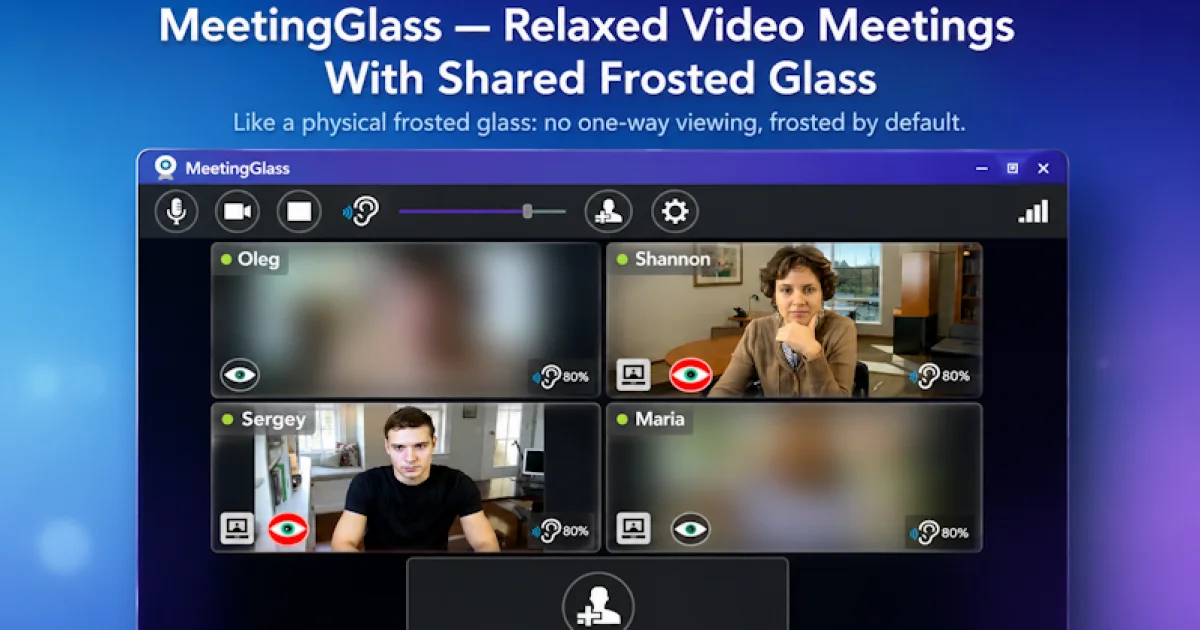
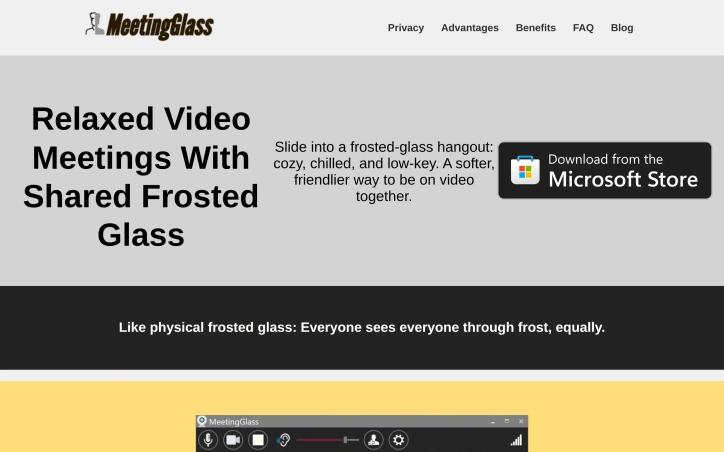
I built MeetingGlass to solve video call fatigue. We realized people feel uncomfortable being constantly watched on video, so I created a shared frosted glass layer where everyone appears obscured equally. Now teams can have more relaxed, stress-free video meetings without feeling on display.
AI Overview
AI-generatedVideo call fatigue drives the design of MeetingGlass, a meeting application built on a counterintuitive premise: that everyone appearing equally obscured creates a more relaxed environment than selective blur or individual privacy filters. The product addresses the specific discomfort people experience being constantly watched on camera during remote work or study sessions, offering a shared frosted glass layer that obscures all participants uniformly.
What distinguishes MeetingGlass from existing video conferencing software is its emphasis on mutual consent for visibility. Participants request to see someone clearly, and that person must accept before both see each other unobstructed. This mutual unfrosting replaces the asymmetry of traditional one-way viewing, where someone might monitor others while remaining unseen. By default, everyone appears frosted, eliminating the social awkwardness that accompanies being the only person with a camera off.
The product targets three main use cases: remote work teams seeking stress-free meetings, study groups wanting equal comfort regardless of appearance, and casual gatherings with friends and family. Rather than individual blur filters that fragment the group experience, MeetingGlass creates a genuinely shared environment where every participant occupies the same visual space.
From a technical standpoint, the application prioritizes efficiency alongside privacy. It consumes minimal CPU and bandwidth, supporting spontaneous communication without resource overhead. Setup takes approximately one minute, and the service imposes no meeting time limits. Users join without email registration or providing their real name, preserving anonymity while enabling group participation.
The design reflects a deliberate choice about what video meetings could be: less surveillance theater, more genuine presence. By obscuring everyone equally and requiring mutual agreement to see clearly, MeetingGlass proposes a different social contract for remote communication. The mutual visibility constraint prevents the dynamic where some participants can observe others without reciprocal awareness. For teams or groups bothered by camera fatigue or the documented discomfort of constant surveillance, this represents a meaningful alternative to mainstream video conferencing platforms that treat clear visibility as the default and only mode.
Key Features
Mutual Visibility Control
Participants request to see someone clearly and must mutually accept before both see each other unobstructed
Uniform Obscuration
Everyone appears equally frosted by default, eliminating social awkwardness of being the only person with camera off
Low Resource Consumption
Minimal CPU and bandwidth requirements enabling spontaneous communication without overhead
Frictionless Onboarding
Users join without email registration or real name in approximately one minute
Unlimited Meeting Duration
No meeting time limits imposed on participants
Use Cases
-
1
Remote Work Teams
Stress-free meetings that eliminate discomfort from being constantly watched on camera
-
2
Study Groups
Equal comfort for all participants regardless of appearance concerns
-
3
Casual Social Gatherings
Shared visual space for informal connection with friends and family
FAQ
How does MeetingGlass reduce video call fatigue? ▾
Can I see someone's face clearly if I want to? ▾
Do I need to register or provide my real name? ▾
Tech Stack & Tags
Discussion
No comments yet — be the first!
Join the conversation — sign up to comment.
Sign up freeCommunity Support
Boost this project on Sell With boost