
Minosphere
- No match
Machine translation — the English original is authoritative.
The Story
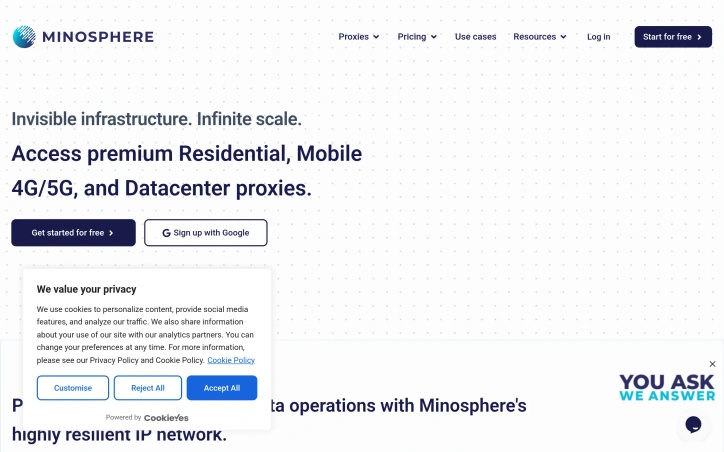
We built Minosphere to solve the challenge of reliable, large-scale data extraction. Enterprises needed premium residential, mobile, and datacenter proxies that maintain high trust scores across 190+ countries—so we created a resilient IP network with 15+ million authentic IPs and 99.99% uptime, making seamless global data aggregation actually possible.
AI Overview
AI-generatedEnterprises that depend on large-scale data extraction face a persistent challenge: sourcing reliable IP infrastructure that maintains trustworthiness across global markets while handling massive concurrent requests. Minosphere addresses this by operating a distributed network of proxy services spanning residential, mobile, and datacenter IPs.
The core value proposition centers on reliability and scale. The service maintains a portfolio of over 100 million residential IP addresses sourced across 190 countries, backed by claims of 99.9 to 99.99 percent uptime depending on the proxy type. For teams extracting data at enterprise scale, the reported 99.82 percent success rate and average response time of 0.41 seconds suggests infrastructure built to handle consistent, high-throughput operations without frequent bottlenecks.
What differentiates Minosphere is its tiered approach to proxy types. Residential proxies leverage authentic ISP-assigned addresses to real homeowners, positioning them as the most trusted option. Mobile proxies tap into carrier-assigned IP space across 3G, 4G, and 5G networks in 30-plus countries and regions, addressing use cases requiring carrier fidelity. Datacenter proxies prioritize raw performance for scenarios where speed matters more than trust perception. Static ISP proxies represent a middle ground, offering dedicated, never-rotating addresses officially registered to consumer ISPs.
The platform emphasizes operational convenience. A unified console and standardized APIs reduce friction for teams integrating multiple proxy types into existing workflows. Features like precise geotargeting, session control, and optimized routing for low-latency performance indicate thoughtful engineering around real production constraints rather than basic proxy forwarding.
Pricing is granular and varies significantly by proxy type. Residential proxies start at 1.60 dollars per gigabyte, datacenter proxies at 0.54 dollars per gigabyte, while mobile proxies range from 2.49 dollars per gigabyte for USA coverage to 3.5 dollars per gigabyte for international options. Static ISP proxies offer unlimited bandwidth at a presumably different cost model. The pricing structure invites cost optimization—teams can mix proxy types based on actual use case requirements rather than overpaying for residential quality when datacenter speed suffices.
The target audience is clear: data-driven enterprises conducting research, competitive intelligence, market monitoring, or other large-scale information collection that demands both reliability and geographic breadth. Whether the infrastructure and uptime claims hold under real production stress remains a question only deployment experience answers, but the architecture and feature set suggest a product designed for serious operational demands rather than casual use.
Founder Diary
DevlogThe maker hasn't posted a diary entry yet.
Key Features
Distributed IP Network
Over 100 million residential IP addresses spanning 190 countries
High Uptime Guarantee
99.9 to 99.99 percent uptime with 99.82 percent success rate and 0.41 second average response time
Multiple Proxy Types
Residential, mobile, datacenter, and static ISP options optimized for different trustworthiness and performance needs
Unified API Platform
Standardized console and APIs for seamless integration of multiple proxy types into existing workflows
Production-Ready Features
Geotargeting, session control, and optimized routing designed for enterprise-scale concurrent requests
Use Cases
-
1
Enterprise Data Extraction
Large-scale reliable data collection requiring high uptime and massive concurrent request handling
-
2
Competitive Intelligence & Market Research
Geographic breadth across 190 countries for monitoring and information gathering
-
3
Carrier-Dependent Applications
Mobile proxy access via 3G, 4G, and 5G networks in 30+ countries for carrier-fidelity scenarios
FAQ
What types of proxies does Minosphere offer? ▾
What uptime does Minosphere guarantee? ▾
Which proxy type should I choose? ▾
How does Minosphere pricing work? ▾
Pricing
Per-gigabyte pricing model with datacenter proxies starting at $0.54/GB and residential at $1.60/GB; mobile proxies range $2.49–$3.50/GB by region.
Tech Stack & Tags
Discussion
No comments yet — be the first!
Join the conversation — sign up to comment.
Sign up freeCommunity Support
Boost this project on Sell With boost