PixelDisk
- No match
Machine translation — the English original is authoritative.
The Story
PixelDisk is a native Mac disk space cleaner that shows your whole disk as one picture and safely clears caches, old installers and developer leftovers. $19 once, no subscription. Like DaisyDisk it shows what fills the disk; like CleanMyMac it cleans, for $19 once instead of a yearly plan.
It is a disk space analyzer, cleaner and app uninstaller for macOS 14 or later, on Apple silicon and Intel. Scanning is free; cleaning needs a one-time $19 license with updates included.
Safe by default: Safe mode moves your own files to the Trash, so you can put them back. Only caches and build files, which rebuild on their own, are deleted. Every item is explained in one sentence before you clear it, biggest first.
For developers it clears Xcode DerivedData, iOS DeviceSupport, simulator runtimes, node_modules, Docker and OrbStack images, and Ollama and LM Studio models, and says what each one costs: a slower next build or a re-download. It leaves DerivedData alone while Xcode is running.
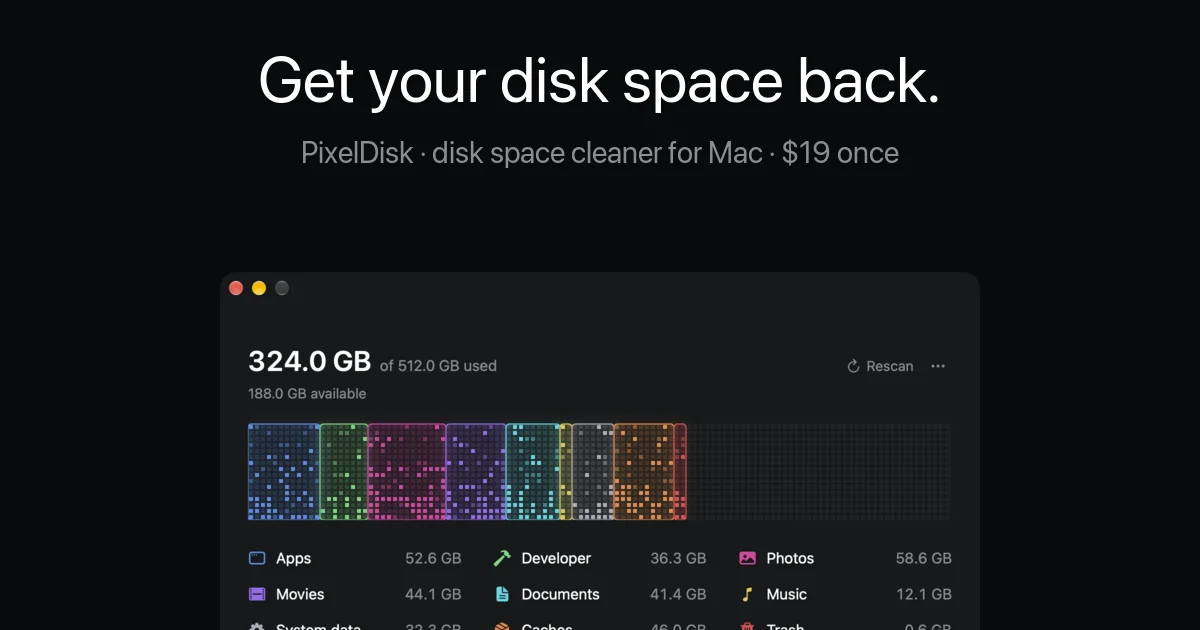
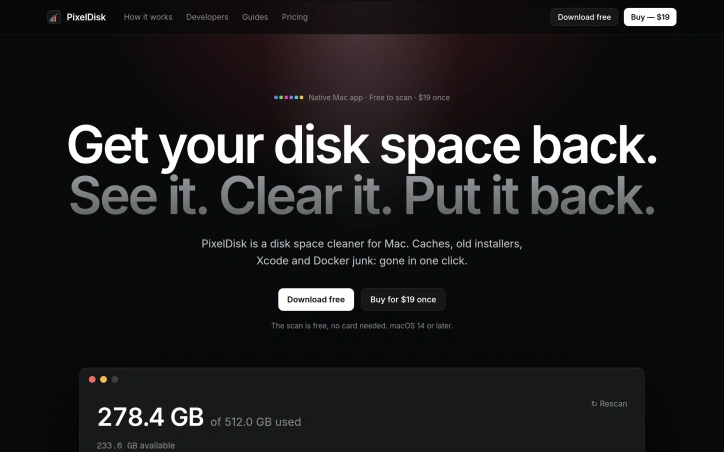
The disk is shown as one bar in nine categories. Also included: an uninstaller that removes apps with their leftovers, a list of large files you haven't opened in a year, a map of your home folder, a menu bar item with free space, and Autopilot, which clears rebuildable caches when space runs low.
Runs 100% on your Mac, no account. Available in 11 languages.
AI Overview
AI-generatedPixelDisk tackles a problem that anyone managing a Mac with a crowded drive will recognize: storage fills up quietly, and the biggest culprits are often hidden in caches, old installers, and developer build leftovers. It is aimed at ordinary Mac users who want to reclaim space without guesswork, and at developers whose Xcode, Docker, and local AI model downloads can consume tens of gigabytes without warning.
What sets the app apart is its visual approach. Rather than presenting a list of alarming warnings, it draws the whole disk as one colored map, so each category of storage is visible at a glance. Clicking into a color reveals what the data is, where it lives, and whether it is safe to remove. The cleanup side follows the same philosophy. Items are listed biggest first, each with a single sentence of explanation and one button to clear it. The product deliberately avoids the inflated scare tactics common in this category, such as invented problem counts, and that restraint makes it feel more trustworthy.
The developer features are especially thorough. The app covers Xcode DerivedData, iOS DeviceSupport, simulator runtimes, node_modules folders, Docker and OrbStack images, and Ollama and LM Studio models. For each item it states the trade-off plainly, whether that is a slower next build or a re-download, so users can decide with full information. Safe mode moves personal files to the Trash rather than deleting them permanently, and it refuses to touch DerivedData while Xcode is running, which reflects careful design.
Beyond cleaning, the app includes an uninstaller that removes applications along with their leftover files, a menu bar readout of free space and fill rate, and an Autopilot option that clears rebuildable caches automatically when storage runs low. Support for eleven languages broadens its reach.
On pricing, the product is straightforward. Scanning is free, and cleaning requires a one-time payment of $19 that includes updates. There is no subscription, and no account is needed. The app runs entirely on the user's Mac and requires macOS 14 or later, on both Apple silicon and Intel hardware.
Overall, PixelDisk is a focused, transparent utility that does its core job clearly. Its main strengths are the readable disk map, the honest explanations before anything is deleted, and its developer-oriented depth, all at a price that avoids recurring fees.
Founder Diary
DevlogThe maker hasn't posted a diary entry yet.
Key Features
Visual Disk Map
Draws the whole disk as one colored map so each storage category is visible at a glance.
Honest Cleanup Explanations
Lists cleanup items biggest first, each with a single sentence of explanation and one button to clear it.
Developer Storage Coverage
Covers Xcode DerivedData, iOS DeviceSupport, simulator runtimes, node_modules, Docker and OrbStack images, and Ollama and LM Studio models.
Safe Mode Trash Handling
Moves personal files to the Trash rather than deleting them permanently and refuses to touch DerivedData while Xcode is running.
App Uninstaller
Removes applications along with their leftover files.
Autopilot Cleanup
Clears rebuildable caches automatically when storage runs low.
Use Cases
-
1
Ordinary Mac users
They want to reclaim space from caches, old installers, and build leftovers without guesswork.
-
2
Software developers
Xcode, Docker, and local AI model downloads can consume tens of gigabytes without warning, and the app shows the trade-off of removing each item.
-
3
Local AI model users
Ollama and LM Studio models can take up large amounts of disk space, and the app lets them review and remove those models with full information.
-
4
Mac users who prefer no subscriptions
The one-time $19 payment covers updates, with no account needed and no recurring fees.
FAQ
Is PixelDisk free to use? ▾
What macOS versions does PixelDisk support? ▾
Does PixelDisk permanently delete my personal files? ▾
Can PixelDisk clean up Xcode and Docker storage? ▾
Pricing
Scanning is free, and cleaning requires a one-time payment of $19 that includes updates, with no subscription.
Tech Stack & Tags
Discussion
No comments yet — be the first!
Join the conversation — sign up to comment.
Sign up freeCommunity Support
Boost this project on Sell With boost
Meet the Founder

More in Productivity
OkComputer
OkComputer is an AI harness for professionals an...

ToolPotion
ToolPotion.ai — Discover the Right AI Tools for...
Word Puzzle World
Word Puzzle World started with a familiar frustr...

SpeakerEject
SpeakerEject is a free collection of browser aud...

Syllable Counter
This is a syllable counter tool made by AIWriteK...

NexusAI
NexusAI began with a straightforward observation...