
PlasticsCalc
- No match
Machine translation — the English original is authoritative.
The Story
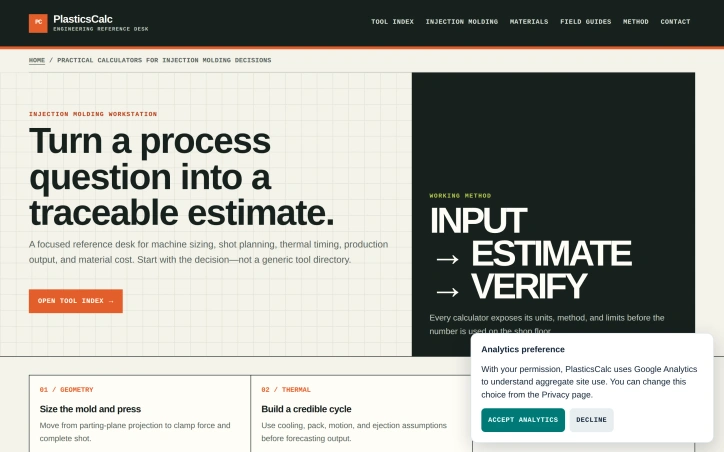
We built PlasticsCalc to give injection molding engineers a transparent way to make credible first-pass estimates on machine sizing, cycle planning, and material costs. Every calculator exposes its methodology, units, and limits before numbers reach the shop floor, turning process questions into traceable decisions backed by verifiable assumptions.
AI Overview
AI-generatedInjection molding engineers face a persistent challenge: converting design and process questions into reliable machine specifications and production forecasts before committing to expensive tooling and equipment. PlasticsCalc addresses this by providing a structured set of calculators that move engineers through three distinct phases—geometry sizing, thermal cycle planning, and economic validation—with methodology transparent at every step.
The product serves a specific audience: manufacturing professionals responsible for mold design, machine selection, and production planning. Rather than presenting a generic calculator directory, PlasticsCalc anchors each tool to a concrete decision point. An engineer asking "What clamp tonnage do I need?" starts with parting-plane geometry and material assumptions, not a blank form. The workflow reflects actual injection molding constraints: cavity pressure, cooling time, uptime, scrap rates, and material handling all factor into the complete picture.
What distinguishes the product is its commitment to transparency and traceability. Each calculator exposes its units, methodology, and computational limits before results leave the desktop. The interface is structured around record-keeping: a parting-plane record captures mold geometry and pressure basis; a shot and process record documents part mass and observed cycles; a production and cost record ties material consumption to utilization. This record-keeping focus signals that PlasticsCalc treats estimates as decision artifacts, not one-off calculations.
The core toolset covers six areas: machine sizing via clamp tonnage and shot weight; process planning through cycle and cooling time; production output per hour; and material costs per part. Beyond these foundation tools, the platform supports expanded workflow checks including cold-runner accounting, machine screening across multiple constraints (clamp, injection unit, platen, tie-bar, mold height), and material planning that carries resin recovery policy and purchase packaging into the estimate.
The strength lies not in computational novelty but in workflow structure. Injection molding sits at the intersection of geometry, thermal physics, and production economics; many engineers lack the confidence to bridge all three without external reference. By sequencing decisions and making assumptions explicit, PlasticsCalc reduces the risk of costly miscalculation and rework.
Pricing and licensing details are not disclosed in available materials. The tool positions itself as a reference desk rather than a simulation suite, suggesting it targets practitioners who need quick, credible first-pass estimates rather than finite-element analysis or production simulation.
Founder Diary
DevlogThe maker hasn't posted a diary entry yet.
Key Features
Geometry Sizing
Captures parting-plane geometry and material specifications for mold design decisions
Thermal Cycle Planning
Calculates cooling time and cavity pressure impacts on production feasibility
Economic Validation
Ties material consumption and per-part costs to production utilization forecasts
Machine Sizing
Determines clamp tonnage and shot weight requirements for equipment selection
Transparent Methodology
Exposes units, methodology, and computational limits before presenting results
Record-Keeping Structure
Documents mold geometry, shot cycles, and production data for decision traceability
Use Cases
-
1
Mold Design Engineers
Validate geometry and pressure assumptions before committing to expensive tool fabrication
-
2
Machine Selection Planners
Determine clamp tonnage and equipment specifications for production procurement
-
3
Cost Estimation
Forecast material consumption and per-part economics before production ramp
-
4
Process Planning
Bridge geometry, thermal physics, and production economics in a single workflow
FAQ
What calculators does PlasticsCalc include? ▾
How does PlasticsCalc handle assumptions and data? ▾
Is PlasticsCalc a simulation tool? ▾
Tech Stack & Tags
Discussion
No comments yet — be the first!
Join the conversation — sign up to comment.
Sign up freeCommunity Support
Boost this project on Sell With boost