
Preceptor.Network
- No match
Machine translation — the English original is authoritative.
The Story
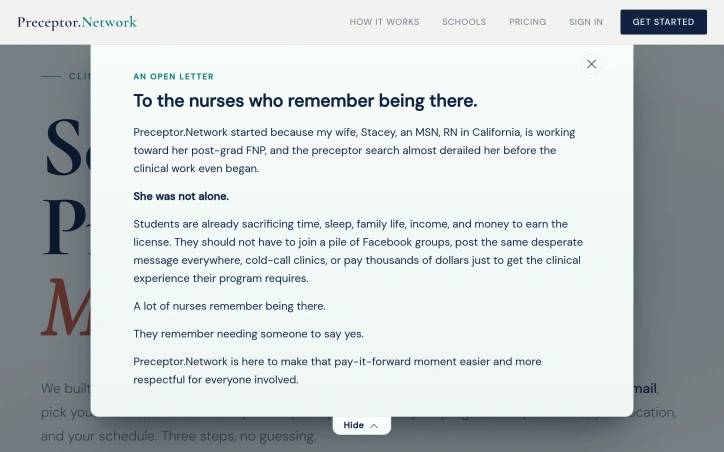
I built Preceptor Network to fix the clinical placement chaos in healthcare education. Students were manually searching for preceptors while coordinators wasted time troubleshooting bad matches. Our intelligent matching engine integrates directly with program requirements, automatically connecting students with qualified preceptors based on specialties, location, and availability.
AI Overview
AI-generatedClinical placement matching represents one of healthcare education's persistent friction points, and Preceptor.Network proposes a direct solution to an unnecessarily manual problem. The platform targets students pursuing advanced nursing and physician assistant credentials—FNP, PMHNP, PA, DNP, and similar programs—who traditionally navigate preceptor recruitment through spreadsheets, department lists, and personal networking. Faculty coordinators simultaneously shoulder the burden of troubleshooting mismatched placements that fail to meet program requirements.
The company's core insight is straightforward: institutional requirements can be codified into matching logic. Rather than treating preceptor directories as glorified listings, Preceptor.Network integrates directly with each school's clinical rules—specialty requirements, minimum hours, accepted credentials—and weights candidate preceptors against those parameters. The matching engine also factors in geographic availability and student location, producing ranked results sorted by fit score rather than undifferentiated lists.
The onboarding flow underscores this automation philosophy. A student provides their school email address; the system recognizes the domain and retrieves their program enrollment automatically. This eliminates form filling and roster uploads. After selecting their course rotation, they receive preceptor recommendations ordered by relevance to their specific requirements. The three-step design feels deliberately friction-minimized, a direct counterpoint to the opaque, coordinator-dependent processes it displaces.
For schools, the value proposition centers on reducing placement fulfillment burden at scale. Once program requirements are configured, the system handles cohorts ranging from twenty to thousands of students without adding administrative overhead. The platform claims to improve through repeated use—each completed match trains recommendations for future cycles.
Pricing for students is direct: ten dollars per confirmed match with no subscription component. The school and preceptor business models remain less explicit, though the architecture suggests a two-sided marketplace where schools configure requirements and preceptors receive filtered requests ordered by relevance.
What's notably absent is data on matching accuracy, program coverage breadth, or current adoption rates. For a product solving a coordination problem in a relatively niche market, these specifics would strengthen confidence in its claims. The email-domain auto-detection is genuinely useful, but the true value depends entirely on whether the matching algorithm actually reduces friction or simply reorders the guesswork it promises to eliminate. That gap between concept and execution remains the critical unknown.
Founder Diary
DevlogThe maker hasn't posted a diary entry yet.
Key Features
Automated Matching Engine
Integrates with each school's clinical rules and weights candidate preceptors against institutional requirements
School Domain Recognition
Auto-detects student enrollment using school email domain, eliminating form filling
Geographic Availability Matching
Factors in geographic availability and student location in recommendation rankings
Requirement Codification
Codifies specialty requirements, minimum hours, and accepted credentials into matching logic
Ranked Results
Produces preceptor recommendations ordered by fit score rather than undifferentiated lists
Use Cases
-
1
Advanced Nursing Students
Eliminates manual spreadsheet-based preceptor recruitment for FNP, PMHNP, PA, and DNP programs
-
2
Faculty Coordinators
Reduces burden of troubleshooting mismatched placements and manual fulfillment
-
3
Large Programs
Handles student cohorts ranging from twenty to thousands without additional administrative overhead
-
4
Multi-Specialty Schools
Automates matching for different specialty requirements, hours, and credentials across program variations
FAQ
How much does Preceptor.Network cost for students? ▾
How does the matching algorithm work? ▾
Do I need to fill out enrollment forms to use Preceptor.Network? ▾
Does the platform improve its recommendations over time? ▾
Pricing
Students pay $10 per confirmed match; school and preceptor pricing models are not explicitly detailed
Tech Stack & Tags
Discussion
No comments yet — be the first!
Join the conversation — sign up to comment.
Sign up freeCommunity Support
Boost this project on Sell With boost
Meet the Founder

"Founder of DDG — The Data Design Group. I design, build, and operate software products focused on se..."
More by R. Davis

More in Medical

ScanSkinAI
We built ScanSkinAI because getting a dermatolog...

AI Doctor Notes
We built an app for people who want to feel more...
Medical Answering Service
I built Medical Answering Service for small and...

Peptide Calculator
Use our peptide calculator to determine peptide...

Navel Moxibustion Wellness Device
I created a wearable moxibustion device to bring...