RadaRadio
- No match
Machine translation — the English original is authoritative.
The Story
RadaRadio is a modern streaming directory that transforms how you discover audio. Instead of endless lists, our smart engine instantly detects your city and recommends hyper-local live stations. Built as a fast Progressive Web App (PWA), you get a native mobile experience—with background play and a favorites list—without downloading anything. Tune in to thousands of global genres directly from your browser
AI Overview
AI-generatedStreaming radio has fragmented across platforms, making it difficult for listeners to find quality broadcasts without subscribing to multiple services or downloading individual station apps. RadaRadio addresses this by functioning as a unified directory and player for radio stations and podcasts, aggregating content from over 150 countries into a single browsable catalog.
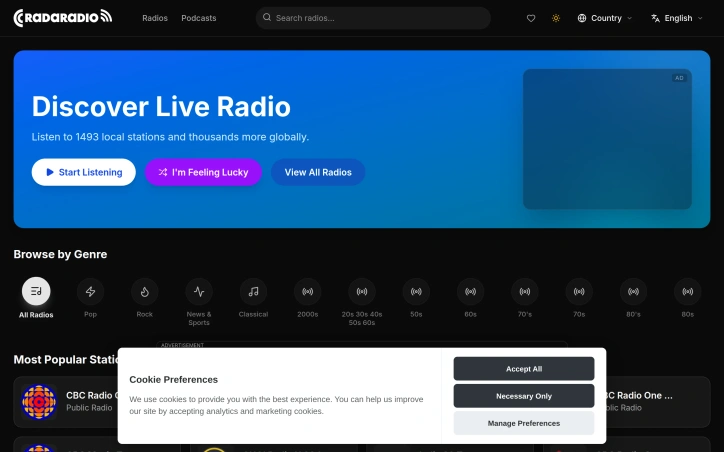
The platform positions itself for radio enthusiasts seeking serendipitous discovery rather than just their favorite stations. This distinction shows in the product's design choices. Beyond the expected search and station browsing, RadaRadio offers a "I'm Feeling Lucky" feature that surfaces random stations, encouraging spontaneous exploration. The interface organizes content through multiple discovery paths simultaneously: by genre (Pop, Rock, Classical, News & Sports), by decade (20s through 90s), and by geography. Users can drill into local stations in specific cities like Montreal and Vancouver, or explore radio across an entire country.
The geographic breadth distinguishes RadaRadio from competitors. The homepage lists nearly 200 countries, from obvious markets like the United States (9,698 stations) and France (2,777 stations) to niche territories with just one or two stations listed. This comprehensive coverage suggests the team indexed radio broadly rather than focusing on a single region or language market. Canada alone represents 1,533 stations, indicating particular depth in the home market.
RadaRadio integrates podcasts alongside live radio, positioning itself as a broader audio streaming alternative to Spotify or Apple Music for listeners who value radio's format. The platform includes major podcast networks—NPR, NBC News, Barstool Sports—signaling an attempt to compete on audio content variety, not just breadth of radio stations.
The product avoids the freemium complexity that plagues many streaming services. No pricing model is mentioned on the homepage, suggesting either a fully free service or a deliberate choice to hide monetization from first-time visitors. This approach lowers friction for trial but raises questions about sustainability.
RadaRadio appeals to a specific audience: radio listeners who have grown frustrated with the death of local radio in their markets, expats seeking home country broadcasts, and audio enthusiasts who view radio as culturally distinct from algorithmic playlists. For travelers, the ability to stream local radio from any country creates genuine utility that generic music services cannot replicate.
The platform's core limitation is execution clarity. A scraped homepage shows features but not user experience; without testing the product, it remains unclear whether the 1,518 stations stream reliably or whether the interface actually delivers the discovery promise the design suggests.
Founder Diary
DevlogThe maker hasn't posted a diary entry yet.
Key Features
Unified Radio Directory
aggregates radio stations and podcasts from over 150 countries into one browsable catalog
I'm Feeling Lucky
surfaces random stations to encourage spontaneous discovery
Multi-Path Organization
content organized by genre, decade, and geographic location
Comprehensive Global Coverage
indexes nearly 200 countries from major markets to territories with single stations
Integrated Podcasts
includes major podcast networks like NPR, NBC News, and Barstool Sports alongside live radio
Use Cases
-
1
Radio Enthusiasts
seeking serendipitous discovery without subscribing to multiple services or apps
-
2
Expats and Travelers
listening to home country broadcasts or local radio from any destination
-
3
Local Radio Explorers
discovering stations in specific cities like Montreal and Vancouver
-
4
Audio Format Seekers
valuing radio's format as distinct from algorithmic playlist services like Spotify
FAQ
How many countries and stations does RadaRadio have? ▾
Does RadaRadio include podcasts? ▾
What discovery methods does RadaRadio offer? ▾
Is RadaRadio free or paid? ▾
Discussion
No comments yet — be the first!
Join the conversation — sign up to comment.
Sign up freeCommunity Support
Boost this project on Sell With boost