Randify
- No match
Machine translation — the English original is authoritative.
The Story
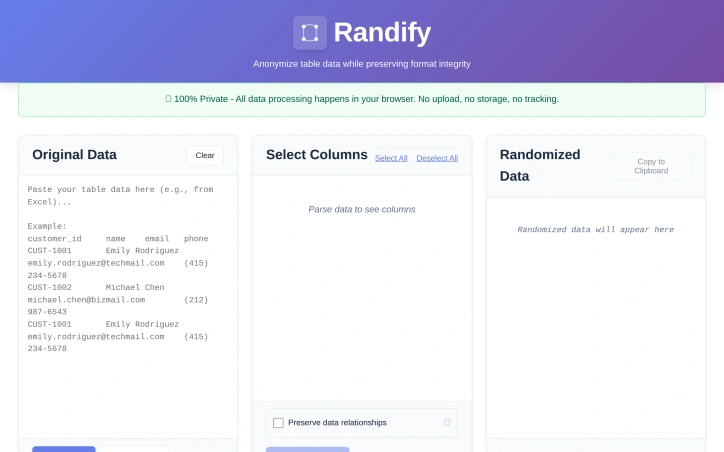
Randify.io is a free, privacy-first web tool that anonymizes sensitive data entirely in your browser with zero uploads to any server. Perfect for HIPAA compliance, testing, and data sharing.
🔒 The Problem It Solves
Organizations need to anonymize PII for testing, demos, or sharing but most tools require uploading sensitive data to third-party servers, creating compliance and security risks. Randify eliminates this by processing everything client-side. Your data never leaves your computer.
🔑 Key Features__
- True Client-Side Processing
- All processing happens in your browser
- Zero server uploads, zero network requests
- Verifiable privacy (check DevTools Network tab)
- Works offline once loaded
- Format-Preserving Randomization
Maintains realistic data formats:
- Names, emails, phone numbers, addresses
- Dates, IDs, numbers with proper formatting
- Preserves data structure and relationships
- Flexible Data Input
Paste data in any format:
- CSV, TSV, table format (Excel/Sheets)
- SQL INSERT statements
- Automatically detects and parses columns
- Customizable Randomization
- Select specific columns to randomize (leave others unchanged)
- Choose randomization type per column (name, email, phone, date, etc.)
- Preserve relationships across rows (same input → same output)
- Control patterns to match your data requirements
- Preview changes before applying
💡 Primary Use Cases
✅ Healthcare: Anonymize patient data for testing (HIPAA-safe)
✅ Finance: Randomize customer data for development (PCI-compliant)
✅ SaaS: Create realistic test data without exposing real users
✅ Data Sharing: Share data structures without exposing PII
✅ Demos: Show products with realistic but fake data
AI Overview
AI-generatedPrivacy-conscious organizations managing sensitive data have long faced a troubling choice: anonymize customer or patient information for testing and demonstrations, or upload it to third-party services and accept the compliance and security risks. Randify eliminates that tension by processing all anonymization within the browser, never transmitting anything to external servers.
The problem it targets is concrete. Development teams, QA engineers, and data analysts regularly need realistic test datasets without exposing actual customer records. Healthcare organizations must anonymize patient data for testing while maintaining HIPAA compliance. Financial services firms need to randomize customer information for development while staying PCI-compliant. SaaS companies want to demonstrate products with convincing but fabricated data. Randify addresses these scenarios through a single architectural commitment: all data stays local.
What distinguishes the tool is its execution of this privacy-first model. It requires no registration and works offline, with zero network requests—users can verify this in their browser's developer console. For organizations subject to data protection regulations, this eliminates an entire class of security and compliance risk.
The feature set reflects genuine practical needs. Rather than indiscriminately scrambling content, Randify lets users specify which columns to randomize and which to preserve, maintaining referential integrity so identical input values consistently produce identical outputs. The tool automatically detects PII patterns including email addresses, phone numbers, dates, names, addresses, and company names, applying appropriate formatting rules during randomization so results look realistic rather than obviously synthetic. It accepts data in multiple formats: CSV, TSV, pasted tables from spreadsheets, and SQL INSERT statements.
Multi-language support for names and regional data patterns demonstrates attention to genuinely global use cases. The ability to preview changes before applying them reduces mistakes and friction.
Randify is free and carries no monetization messaging in available materials, making it an accessible entry point for privacy-conscious teams. For organizations already skeptical of third-party data handling, a purpose-built, client-side-only solution occupies meaningful space in an otherwise server-dependent tooling landscape.
Founder Diary
DevlogThe maker hasn't posted a diary entry yet.
Key Features
Client-Side Processing
All anonymization happens in the browser with zero network requests to external servers.
PII Auto-Detection
Automatically identifies sensitive patterns including emails, phone numbers, names, addresses, and company names.
Selective Randomization
Users specify which columns to randomize while maintaining referential integrity so identical inputs produce identical outputs.
Multiple Data Formats
Accepts CSV, TSV, spreadsheet tables, and SQL INSERT statements.
Preview Before Apply
Users can preview changes before finalizing anonymization to reduce mistakes.
Multi-Language Support
Supports multiple languages for names and regional data patterns.
Use Cases
-
1
Development & QA Teams
Need realistic test datasets without exposing actual customer records or triggering compliance risk.
-
2
Healthcare Organizations
Must anonymize patient data for testing and demonstrations while maintaining HIPAA compliance.
-
3
Financial Services
Need to randomize customer information for development environments while staying PCI-compliant.
-
4
SaaS Companies
Want to demonstrate products with convincing but fabricated data in client presentations.
FAQ
Does Randify upload my data to external servers? ▾
What file formats does Randify accept? ▾
Can Randify automatically detect sensitive information? ▾
Is Randify compliant with data protection regulations? ▾
Pricing
Randify is free with no monetization messaging in available materials.
Tech Stack & Tags
Discussion
No comments yet — be the first!
Join the conversation — sign up to comment.
Sign up freeCommunity Support
Boost this project on Sell With boost