
SwipeToLaunch
- No match
Machine translation — the English original is authoritative.
The Story
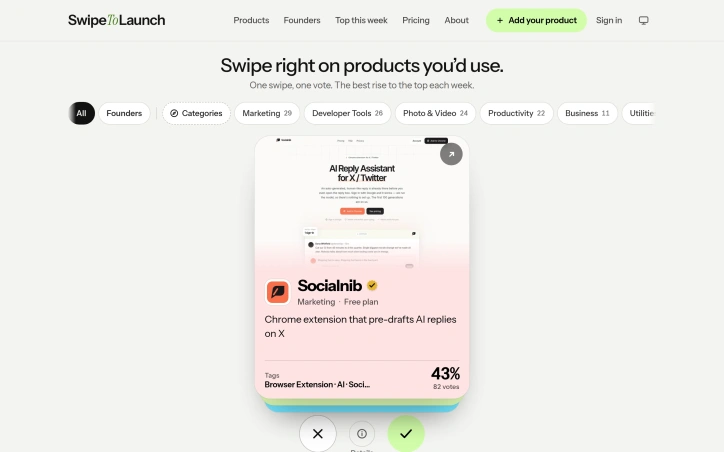
Launch days on most directories turn into an upvote race, where the raw vote count decides the ranking. SwipeToLaunch is a launch directory built around one mechanic instead: swipe. New startups, SaaS products, dev tools and apps appear one card at a time, and visitors swipe right if they like the idea and left if they don't. Every swipe is a vote, no account needed.
The ranking comes from approval, not upvote counts. A product's score is the share of its swipes that said launch, and the board weighs that share against sample size, so 100% from 2 swipes sits below 92% from hundreds. Below 5 swipes a score is labelled Early. One vote per person per product.
For makers:
- Submit with one link and no account; the site drafts the listing from your page
- Free listing: put the SwipeToLaunch badge on your homepage and the listing goes live, with a followed link while the badge is up
- Paid plans, one payment with no renewal: Ship $9 (live today, no badge, permanent followed link), Boost $19 (adds 7 days first in the deck and at the top of the board) and Spotlight $29 (30 days first and pinned on the home page, plus a permanent gold tick)
- A moderator reviews each new listing within about a day
- Every product gets a public listing page, a place in the swipe deck and a spot on the weekly board
Developers and agents can read launch data over REST, MCP and Markdown: https://swipetolaunch.com/developers
AI Overview
AI-generatedA launch directory that replaces the typical upvote race with an approval-rating system stands out for solving a real friction point in product discovery. Most platforms rank by raw vote count, creating an incentive to mobilize networks rather than showcase merit. This one inverts that by measuring what fraction of visitors would actually use each product, then weighing that share against sample size to penalize low-volume noise.
The mechanic is familiar but well-applied: visitors swipe through a deck of new products one card at a time and vote right (would use) or left (wouldn't). Each swipe counts as one vote, no login required, and rankings emerge from approval percentage rather than total votes. A product with 92 percent approval across hundreds of swipes outranks one at 100 percent from just two swipes. This design pulls focus toward genuine user interest instead of network effects or early-timing advantages.
For makers, the submission flow is remarkably frictionless. A single link suffices; the platform auto-generates the listing by scraping the product page. The free tier requires placing a badge on your homepage in exchange for a live listing with a followed backlink. Paid options are one-time charges: nine dollars for immediate listing without badge requirements, nineteen dollars to add a week of deck-first placement, and twenty-nine dollars for a month of prominence plus home-page pinning and a gold marker. A moderator reviews submissions within roughly a day.
The product caters to two distinct audiences. Makers get a discovery channel that rewards genuine appeal over mobilization tactics and straightforward pricing without recurring costs. Visitors benefit from voting influence that actually shapes rankings and a deck reflecting authentic user demand rather than marketing budgets.
Developer access merits mention: the platform exposes launch data through REST APIs, MCP, and Markdown, opening doors to downstream applications. The weekly leaderboard and submission simplicity hint at a direction toward lightweight, voting-first discovery without the friction of more elaborate launch platforms.
The approval-rating mechanic is the core bet. If swipers rate products honestly and the weighting algorithm holds up, the leaderboard will feel like authentic demand. If swipers treat it as casual entertainment, the signal degrades. The platform's success hinges on whether this mechanic sustains genuine voting behavior at scale.
Founder Diary
DevlogThe maker hasn't posted a diary entry yet.
Key Features
Approval-Rating Rankings
Products ranked by approval percentage weighted against sample size rather than total votes
Swipe-Based Voting
Visitors vote right or left on product cards without login required
Auto-Generated Listings
Platform automatically generates listings by scraping product pages from a single submission link
Developer APIs
Launch data accessible through REST APIs, MCP, and Markdown formats for custom integrations
One-Time Pricing
Paid options charged as one-time fees rather than recurring subscriptions
Use Cases
-
1
Product makers
Achieve discovery based on genuine user interest rather than network mobilization ability
-
2
Product seekers
Vote on new products and directly influence rankings through swipe voting
-
3
Developers
Access launch leaderboard data via REST APIs and MCP for downstream applications
FAQ
How much does it cost to list on SwipeToLaunch? ▾
Do I need an account to vote? ▾
How are products ranked? ▾
Can I access the leaderboard data programmatically? ▾
Pricing
Free tier requires homepage badge; paid options are one-time charges starting at $9.
Tech Stack & Tags
Discussion
No comments yet — be the first!
Join the conversation — sign up to comment.
Sign up freeCommunity Support
Boost this project on Sell With boost
Meet the Founder

More in Startup communities

Nick Launches: Product Launches, Tools and Builder Guides
Nick Launches helps developers build and launch...
Launchory
We built Launchory to solve the discoverability...

Vercel Domains
Search, register, and manage domain names with V...

Pro Launch
I built Pro Launch to give startups a platform f...

LaunchStall
I built LaunchStall to solve the discoverability...

LaunchAF
We built LaunchAF to help founders get their pro...