Talking Stick
- No match
Machine translation — the English original is authoritative.
The Story
I created Talking Stick to fix the chaos of group meetings where dominant voices silence others. Using the talking stick principle, only one person can speak at a time, ensuring everyone gets heard equally and discussions stay focused and productive.
AI Overview
AI-generatedMeetings where a handful of voices dominate while others struggle to contribute represent a persistent problem in remote and in-person collaboration. Talking Stick addresses this dynamic by reimplementing a traditional facilitation technique in a digital voice chat environment.
The application enforces a structured speaking model where only one person can actively broadcast at a time. Rather than relying on social dynamics or moderator intervention, the platform's architecture ensures turn-based conversation. This prevents the common scenario where faster talkers, higher-status participants, or louder personalities monopolize discussion time while quieter team members remain sidelined.
The product targets teams and organizations frustrated with inefficient meetings. Workplace groups conducting brainstorming sessions, decision-making discussions, or any meeting where balanced input matters represent the primary use case. Educational settings, community groups, and any collaborative context where equitable participation improves outcomes could benefit from the structure Talking Stick enforces.
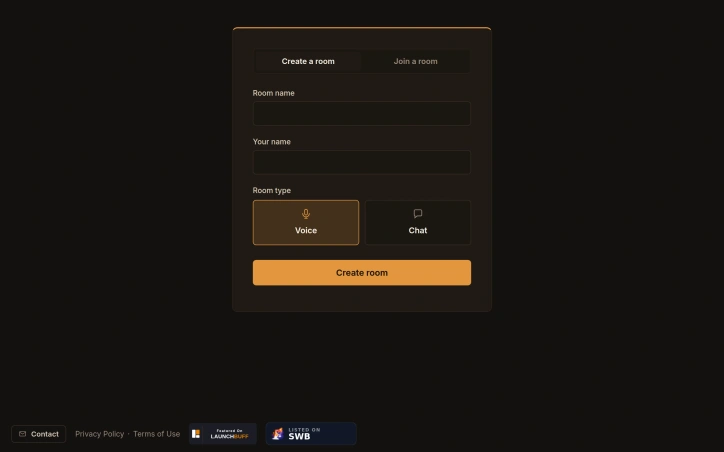
The core features revolve around simplicity. Users create a named room, enter their name, and join voice conversations. The interface assumes minimal setup friction. Room codes enable straightforward participant management. The voice chat foundation provides real-time audio communication while the turn-taking mechanism handles the facilitation layer.
What distinguishes Talking Stick from standard video conferencing platforms is its singular focus on solving one specific meeting problem rather than offering comprehensive communication features. It does not attempt to replace Zoom, Teams, or other all-in-one collaboration suites. Instead, it positions itself as a specialized tool for contexts where meeting equity directly impacts productivity and participant satisfaction.
The talking stick principle itself carries cultural and historical weight, suggesting intentional design rooted in proven facilitation practices rather than arbitrary feature choices. This positioning signals that the founder understands not just the technical problem but the organizational behavior underlying poor meeting dynamics.
The stripped-down web interface and contact email suggest an early-stage project still refining its core value proposition. No pricing information appears publicly, indicating either a free model or pre-launch monetization strategy. The simplicity of the core interaction model suggests the product aims for rapid adoption in contexts where meeting quality matters most, though broader organizational adoption would depend on integration capabilities and team management features not evident from the current presentation.
Founder Diary
DevlogThe maker hasn't posted a diary entry yet.
Key Features
Turn-Based Voice Chat
Only one person can broadcast at a time to prevent conversation monopolization
Room Code Management
Straightforward participant management through simple room codes
Minimal Setup
Users create a room and join voice conversations with minimal friction
Structured Speaking Model
Enforces turn-taking to ensure equitable participation in discussions
Real-Time Audio
Provides real-time audio communication for voice conversations
Use Cases
-
1
Teams and Organizations
Workplace groups conducting brainstorming sessions and decision-making discussions where balanced input matters
-
2
Educational Settings
Schools and learning environments where equitable participant participation improves outcomes
-
3
Community Collaboration
Community groups and collaborative contexts requiring equal voice from all participants
-
4
Meeting-Focused Teams
Organizations frustrated with inefficient meetings where faster talkers or high-status participants monopolize discussion time
FAQ
How does Talking Stick prevent meeting domination? ▾
What is Talking Stick used for? ▾
Is Talking Stick a replacement for Zoom or Teams? ▾
How do I start using Talking Stick? ▾
Tech Stack & Tags
Discussion
No comments yet — be the first!
Join the conversation — sign up to comment.
Sign up freeCommunity Support
Boost this project on Sell With boost