
TickClip
- No match
Machine translation — the English original is authoritative.
The Story
I built TickClip to protect buyers from e-commerce manipulation and deceptive practices. The platform works as a fiduciary decision layer, examining price history, reviews, and seller reputation to recommend whether you should buy, wait, or skip any product—without affiliate conflicts or seller influence. We triangulate evidence from multiple sources so you can make confident purchasing decisions.
AI Overview
AI-generatedE-commerce buyers face a gauntlet of manipulation: phantom discounts, inflated list prices, fake reviews, and seller red flags designed to exploit purchasing decisions. TickClip addresses this head-on by positioning itself as a neutral decision-making layer between shoppers and retailers.
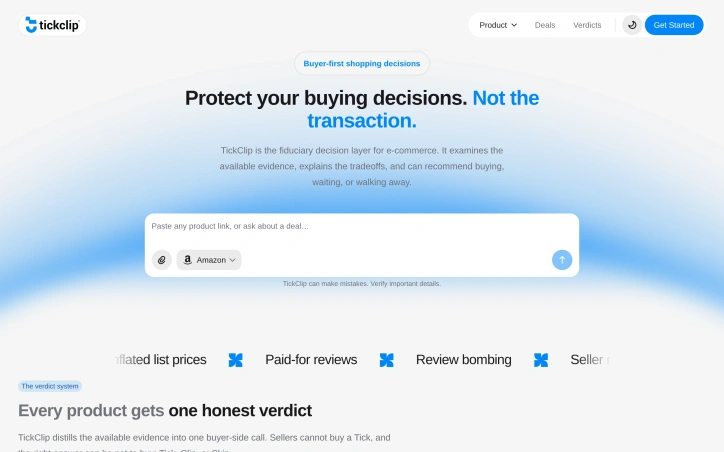
The core premise is straightforward. Users paste a product link from Amazon, Walmart, or Macy's, and TickClip delivers a three-option verdict: Tick (buy now), Clip (wait and watch), or Skip (avoid). Rather than ranking products or optimizing for conversion, the platform examines price history, reviews, and seller reputation to triangulate whether a purchase makes financial sense at that moment. The differentiation is structural. TickClip earns no affiliate commission from retailer links and explicitly forbids sellers from purchasing placement or influencing verdicts. This business model choice is rare in commerce technology and sets it apart from comparison shopping tools designed to reward merchant participation.
The verdict logic addresses legitimate buyer pain points. Price manipulation detection flags phantom discounts and artificially inflated list prices. Review analysis catches paid endorsements and bombing campaigns. Seller context surfaces reputation risks. Each verdict includes supporting evidence—price, timing, demand signals, confidence level, uncertainty—that buyers can inspect themselves, rejecting the black-box recommendation approach common elsewhere. TickClip's willingness to recommend not buying is noteworthy in an ecosystem optimized for transaction velocity.
The product tracks ninety days of price history per item and performs independent checks on each recommendation. The simplicity of the three-option output reduces decision fatigue compared to spreadsheet-based comparison tools. The company operates with no affiliate conflicts, a constraint that limits immediate revenue but strengthens the fiduciary positioning.
Open questions remain around scale and maintainability. The platform relies on triangulating multiple data sources—marketplace prices, review signals, seller ratings—which requires continuous maintenance as retailers change their systems. The product roadmap is not visible from public materials. The seller red flags feature suggests some proprietary methodology, though the details stay opaque.
TickClip taps genuine frustration with e-commerce dishonesty. Its refusal of seller fees and affiliate income is refreshing in a category usually bent toward merchant interests. Whether that independence can scale into a durable business model remains to be tested.
Founder Diary
DevlogThe maker hasn't posted a diary entry yet.
Key Features
Verdict System
Delivers Tick, Clip, or Skip recommendations based on whether a purchase makes financial sense at that moment
Price History Tracking
Monitors 90 days of price history per product to detect phantom discounts and price manipulation
Review Authentication
Analyzes reviews to identify paid endorsements and bombing campaigns
Seller Risk Assessment
Surfaces seller reputation risks and red flags to inform purchase decisions
Transparent Evidence
Displays price, timing, demand signals, confidence levels, and uncertainty for each verdict
No Affiliate Conflicts
Operates without affiliate commissions and forbids sellers from purchasing placement or influencing verdicts
Use Cases
-
1
E-commerce shoppers
Avoid phantom discounts and artificially inflated list prices
-
2
Review-conscious buyers
Identify fake reviews and paid endorsements before making purchases
-
3
Price-aware consumers
Determine optimal timing for purchases using 90-day price history and demand signals
-
4
Integrity-focused shoppers
Shop with a platform that has no financial incentive to push sales
FAQ
Which stores does TickClip work with? ▾
Does TickClip ever recommend not buying? ▾
How far back can TickClip check prices? ▾
Is TickClip paid or free? ▾
Tech Stack & Tags
Discussion
No comments yet — be the first!
Join the conversation — sign up to comment.
Sign up freeCommunity Support
Boost this project on Sell With boost