TKCORE AI

- No match
Machine translation — the English original is authoritative.
The Story
TKCORE AI addresses the problem of AI fragmentation. Elsewhere you chat; here you ship. Tasks that previously required opening five browser tabs, subscribing to three separate services, and constant copy-pasting are streamlined into a single pipeline. Elevator pitch: It is a project-centric AI digital production factory powered by private knowledge bases and integrated with multi-model capabilities.
AI Overview
AI-generatedFragmented AI workflows drain productivity more than the technology itself should. TKCORE AI consolidates what typically demands five browser tabs, three separate subscriptions, and endless copy-pasting into a single workspace—collapsing a two-hour content production cycle into ten minutes.
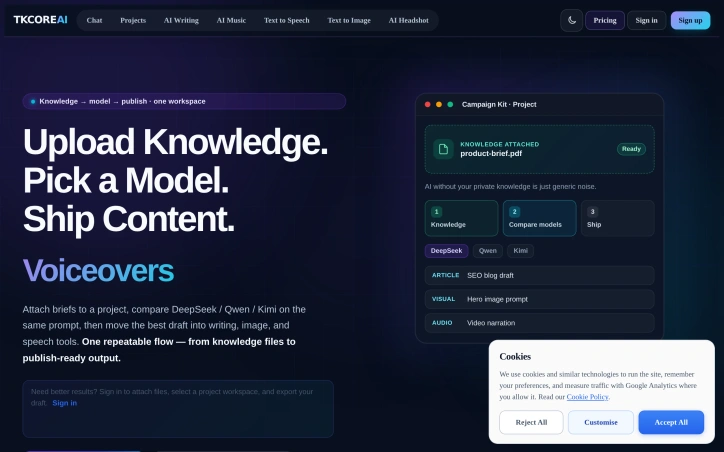
The product targets content teams and marketing departments that produce articles, visuals, and narration from research materials. Rather than shuttling between ChatGPT for writing, a separate image tool, and another service for voiceovers, users attach knowledge files to a project, run prompts across multiple models simultaneously, and route the strongest output into integrated writing, image, and speech tools without ever leaving the platform.
What distinguishes TKCORE AI is its explicit commitment to context persistence and privacy. Project knowledge remains attached to a single workspace rather than scattered across disconnected chats. The company promises not to use prompts or outputs for model training, processing content only to deliver service. Data moves over encrypted connections with contractual safeguards. This matters to organizations that cannot risk proprietary briefs or brand guidelines contaminating a training dataset or leaking across competing projects.
The multi-model comparison engine stands out operationally. Rather than testing DeepSeek, Qwen, and Kimi sequentially in separate interfaces, users compare outputs from all three against the same prompt on a single screen, then promote the best draft downstream. This transforms model selection from guesswork into deliberate evaluation within a single workflow.
The platform supports an expanding roster of models: TkCore-V5.5-Pro, DeepSeek-V4 variants, Qwen models including a vision-enabled version, Kimi K2.5, GLM-5.1, and MiniMax M2.5. This breadth avoids locking users into a single vendor's capabilities. A project generates a research PDF, then produces an SEO blog post, three social posts, and video narration in parallel—all derived from the same knowledge base, all contained within the project boundary.
The comparison between traditional fragmented workflows and TKCORE's model is stark: longer, more error-prone, context-bleeding processes versus tighter, single-interface pipelines. For teams currently outsourcing content production or spending disproportionate time on tool switching rather than creation, the efficiency gain is tangible. The product does not claim to replace human editorial judgment, only to eliminate the logistical overhead that prevents teams from reaching content velocity. That's a narrower and more credible promise than most AI publishing tools make.
Founder Diary
DevlogThe maker hasn't posted a diary entry yet.
Key Features
Multi-Model Comparison
Compare outputs from multiple AI models simultaneously on a single screen instead of testing them sequentially in separate interfaces
Unified Workspace
Consolidates content production tools for writing, image generation, and speech synthesis into one platform eliminating tool switching
Context Persistence
Project knowledge remains attached to a workspace maintaining context across all outputs instead of scattering information across disconnected chats
Privacy & Encryption
Data is never used for model training, processed only to deliver service, with encrypted connections and contractual safeguards
Parallel Content Generation
Generate multiple content types including blog posts, social posts, and video narration simultaneously from the same knowledge base
Multi-Model Support
Access a roster of AI models including TkCore-V5.5-Pro, DeepSeek-V4, Qwen, Kimi K2.5, GLM-5.1, and MiniMax M2.5
Use Cases
-
1
Content Teams
Reduce two-hour content production cycles to ten minutes by consolidating five browser tabs and three separate subscriptions into one workspace
-
2
Marketing Departments
Produce articles, visuals, and narration from research materials within a single interface without shuttling between multiple services
-
3
Organizations with IP Concerns
Protect proprietary briefs and brand guidelines from contaminating training datasets or leaking across competing projects
-
4
Companies Reducing Outsourcing
Bring content production in-house by eliminating logistical overhead that prevents teams from reaching content velocity
FAQ
How do I compare different AI models? ▾
Is my data used for AI model training? ▾
What AI models does TKCORE support? ▾
Can I generate multiple types of content from one source? ▾
Tech Stack & Tags
Discussion
No comments yet — be the first!
Join the conversation — sign up to comment.
Sign up freeCommunity Support
Boost this project on Sell With boost
Meet the Founder

More in AI notetakers

Lynote
I built Lynote because AI-generated text sounds...

aipen.ink
Turn AI answers & math into hyper-realistic hand...

Corder. The Mac recorder with no bot in the call
Record any meeting on macOS. Speakers labelled,...

Aripsy
I built Aripsy to solve the tedious process of c...
Inkgest
Inkgest is an agentic writing tool for content c...

Merry AI
We built Merry AI to give clinicians their eveni...