
AI Visibility Audit
- No match
Machine translation — the English original is authoritative.
The Story
We are building INITE to help businesses simplify daily operations with AI. Our goal is to reduce repetitive work, connect customer communication with business workflows, and make powerful software easier to use.
AI Overview
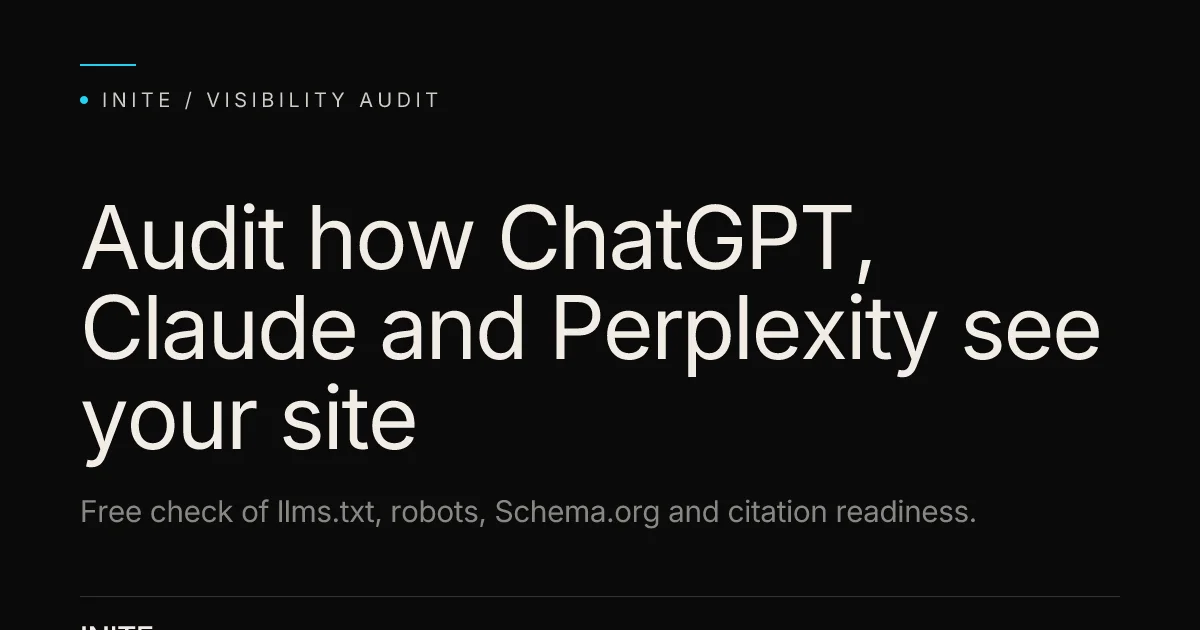
AI-generatedBillions of queries flow through AI assistants like ChatGPT and Claude each day, yet most websites never appear in the results. This audit addresses that gap by measuring how visible websites are to AI systems.
The service targets website owners and marketers concerned with AI discoverability. Rather than guessing why a website might be excluded from AI answers, the audit pinpoints the exact obstacles blocking visibility.
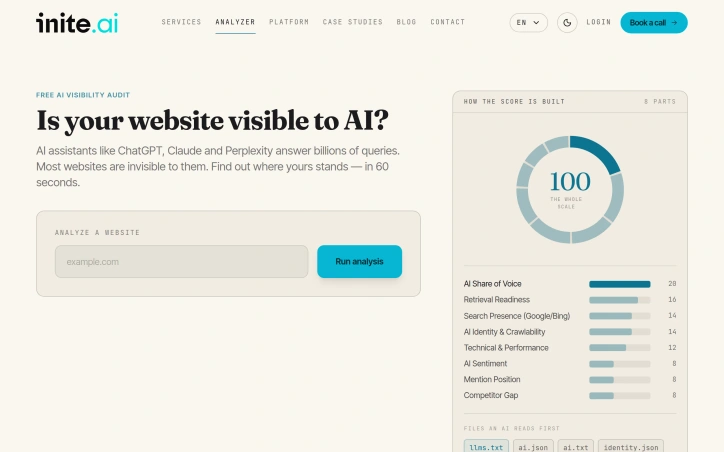
The methodology is comprehensive. The tool checks whether AI crawlers like GPTBot have permission to index the site, examines identity files that AI systems read first (such as ai.json and llms.txt), and evaluates the technical infrastructure underlying the website. It then tests what AI models actually say when asked about the brand, comparing that against competitor mentions. The audit scores visibility across eight dimensions—retrieval readiness, search presence, technical performance, AI sentiment, mention position, and others—with each component weighted as part of a larger 100-point scale.
What distinguishes this service is its specificity. Rather than offering generic SEO advice, it traces the path an AI assistant takes when researching a topic: verifying crawler access, identifying the company, and finding quotable content. When visibility is low, the report identifies which step failed, making remediation concrete rather than speculative.
The platform walks through six stages during an audit. It fetches the live website and samples surrounding content, reads the site's metadata and schema structure, assesses whether retrieval is actually possible, runs live queries across answer engines, scores the results, and generates an action plan with specific files to implement. The audit can be run once as a baseline or repeated weekly for ongoing monitoring.
The action plan component focuses on implementation. Rather than abstract recommendations, it specifies which files to create or modify—from standard files like robots.txt to AI-specific ones like llms.txt. This makes the findings immediately actionable for technical teams.
The founding team frames this work within a broader mission to help organizations use AI to reduce repetitive operational tasks and improve how teams communicate with customers. For businesses relying on AI-driven discovery, the audit addresses a critical but often overlooked gap: being present in the systems people actually consult when making decisions.
Founder Diary
DevlogThe maker hasn't posted a diary entry yet.
Key Features
Crawler Access Verification
Checks whether AI crawlers like GPTBot have permission to index the site.
Identity File Analysis
Examines identity files such as ai.json and llms.txt that AI systems read first.
Multi-Dimensional Scoring
Scores visibility across eight dimensions with each component weighted as part of a 100-point scale.
Live Query Testing
Runs live queries across answer engines to test what AI models actually say about your brand.
Actionable Implementation Plan
Specifies which files to create or modify, making remediation concrete for technical teams.
Flexible Monitoring
Can be run once as a baseline or repeated weekly for ongoing performance tracking.
Use Cases
-
1
Website Owners
Measure how visible their website is to AI systems and discover why they might not appear in AI-generated answers.
-
2
Marketers
Pinpoint the exact obstacles blocking AI visibility rather than guessing at generic SEO improvements.
-
3
AI-Dependent Businesses
Ensure presence in the systems that people actually consult when researching topics and making decisions.
FAQ
What does the AI Visibility Audit actually check? ▾
How is my AI visibility scored? ▾
What kind of action plan will I receive? ▾
Can I monitor my visibility over time? ▾
Discussion
No comments yet — be the first!
Join the conversation — sign up to comment.
Sign up freeCommunity Support
Boost this project on Sell With boost
Meet the Founder

More in SEO tools
LinkNest
I noticed SEO professionals and independent blog...
Daybreaker.ai
Stop tracking random prompts. Find the exact pro...

Ai Visibility Audit
Businesses increasingly appear in AI-powered sea...

ClaroRank
I built ClaroRank to provide honest SEO tool rev...
Productivity tools
Toolvio is a modern platform of fast and useful...
Decyde
I built Decyde to help businesses track their AI...