
Cloud GPU Rating

- No match
Machine translation — the English original is authoritative.
The Story
I built Cloud GPU Rating to solve the opacity in GPU cloud pricing and provider selection. We provide independent benchmarks, verified specs, and transparent hourly rates from 12+ verified cloud providers without affiliate markup, helping teams make informed decisions for AI and HPC workloads.
AI Overview
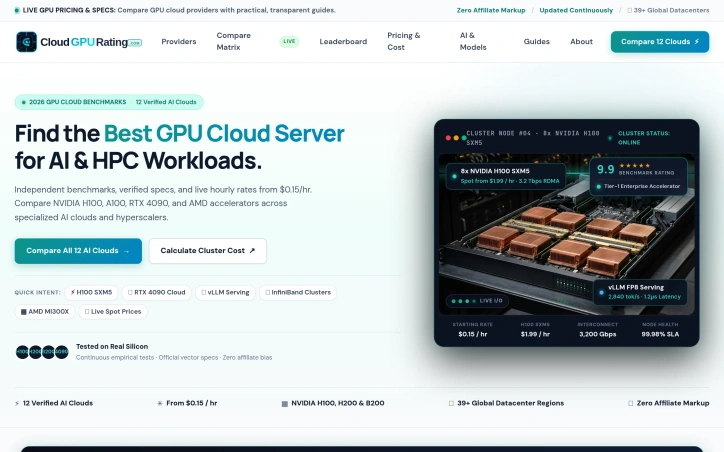
AI-generatedChoosing a GPU cloud provider for AI or high-performance computing projects involves navigating a fragmented market where pricing opacity and inconsistent specifications make comparison difficult. Cloud GPU Rating addresses this friction by providing a centralized, independent comparison platform that aggregates live pricing, verified performance benchmarks, and detailed specifications across 12 major cloud providers spanning 39 global datacenters.
The platform's core strength lies in its commitment to transparency. It explicitly operates without affiliate markup, a distinction that differentiates it from many comparison sites that monetize through hidden kickbacks. Instead, it presents real hourly rates pulled directly from providers, starting from $0.15 per hour for base compute and scaling upward depending on GPU architecture and configuration. This straightforward approach gives technical teams an immediate sense of cost structure without obscured pricing layers.
The benchmarking methodology sets it apart further. Rather than relying solely on manufacturer specifications, the platform tests on actual hardware, measuring real-world performance metrics for popular accelerators including NVIDIA H100, H200, and B200 chips alongside consumer-grade options like RTX 4090. This empirical approach is valuable for teams evaluating vLLM serving, inference latency, or large-scale training workloads where theoretical specs diverge from production performance.
Feature-wise, the platform covers multiple dimensions of the selection problem. It catalogs supported GPU types by provider, datacenter availability across regions, infrastructure specifications like interconnect bandwidth, and service reliability metrics such as SLA percentages. A cluster cost calculator helps teams model multi-node expenditures, a practical addition for enterprise workloads. The interface also highlights quick-intent searches, allowing users to filter by specific use cases like distributed inference or InfiniBand clusters.
The product targets technical procurement teams, ML engineers evaluating infrastructure costs, and companies scaling AI operations. The breadth of providers included spans specialized cloud vendors optimized for AI workloads alongside established hyperscalers, so both startup-focused and enterprise audiences find relevant options.
The main limitation is that while the platform excels at price and spec transparency, there is no indication it evaluates subjective factors like customer support quality, API usability, or deployment friction. The review process appears purely technical, leaving teams to assess operational fitness separately.
Founder Diary
DevlogThe maker hasn't posted a diary entry yet.
Key Features
Independent Comparison Platform
Aggregates live pricing and verified performance benchmarks across 12 major cloud providers spanning 39 global datacenters.
Transparent Pricing Model
Displays real hourly rates pulled directly from providers starting from $0.15 per hour without affiliate markup.
Real-World Performance Testing
Tests actual hardware to measure performance metrics for NVIDIA H100, H200, and B200 chips alongside consumer-grade options.
Cluster Cost Calculator
Models multi-node expenditures for enterprise AI workloads.
Comprehensive Infrastructure Data
Catalogs GPU types, datacenter availability, interconnect bandwidth, and SLA percentages by provider and region.
Use Cases
-
1
Technical Procurement Teams
Evaluate GPU cloud providers with transparent pricing and verified benchmarks to inform infrastructure procurement decisions.
-
2
ML Engineers
Compare infrastructure costs and real-world performance for workloads like vLLM serving, inference latency, and large-scale training.
-
3
Companies Scaling AI Operations
Model multi-node costs and identify optimal provider configurations across global datacenters.
FAQ
How does Cloud GPU Rating avoid conflicts of interest? ▾
What makes Cloud GPU Rating's benchmarks different? ▾
Can I filter GPUs by my specific use case? ▾
What subjective factors does Cloud GPU Rating evaluate? ▾
Tech Stack & Tags
Discussion
No comments yet — be the first!
Join the conversation — sign up to comment.
Sign up freeCommunity Support
Boost this project on Sell With boost