Elvish Translator
- No match
Machine translation — the English original is authoritative.
The Story
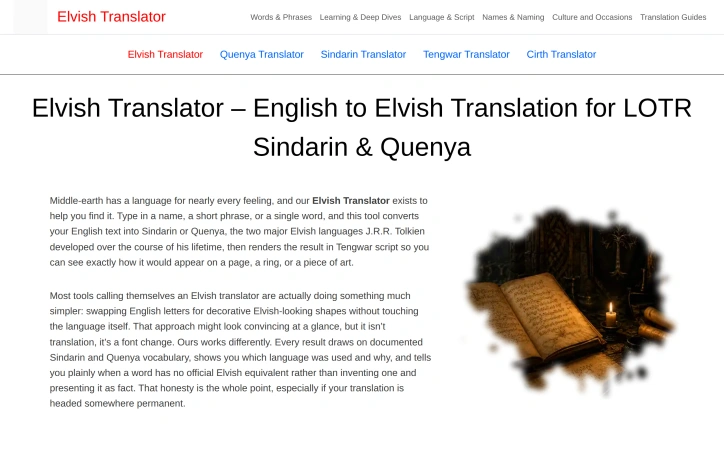
I built Elvish Translator because existing tools were just decorative font changes, not real translations. I wanted something that used actual documented Sindarin and Quenya vocabulary, with honesty about language choice and when no official translation exists. It's perfect for anyone creating permanent Elvish text—from ring inscriptions to tattoos—who needs authenticity.
AI Overview
AI-generatedTranslation into Sindarin and Quenya has long been plagued by imposters masquerading as genuine converters. Elvish Translator cuts through the noise by delivering actual linguistic work rather than the decorative font substitutions that dominate the space.
The problem the tool addresses is specific but real: anyone creating permanent Elvish text—whether for a tattoo, jewelry inscription, or artistic project—needs confidence that what they're marking is authentic, not an invented approximation. Existing tools typically swap English letters for Elvish-looking characters without touching the underlying language. The Elvish Translator takes a fundamentally different approach, building translations from documented Sindarin and Quenya vocabulary that Tolkien himself established over decades as a professional philologist.
What distinguishes this product is its commitment to transparency. The tool makes clear which language is being used and why, a critical distinction that most competitors ignore. Sindarin, the everyday Elvish speech throughout The Lord of the Rings, draws from Welsh phonology and offers conversational flow. Quenya, derived from Finnish and Latin structures, carries ceremonial weight better suited to formal titles and songs. A translation tool that blends these languages without distinction misleads users into thinking they have authentic Sindarin or Quenya when they actually have neither.
Perhaps most striking is the tool's willingness to admit when no official translation exists. Rather than inventing vocabulary and presenting it as documented fact, the Elvish Translator labels such gaps honestly. This restraint matters enormously for permanent applications where authenticity justifies the effort.
The core functionality is straightforward: users input English text and receive Sindarin or Quenya translations rendered in Tengwar script, the actual writing system Tolkien developed for the Elvish languages. The tool supports multiple input languages and offers basic features like copy and speak options. The interface provides a 500 character limit, appropriate for the short phrases and individual words the tool is built for.
The product serves a narrow but dedicated audience: Tolkien enthusiasts who prioritize linguistic authenticity over convenience, creative professionals making permanent work, and anyone who understands that not all Elvish-shaped text is actually Elvish. For that audience, the tool delivers on substance rather than flash. It succeeds precisely where other Elvish translators fail: by respecting both the languages themselves and the people creating permanent expressions in them.
Founder Diary
DevlogThe maker hasn't posted a diary entry yet.
Key Features
Authentic Translation
Builds translations from documented Sindarin and Quenya vocabulary established by Tolkien, not decorative font substitutions
Tengwar Rendering
Outputs translations in Tengwar script, the actual writing system Tolkien developed for Elvish languages
Language Transparency
Clearly distinguishes between Sindarin (Welsh-based, conversational) and Quenya (Finnish/Latin-based, ceremonial) rather than blending them
Translation Honesty
Labels gaps honestly when no official translation exists rather than inventing vocabulary and presenting it as documented
Multi-Language Input
Supports multiple input languages for translation into Elvish
Copy and Speak
Provides copy and speak options for sharing and pronunciation of rendered translations
Use Cases
-
1
Tattoo and Permanent Marking
Users creating permanent Elvish text need confidence that what they're marking is authentic, not an invented approximation
-
2
Jewelry Inscription
Permanent engravings require verified authenticity so users know the work is based on Tolkien's documented linguistics
-
3
Artistic Projects
Creative professionals making permanent Elvish work prioritize linguistic authenticity and scholarly grounding over convenience
-
4
Tolkien Enthusiasts
Dedicated fans who understand that not all Elvish-shaped text is actually Elvish and value genuine linguistic work
FAQ
What's the difference between Sindarin and Quenya? ▾
How is this different from other Elvish translators? ▾
What happens if there's no official translation for my text? ▾
What writing system does it use? ▾
Tech Stack & Tags
Discussion
No comments yet — be the first!
Join the conversation — sign up to comment.
Sign up freeCommunity Support
Boost this project on Sell With boost