#translation Startups & Tools
Discover the best translation startups, tools, and products on SellWithBoost.

Translation into Sindarin and Quenya has long been plagued by imposters masquerading as genuine converters. Elvish Translator cuts through the noise by delivering actual linguistic work rather than the decorative font substitutions that dominate the space. The problem the tool addresses is specific but real: anyone creating permanent Elvish text—whether for a tattoo, jewelry inscription, or artistic project—needs confidence that what they're marking is authentic, not an invented approximation. Existing tools typically swap English letters for Elvish-looking characters without touching the underlying language. The Elvish Translator takes a fundamentally different approach, building translations from documented Sindarin and Quenya vocabulary that Tolkien himself established over decades as a professional philologist. What distinguishes this product is its commitment to transparency. The tool makes clear which language is being used and why, a critical distinction that most competitors ignore. Sindarin, the everyday Elvish speech throughout The Lord of the Rings, draws from Welsh phonology and offers conversational flow. Quenya, derived from Finnish and Latin structures, carries ceremonial weight better suited to formal titles and songs. A translation tool that blends these languages without distinction misleads users into thinking they have authentic Sindarin or Quenya when they actually have neither. Perhaps most striking is the tool's willingness to admit when no official translation exists. Rather than inventing vocabulary and presenting it as documented fact, the Elvish Translator labels such gaps honestly. This restraint matters enormously for permanent applications where authenticity justifies the effort. The core functionality is straightforward: users input English text and receive Sindarin or Quenya translations rendered in Tengwar script, the actual writing system Tolkien developed for the Elvish languages. The tool supports multiple input languages and offers basic features like copy and speak options. The interface provides a 500 character limit, appropriate for the short phrases and individual words the tool is built for. The product serves a narrow but dedicated audience: Tolkien enthusiasts who prioritize linguistic authenticity over convenience, creative professionals making permanent work, and anyone who understands that not all Elvish-shaped text is actually Elvish. For that audience, the tool delivers on substance rather than flash. It succeeds precisely where other Elvish translators fail: by respecting both the languages themselves and the people creating permanent expressions in them.
Communication across languages often breaks down not just linguistically but tonally. What someone means in their native language can feel awkward, overly formal, or unintentionally blunt when expressed in another tongue. Verbia addresses this friction with a browser extension designed to bridge the gap between intent and expression in text-based conversations. The product targets multilingual communicators, people who experience tone anxiety in writing, and anyone spending significant time responding on platforms like Gmail, Reddit, WhatsApp Web, Outlook, and QQ Mail. Rather than forcing users to leave the conversation and rebuild context in a separate tool, Verbia integrates directly into the communication flow, making the assist feel native to how people actually work. The core proposition centers on automation paired with human agency. The extension detects conversation context automatically on supported platforms, but always surfaces everything for review. Users express their meaning in any language and specify a desired tone, and Verbia generates a draft grounded in the detected context. This emphasis on human review at every stage positions the tool as an augment to judgment rather than a replacement. Three input modes adapt to different platforms. Automatic Mode handles detection on major services without intervention. For webmail, an AI Identify feature lets users request correction when needed. On other websites, Universal Mode lets users manually select the context text themselves. This tiered approach avoids the friction that limits many writing assistants, which force users into a single workflow regardless of platform. The product demonstrates particular strength in its scope and framing. Rather than positioning itself as a general AI chatbot alternative, it focuses narrowly on one task: turning what you already mean into something that reads naturally in context. The comparison to ChatGPT is instructive. ChatGPT can write replies but requires users to manually rebuild the entire situation, adding multiple steps before producing something usable. By detecting context, accepting voice or text input, and staying within the original application, Verbia eliminates unnecessary overhead. The walkthrough reveals thoughtful product design. Language support spans at least English and Chinese. Tone adaptation lets users control register. Draft review happens before anything gets sent. Integration into existing workflows keeps cognitive load low. What remains unclear is monetization. The website doesn't mention pricing or subscription details, making it difficult to assess value relative to free or cheaper alternatives.

Communication across language barriers typically demands friction: copying text between applications, waiting for translation services to process, losing conversational flow. Lispr addresses this by collapsing the entire workflow into a single gesture—hold a key to dictate, tap a second key mid-speech to translate, and watch the text appear directly at your cursor in any application. The product serves anyone who regularly switches between languages or dictates extensively, whether composing WhatsApp messages in Spanish, writing Slack threads in Portuguese, or taking notes in French. Built by Codebridge, it eliminates the context-switching that characterizes existing solutions: no jumping between apps, no chat interfaces cluttering your workspace, no account creation required. What distinguishes Lispr is execution speed combined with aggressive scope minimization. Dictation completes in under a second, translation follows within roughly 700 milliseconds. This isn't aspirational—the product targets actual responsiveness, not theoretical performance. The feature set reflects this focus: plain dictation, translation into 32 native languages, custom vocabulary support for product names or domain-specific terms, and clipboard-aware insertion that restores whatever you'd previously copied. It works identically everywhere a cursor blinks, from terminal emulators to design tools to text editors. The technical choices reinforce privacy defaults. Lispr uses Whisper's large-v3-turbo model and requires no account creation or persistent connectivity. Every release receives Apple's notarization process, which scans for malware and eliminates security warnings on installation. The entire application consumes roughly 17 megabytes. Lispr's business model stands out primarily for its absence—the application is free. The founder emphasizes eliminating friction rather than monetizing it. This positions Lispr differently from Wispr and Flow, competitors that charge either subscription or upfront fees for similar functionality. Whether this free model scales depends on factors outside the visible product, but it currently represents a significant advantage for adoption. The interface philosophy mirrors the core insight: a menu bar presence, push-to-talk activation, and zero visual clutter. Speech language detection operates across roughly 99 languages, though translation output targets the 32 languages listed. This constraint reflects pragmatic design rather than accidental limitation—supporting everything weakens everything. For users who spend time moving between languages or dictating across multiple applications, Lispr substantially reduces both time spent typing and cognitive overhead. It targets a specific workflow and executes within that scope with discipline.

Communicating across borders grows harder as businesses expand internationally, especially when managing conversations in different languages across platforms like WhatsApp and Telegram. TranAI addresses this friction by combining customer relationship management with real-time translation, targeting small business owners, support teams, and companies navigating cross-border commerce. The platform's strength lies in its free tier. Rather than paywalling core features, TranAI offers genuine capabilities without requiring a credit card, including multi-account management, broadcast messaging, scheduled sends, and group joining automation. These address real needs for entrepreneurs managing customer interactions at scale without upfront investment. Real-time translation stands as the core differentiator. Supporting over 20 platforms and 200 languages, TranAI enables users to chat with customers in Spanish, Arabic, or other languages without switching apps or managing separate conversations. Voice synthesis and voice cloning allow businesses to maintain personality in customer interactions despite geography, addressing a practical gap that most translation tools ignore. The CRM functionality adds practical value beyond translation alone. Smart number filtering, cold messaging to non-contacts, unlimited message pinning, and privacy blur (auto-concealing sensitive customer information in screenshots) directly address pain points for teams managing lead databases and customer relationships. A quick-reply system helps support staff respond faster to recurring questions, compounding the time savings from consolidated account management. The freemium model reveals TranAI's confidence in its free offering, with premium translation services available for advanced capabilities. This positioning avoids the trap of "free trials that do almost nothing," instead building product momentum through genuine utility that works immediately upon signup. Testimonials from real estate agents, small business owners, and export managers suggest the tool resonates across different use cases. A customer support lead highlights hours saved daily through multi-account consolidation, while an export manager emphasizes translation reliability for maintaining fluent conversations with international clients. The product solves a concrete problem—enabling communication at scale across languages and platforms—without the complexity or cost competitors demand. For global-minded entrepreneurs or multinational businesses with lean operations teams, TranAI delivers immediate practical value without the typical friction of enterprise software adoption.
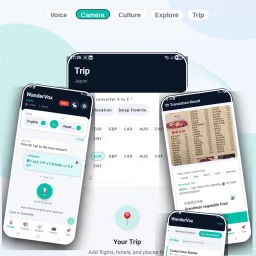
Traveling to foreign destinations can be a daunting experience, especially when language barriers hinder communication and navigation. WanderVox addresses this issue head-on, catering to travelers seeking to immerse themselves in local cultures. At its core, the app solves the problem of language barriers, enabling users to communicate effectively and discover hidden gems that often elude tourists. What stands out about WanderVox is its comprehensive approach to travel facilitation. It integrates multiple features that work together seamlessly to provide a holistic travel experience. The app's voice translation capability allows for instant speech-to-speech translation in 49 languages, facilitating real-time conversations with locals. The smart camera feature uses AI to detect and translate text from images, making it easier to understand menus, signs, and documents. The app's cultural guidance is another notable aspect, offering users essential local phrases, etiquette tips, and cultural insights for 51 destinations. This information is cached offline, ensuring access even without a signal. Additionally, the AI-curated local recommendations surface hyper-local suggestions, such as street food stalls and secret viewpoints, that are tailored to the user's location. WanderVox also includes a trip planner that organizes bookings, places, and reminders into a dated itinerary, complete with live currency conversion and booking reminders. Notably, Android users can translate typed text offline via on-device ML Kit, although voice and camera translation require a connection. The app is free to start, with availability on Google Play and a promised iOS release. By providing a robust set of features that cater to various aspects of travel, WanderVox positions itself as a valuable companion for travelers seeking an authentic experience.

Evaluating AI infrastructure tools sprawls across dozens of specialized vendors, pricing models, and documentation sites, creating significant friction for teams assembling their tech stack. Infrabase.ai consolidates this fragmentation into a single directory organized by functional category—vector databases, prompt engineering tools, observability platforms, inference APIs, and more—making it possible to compare options within each domain without hunting across the web. The directory serves builders deciding which AI infrastructure components to adopt: founders prototyping at seed stage, engineering teams scaling inference and observability, and architects selecting vector database solutions. The categories span the full infrastructure stack, from foundational services like vectorization and embedding APIs to higher-order tools for prompt management, agent monitoring, and evaluation frameworks. What distinguishes Infrabase from generic tool aggregators is the specificity of its curation. Each category contains substantive options rather than purely aspirational listings. The directory emphasizes practical attributes: it flags open-source projects alongside commercial offerings, marks free trial availability, and acknowledges the diversity of deployment models—serverless, self-hosted, EU-sovereign—relevant to different organizational constraints. This matters because infrastructure decisions often turn on operational characteristics like data residency and cost scaling, not just feature parity. The founder built Infrabase from direct experience evaluating infrastructure for a real project, accumulating working lists of products and technical notes substantial enough to justify sharing. This origin explains the site's practical bias. Rather than listing every tangential tool, it focuses on products that demonstrably function within specific categories. The selection acknowledges that the AI infrastructure market extends far beyond dominant cloud providers, a reality that reshapes purchasing power for teams taking AI seriously. The directory's limitations stem from its breadth. With sixty-one inference APIs, twenty vector databases, and comparable volumes across categories, individual product comparisons flatten into metadata. Users cannot evaluate full feature matrices, benchmark results, or integration patterns within the directory itself. The site succeeds by redirecting focus to vendor pages rather than attempting comprehensive comparison. For teams in early evaluation stages this works appropriately; for detailed diligence it points the right direction without replacing specialized analysis.
Streaming content across borders often creates a subtitle problem: foreign-language shows either come with no English subtitles, or viewers miss the challenge of engaging with original-language dialogue. Netflix Live Translator solves this by intercepting Netflix subtitles in real-time and replacing them with translations in any of 106 languages, letting viewers watch without missing dialogue or context. The extension targets language learners, international viewers, and anyone seeking content access beyond what Netflix's built-in subtitle options provide. What distinguishes this tool from other subtitle translation extensions is its architecture: it runs entirely in the browser with no backend server, no account creation, and no data collection. The developer has committed to privacy by design—your API key never leaves your browser and only communicates directly with Google's translation API. The workflow is deliberately minimal. Users select source and target languages from a popup, and the extension automatically detects subtitles on screen, translates them via Google Cloud, and replaces the originals instantly. A caching system prevents redundant API calls for repeated subtitle lines, reducing both latency and translation costs. The economic model relies on users bringing their own Google Cloud credentials. Google's free tier provides 500,000 characters per month—approximately sixteen feature-length films—enough for casual viewers at no cost. With only ten reported users and no ratings on the Chrome Web Store, Netflix Live Translator remains a niche utility. The extension launched in February 2026 and carries minimal friction for adoption: installation requires only a straightforward API key setup, which the developer guides users through directly in the interface. The developer operates it as a free project funded by optional donations, signaling this is more passion project than commercial venture. For viewers frustrated by subtitle limitations on Netflix or language learners seeking immersive practice, the tool addresses a genuine gap. Its browser-native architecture avoids the privacy and latency concerns of server-dependent translators, and the zero-cost base model removes financial barriers for eligible users. The main constraint is dependency on Google Cloud's free tier—once exhausted, users must fund their own API calls—but for casual use, the offering remains practical.

Breaking down language barriers during real-time conversations has long been a friction point for globally distributed teams, and Audilate directly addresses this challenge. The platform combines AI-powered speech transcription with simultaneous translation across over 100 languages, making it a practical solution for organizations where meetings, interviews, and collaborative discussions frequently span multiple geographies and language groups. The core value proposition centers on eliminating the lag and complexity that typically come with asynchronous translation workflows. Rather than recording conversations and processing them after the fact, Audilate delivers live transcription and translation, allowing participants to collaborate without stopping to manage language gaps. This is particularly relevant for companies hiring internationally, conducting cross-border partnerships, or operating distributed teams where English is not universally spoken as a first language. What distinguishes the product is its breadth of language support. With coverage across 100+ languages, the platform moves beyond serving just major language pairs and opens functionality to teams working in less commonly supported languages. This scope suggests the founders recognize that global collaboration extends well beyond English-to-Spanish or English-to-Mandarin scenarios. The integration of transcription and translation in a single workflow is also noteworthy—separate tools for these functions create unnecessary switching costs and synchronization challenges. The positioning emphasizes real-time processing, which is critical for the use cases mentioned. Whether facilitating a live meeting between team members in different countries, conducting remote interviews with international candidates, or enabling seamless cross-border conversations, the speed at which transcription and translation occur directly impacts usability. Delays of even a few seconds can derail natural conversation flow. The product targets organizations serious about global teamwork, particularly those for whom language support has become a competitive advantage or operational necessity. This includes multinational corporations, international service providers, distributed startups, and any team conducting work across language boundaries on a regular basis. The emphasis on meetings and interviews suggests the founders see their strongest initial adoption among HR, engineering, and business development functions that routinely conduct cross-language conversations. One practical consideration for potential users is how the platform integrates with existing communication infrastructure—meetings apps, video conferencing tools, and collaboration platforms—though those implementation details fall outside the scope of what's presented here. The foundational premise, however, is sound: removing language as a barrier to real-time collaboration remains a genuine problem for many organizations.