Netflix Live Translator

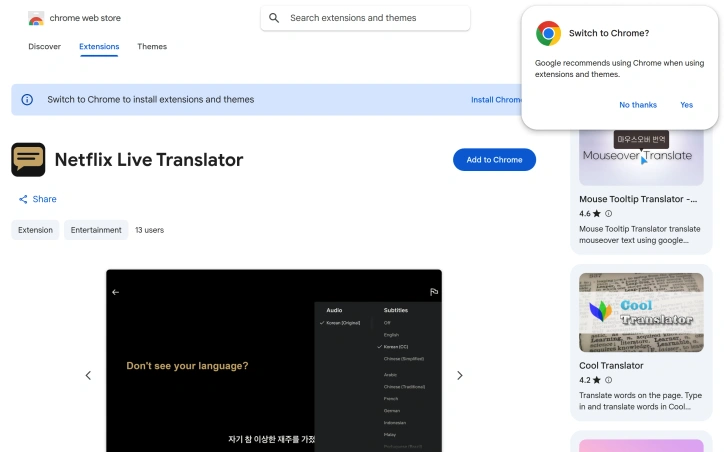
- No match
Machine translation — the English original is authoritative.
The Story
When I'm traveling and watching Netflix, there are so many good shows and movies I would like to watch but there's no English subtitles.
So I built Netflix Live Translator – it allows you to take any Netflix subtitle language and translate it into your preferred language.
AI Overview
AI-generatedStreaming content across borders often creates a subtitle problem: foreign-language shows either come with no English subtitles, or viewers miss the challenge of engaging with original-language dialogue. Netflix Live Translator solves this by intercepting Netflix subtitles in real-time and replacing them with translations in any of 106 languages, letting viewers watch without missing dialogue or context.
The extension targets language learners, international viewers, and anyone seeking content access beyond what Netflix's built-in subtitle options provide. What distinguishes this tool from other subtitle translation extensions is its architecture: it runs entirely in the browser with no backend server, no account creation, and no data collection. The developer has committed to privacy by design—your API key never leaves your browser and only communicates directly with Google's translation API.
The workflow is deliberately minimal. Users select source and target languages from a popup, and the extension automatically detects subtitles on screen, translates them via Google Cloud, and replaces the originals instantly. A caching system prevents redundant API calls for repeated subtitle lines, reducing both latency and translation costs. The economic model relies on users bringing their own Google Cloud credentials. Google's free tier provides 500,000 characters per month—approximately sixteen feature-length films—enough for casual viewers at no cost.
With only ten reported users and no ratings on the Chrome Web Store, Netflix Live Translator remains a niche utility. The extension launched in February 2026 and carries minimal friction for adoption: installation requires only a straightforward API key setup, which the developer guides users through directly in the interface. The developer operates it as a free project funded by optional donations, signaling this is more passion project than commercial venture.
For viewers frustrated by subtitle limitations on Netflix or language learners seeking immersive practice, the tool addresses a genuine gap. Its browser-native architecture avoids the privacy and latency concerns of server-dependent translators, and the zero-cost base model removes financial barriers for eligible users. The main constraint is dependency on Google Cloud's free tier—once exhausted, users must fund their own API calls—but for casual use, the offering remains practical.
Founder Diary
DevlogThe maker hasn't posted a diary entry yet.
Key Features
Real-Time Translation
Intercepts Netflix subtitles and translates them to any of 106 languages instantly
Browser-Native Architecture
Runs entirely in the browser with no backend server or account creation required
Privacy by Design
No data collection; your API key never leaves your browser and communicates directly with Google's API
Smart Caching System
Prevents redundant API calls for repeated subtitle lines, reducing latency and translation costs
Zero Friction Setup
Simple API key configuration guided directly in the extension interface
Use Cases
-
1
Language learners
Practice immersive language skills by engaging with original-language dialogue
-
2
International viewers
Access content in languages beyond Netflix's built-in subtitle options
-
3
Privacy-conscious users
Use translation without worrying about data collection or server dependencies
-
4
Casual streamers
Watch foreign-language content at no cost using Google's free tier
FAQ
How does Netflix Live Translator work? ▾
Is Netflix Live Translator free? ▾
How many languages does it support? ▾
Is my data private? ▾
Pricing
Free using Google Cloud's free tier (500,000 characters per month); users exceeding this limit must fund their own API calls.
Tech Stack & Tags
Discussion
No comments yet — be the first!
Join the conversation — sign up to comment.
Sign up freeCommunity Support
Boost this project on Sell With boost
Meet the Founder

More in Chrome Extensions

Page Walker
Read with Ease, Browse with Comfort. Page Wa...

SFM - Surface Filter Mode
Our Surface Filter Mode (SFM) plugin enhances we...

LexiLint
LexiLint started from a simple frustration: ever...

How Much Does It Cost? - Know what things really cost. in dollars and lattes
How Much Does It Cost? — The Chrome extension th...
Tabme
I'm Oleg, the creator of Tabme. A few years ago...

Sidenote
I kept catching AI summaries that were confident...