
Infrabase.ai

- No match
Machine translation — the English original is authoritative.
The Story
I was evaluating AI infrastructure products for a project and kept collecting links, pricing pages, and notes on what actually worked. The list got long enough that I figured other people in the space might find it useful too. So I turned it into a website. There's a lot more out there than OpenAI, Google, and Anthropic, and having real choices matters when you're picking the stack you'll depend on.
AI Overview
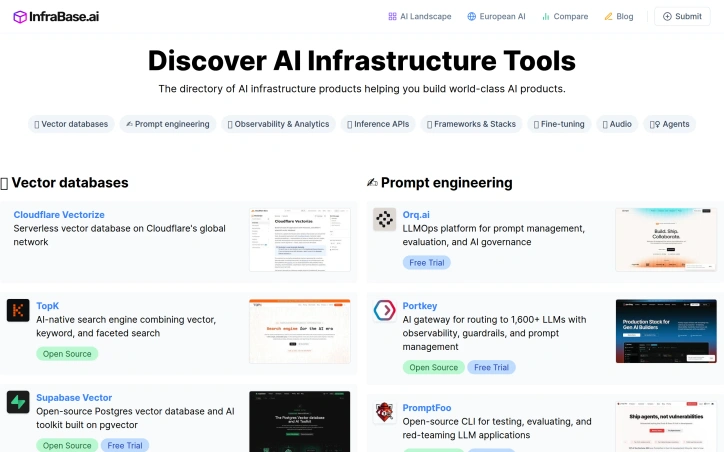
AI-generatedEvaluating AI infrastructure tools sprawls across dozens of specialized vendors, pricing models, and documentation sites, creating significant friction for teams assembling their tech stack. Infrabase.ai consolidates this fragmentation into a single directory organized by functional category—vector databases, prompt engineering tools, observability platforms, inference APIs, and more—making it possible to compare options within each domain without hunting across the web.
The directory serves builders deciding which AI infrastructure components to adopt: founders prototyping at seed stage, engineering teams scaling inference and observability, and architects selecting vector database solutions. The categories span the full infrastructure stack, from foundational services like vectorization and embedding APIs to higher-order tools for prompt management, agent monitoring, and evaluation frameworks.
What distinguishes Infrabase from generic tool aggregators is the specificity of its curation. Each category contains substantive options rather than purely aspirational listings. The directory emphasizes practical attributes: it flags open-source projects alongside commercial offerings, marks free trial availability, and acknowledges the diversity of deployment models—serverless, self-hosted, EU-sovereign—relevant to different organizational constraints. This matters because infrastructure decisions often turn on operational characteristics like data residency and cost scaling, not just feature parity.
The founder built Infrabase from direct experience evaluating infrastructure for a real project, accumulating working lists of products and technical notes substantial enough to justify sharing. This origin explains the site's practical bias. Rather than listing every tangential tool, it focuses on products that demonstrably function within specific categories. The selection acknowledges that the AI infrastructure market extends far beyond dominant cloud providers, a reality that reshapes purchasing power for teams taking AI seriously.
The directory's limitations stem from its breadth. With sixty-one inference APIs, twenty vector databases, and comparable volumes across categories, individual product comparisons flatten into metadata. Users cannot evaluate full feature matrices, benchmark results, or integration patterns within the directory itself. The site succeeds by redirecting focus to vendor pages rather than attempting comprehensive comparison. For teams in early evaluation stages this works appropriately; for detailed diligence it points the right direction without replacing specialized analysis.
Founder Diary
DevlogThe maker hasn't posted a diary entry yet.
Key Features
Consolidated Directory
Aggregates dozens of AI infrastructure vendors into a single organized database by functional category.
Category-Based Organization
Structures tools into domains including vector databases, prompt engineering, observability platforms, and inference APIs.
Practical Curation
Flags open-source projects alongside commercial offerings and marks free trial availability and diverse deployment models.
Infrastructure Stack Coverage
Spans foundational services like vectorization APIs through advanced tools for prompt management and agent monitoring.
Operational Focus
Emphasizes practical attributes including data residency, cost scaling, and vendor-neutral selection beyond dominant cloud providers.
Use Cases
-
1
Seed-stage Founders
Prototyping AI products requires evaluating multiple infrastructure components without researching dozens of specialized vendors separately.
-
2
Engineering Teams Scaling
Teams managing inference and observability benefit from understanding available options across deployment models and cost structures.
-
3
Enterprise Architects
Selecting vector databases and infrastructure hinges on operational characteristics like data residency and cost scaling relevant to organizational constraints.
-
4
Early-stage Stack Assembly
Reducing friction when evaluating a complete AI tech stack by consulting a curated consolidated directory.
FAQ
What categories of AI infrastructure tools does Infrabase cover? ▾
Does Infrabase include open-source and self-hosted options? ▾
Can I compare detailed features and benchmarks within Infrabase? ▾
Tech Stack & Tags
Discussion
No comments yet — be the first!
Join the conversation — sign up to comment.
Sign up freeCommunity Support
Boost this project on Sell With boost
Meet the Founder

More in Automation tools
CMDragon Tools
I built CMDragon Tools to eliminate the friction...

ListFlow – Crosslist to Poshmark, eBay, Mercari & More
I built ListFlow because resellers were wasting...
QRSnap | Free Online QR Code Generator
QRSnap is a free online QR code generator that m...

HVAC Tools Hub
I built HVAC Tools Hub because I saw professiona...
Hackpack-CLI
What is Hackpack CLI? Hackpack CLI is a lightwei...

DMly
We built DMly to help local service businesses a...