EvidenceFlow
- No match
Machine translation — the English original is authoritative.
The Story
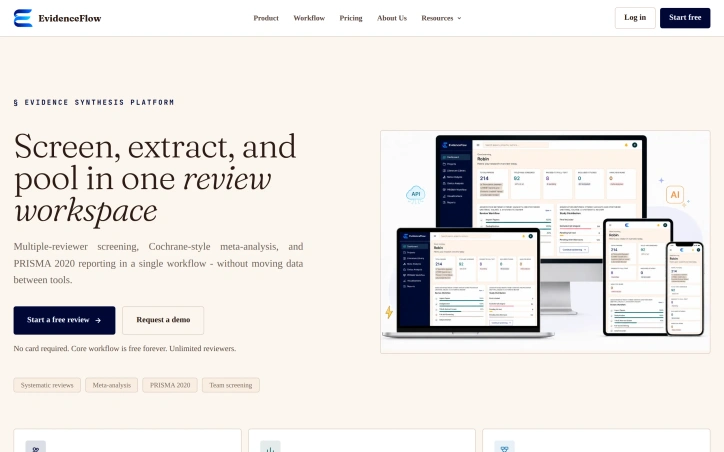
We built EvidenceFlow because researchers conducting systematic reviews were juggling multiple tools for screening, extraction, and meta-analysis. We created one unified platform that connects the complete evidence synthesis workflow—from research question to PRISMA-ready publication—with team collaboration features and blind review built-in.
AI Overview
AI-generatedResearchers coordinating evidence synthesis have long faced a fragmented toolchain problem: screening studies in one system, extracting data in another, and analyzing results in a third, with handoffs between each step introducing friction and error. EvidenceFlow consolidates this workflow into a single platform designed explicitly for the research team conducting systematic reviews rather than individual researchers working alone.
The platform connects the full cycle from research question definition through publication-ready reporting. A researcher starts by establishing their study's PICO framework—population, intervention, comparator, and outcome—which then serves as the reference point for every downstream decision. This traceability extends from initial screening through final meta-analysis, creating an audit trail that documents who made each decision, when, and at which workflow stage.
What distinguishes EvidenceFlow is its focus on collaborative review structures. Rather than treating systematic review as a solitary task, it implements blind dual review as a core feature: two reviewers screen studies independently, neither seeing the other's decisions until conflicts emerge. The platform flags disagreements automatically and routes unresolved records to a third reviewer or manager for arbitration. This architecture prevents studies from silently slipping through as included when reviewers actually disagree, a common failure mode in manual processes.
The meta-analysis engine handles the quantitative synthesis that follows screening. It supports multiple pooling approaches—inverse variance, Mantel-Haenszel, and Peto methods—and generates publication-ready forest and funnel plots directly from live screening data. The platform also integrates specialized omics support, enabling synthesis of GWAS and RNA-seq data across studies.
On integration, EvidenceFlow connects to standard academic sources like PubMed, Crossref, and OpenAlex, and supports common formats including RIS, BibTeX, CSV, and JSON for import and export. Outputs comply with PRISMA 2020 guidelines, the current standard for systematic review reporting.
The pricing model offers a free tier that includes the core workflow and unlimited reviewers—a significant differentiator for academic teams. The platform has received recognition through the AWS Activate Startup Program, suggesting traction among early adopters.
EvidenceFlow addresses a genuine coordination gap in evidence synthesis, particularly for multi-reviewer research teams that currently piece together disparate tools. The combination of built-in collaboration features, standardized reporting, and integrated workflow reduces operational overhead for a process that remains computationally demanding and error-prone when fragmented.
Founder Diary
DevlogThe maker hasn't posted a diary entry yet.
Key Features
Unified Workflow Platform
consolidates screening, data extraction, and analysis into a single integrated system
PICO Framework Integration
establishes and maintains study framework as reference point throughout the entire workflow
Blind Dual Review
implements independent review by two researchers with automatic conflict detection and arbitration
Meta-Analysis Engine
supports multiple pooling approaches and generates publication-ready forest and funnel plots
Academic Data Integration
connects to PubMed, Crossref, and OpenAlex with support for RIS, BibTeX, CSV, and JSON
Use Cases
-
1
Multi-reviewer research teams
eliminates fragmented toolchain and coordination friction across screening, extraction, and analysis
-
2
Academic evidence synthesis
provides PRISMA 2020 compliant reporting with built-in audit trails for reviewer decisions
-
3
Omics research synthesis
enables pooling and analysis of GWAS and RNA-seq data across multiple studies
FAQ
How does EvidenceFlow prevent reviewer disagreement from causing studies to be missed? ▾
Can I import studies from PubMed? ▾
Is there a free tier? ▾
What meta-analysis pooling methods are supported? ▾
Pricing
Free tier includes core workflow with unlimited reviewers; paid tier pricing not specified.
Tech Stack & Tags
Discussion
No comments yet — be the first!
Join the conversation — sign up to comment.
Sign up freeCommunity Support
Boost this project on Sell With boost