#team collaboration Startups & Tools
Discover the best team collaboration startups, tools, and products on SellWithBoost.
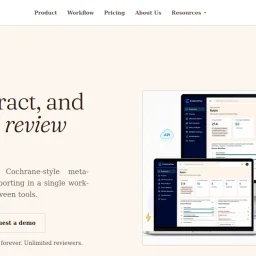
Researchers coordinating evidence synthesis have long faced a fragmented toolchain problem: screening studies in one system, extracting data in another, and analyzing results in a third, with handoffs between each step introducing friction and error. EvidenceFlow consolidates this workflow into a single platform designed explicitly for the research team conducting systematic reviews rather than individual researchers working alone. The platform connects the full cycle from research question definition through publication-ready reporting. A researcher starts by establishing their study's PICO framework—population, intervention, comparator, and outcome—which then serves as the reference point for every downstream decision. This traceability extends from initial screening through final meta-analysis, creating an audit trail that documents who made each decision, when, and at which workflow stage. What distinguishes EvidenceFlow is its focus on collaborative review structures. Rather than treating systematic review as a solitary task, it implements blind dual review as a core feature: two reviewers screen studies independently, neither seeing the other's decisions until conflicts emerge. The platform flags disagreements automatically and routes unresolved records to a third reviewer or manager for arbitration. This architecture prevents studies from silently slipping through as included when reviewers actually disagree, a common failure mode in manual processes. The meta-analysis engine handles the quantitative synthesis that follows screening. It supports multiple pooling approaches—inverse variance, Mantel-Haenszel, and Peto methods—and generates publication-ready forest and funnel plots directly from live screening data. The platform also integrates specialized omics support, enabling synthesis of GWAS and RNA-seq data across studies. On integration, EvidenceFlow connects to standard academic sources like PubMed, Crossref, and OpenAlex, and supports common formats including RIS, BibTeX, CSV, and JSON for import and export. Outputs comply with PRISMA 2020 guidelines, the current standard for systematic review reporting. The pricing model offers a free tier that includes the core workflow and unlimited reviewers—a significant differentiator for academic teams. The platform has received recognition through the AWS Activate Startup Program, suggesting traction among early adopters. EvidenceFlow addresses a genuine coordination gap in evidence synthesis, particularly for multi-reviewer research teams that currently piece together disparate tools. The combination of built-in collaboration features, standardized reporting, and integrated workflow reduces operational overhead for a process that remains computationally demanding and error-prone when fragmented.

Marketing teams today operate in a state of constant tool sprawl. They switch between ChatGPT for strategy, Claude for copy, Midjourney for visuals, and a dozen analytics dashboards, each requiring separate logins and repeated context. Every transition means re-explaining the brief, starting over with new prompts, and losing the thread of prior conversations. This creates friction that makes it harder for marketing departments to move quickly, even with AI assistance. Team24 attacks this inefficiency by consolidating an entire marketing team into Slack, the communication hub most marketing organizations already inhabit. Rather than routing requests to different tools, users message a shared Slack channel and receive work from five specialized AI agents: a strategist who sets positioning and messaging, a copywriter who produces copy and email sequences, a designer who builds landing pages and ad creatives, an analyst who tracks performance, and a manager who orchestrates the workflow. Each agent has a distinct persona and expertise, and they collaborate with each other to produce integrated deliverables without additional user guidance. The key differentiator is not the individual agents but the internal collaboration between them. A copywriter doesn't write in isolation; the strategist's positioning informs the copy, which then informs the designer's creative direction, which feeds back to the analyst's recommendations. This interdependence mirrors how a real marketing team works, except all conversation and file sharing happens in a single thread with shared context preserved throughout. The product delivers finished work, not suggestions. Users submit a brief like "Launch our Q3 product to mid-market SaaS buyers," and Team24 returns completed landing pages, ad campaigns, positioning decks, and performance reports. This stands in contrast to most AI tools that generate drafts requiring further refinement and assembly. The emphasis on delivery over iteration changes the value proposition: instead of augmenting a marketer's output, Team24 positions itself as a replacement for routine marketing work. The product covers a comprehensive marketing workflow spanning strategy, copywriting, design, paid media, email marketing, and analytics. For bootstrapped startups and small-to-mid-market companies that lack dedicated marketing teams, this consolidation could reduce both tool costs and cognitive load. For larger departments, Team24's value hinges on how well the AI's output meets brand standards and performance expectations. No pricing details are disclosed in available materials, leaving the business model unclear. Whether Team24 charges per request, by subscription, or through other models will significantly affect adoption decisions for budget-constrained teams.

Positioned as a stripped-down alternative to heavier platforms like Basecamp and Bitrix, this secure chat and task management tool targets small-to-medium remote teams seeking simplicity over feature richness. The product's defining feature is end-to-end encryption for all communications—an unusual emphasis in the team chat space that directly addresses organizations handling sensitive information. Finance, legal, and healthcare firms can discuss confidential matters without concern that internal administrators might access message content. Operationally, the platform centers on three core capabilities: asynchronous chat, task assignment, and comment-based collaboration. Users assign work to specific team members, request urgent responses, and thread discussions directly within tasks. The interface is consistently praised as intuitive and non-technical-friendly, suggesting thoughtful UX design that avoids overwhelming users with excessive options. Multiple reviewers specifically highlight the absence of unnecessary features—a deliberate trade-off prioritizing speed and simplicity over breadth. Adoption appears strongest in Eastern European markets based on review languages and company references. User feedback clusters around productivity gains and practical reliability. One company reports a 20–25 percent productivity increase following implementation. The platform has accumulated 58 reviews with an "Excellent" rating, indicating solid satisfaction among early adopters, though this reflects a relatively modest user base compared to mainstream competitors. The most significant business model detail is the current pricing strategy: all functionality is free through May 1, 2026. This appears to be a launch-phase offer rather than a permanent free tier, indicating the company plans to introduce paid tiers after the promotional period. For prospects evaluating the platform, this deadline creates genuine urgency to test features before pricing changes take effect. Remote.Team succeeds as a focused product for teams with specific needs: organizations that prioritize security and simplicity over integrations and advanced features. It's neither attempting to be an enterprise platform nor reinventing team communication from first principles. The deliberate restraint in scope, combined with strong end-to-end encryption and demonstrated productivity improvements, makes it a credible option for organizations whose actual needs align with its design philosophy rather than aspirational enterprise requirements.