Glazed AI
- No match
Machine translation — the English original is authoritative.
The Story
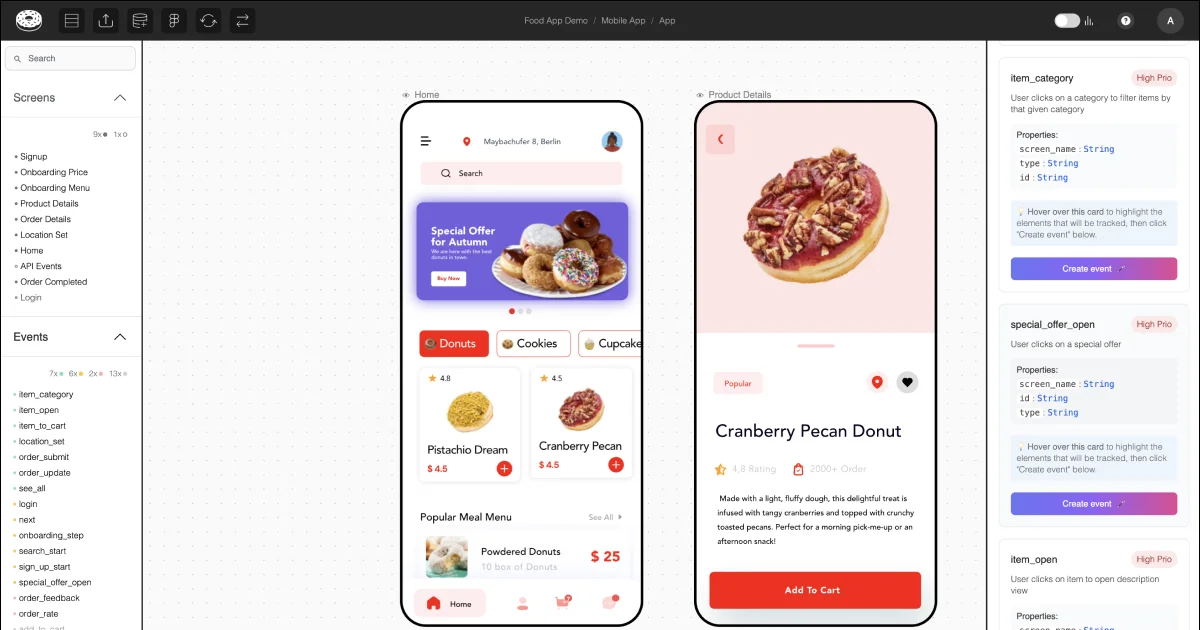
Glazed creates and ships tracking events from Figma files. Our AI analyses Figma screens, suggests events and generates prompts that Cursor and Claude Code execute instantly. Ship tracked features without developer handoffs.
AI Overview
AI-generatedCommunication breakdowns between product and engineering teams often stem from a single source: tracking specifications scattered across multiple tools and formats. When a product manager's tracking plan lives in a spreadsheet, a developer's reference is a Markdown file, and a data analyst checks Confluence, alignment becomes impossible. Glazed addresses this fragmentation by anchoring tracking documentation directly to Figma designs—the source of truth that product, design, and engineering already reference.
The product works by analyzing Figma screens to automatically suggest tracking events aligned with a team's existing taxonomy, then generating implementation prompts that integrate with AI coding assistants like Cursor and Claude Code. This workflow eliminates the traditional handoff where engineers decipher abstract tracking specifications and make implementation decisions in isolation. By linking each event directly to the UI element that triggers it, developers understand instantly what needs tracking and why.
What distinguishes Glazed is its focus on the multi-platform problem. Teams managing iOS, Android, and Web simultaneously face constant risk of tracking inconsistency—different implementations for the same user action across platforms. The tool enforces a single visual source of truth, enabling data, product, and engineering to reference the same specifications without resorting to separate platform-specific interpretations.
The platform integrates with major analytics services including Amplitude, Mixpanel, and Segment, positioning it as an overlay on existing data stacks rather than a replacement. It scales from early-stage startups to larger organizations managing dozens of developers, suggesting flexibility across team sizes and complexity levels.
The claimed outcomes are specific: one customer reportedly eliminated weekly alignment meetings, reduced tracking implementation bugs by fifty percent, and freed up over a hundred hours per month that would otherwise be spent debugging preventable errors. Whether these results generalize depends on existing team maturity and how closely teams currently adhere to specification standards. For teams currently mired in tracking miscommunication, the value proposition is compelling. For those already running systematic documentation practices, the incremental benefit may be more modest.
Founder Diary
DevlogThe maker hasn't posted a diary entry yet.
Key Features
Figma-Anchored Tracking
Anchors tracking documentation directly to Figma designs as the single source of truth
Automated Event Suggestions
Analyzes Figma screens to automatically suggest tracking events aligned with team taxonomy
AI Integration
Generates implementation prompts compatible with AI coding assistants like Cursor and Claude Code
Multi-Platform Consistency
Enforces consistent tracking specifications across iOS, Android, and Web platforms
Analytics Stack Overlay
Integrates with Amplitude, Mixpanel, and Segment as an addition to existing data infrastructure
Use Cases
-
1
Product and Engineering Teams
Eliminates fragmentation when tracking specifications are scattered across spreadsheets, Markdown files, and Confluence
-
2
Cross-Platform Development
Prevents tracking inconsistencies by enforcing a single visual specification source across multiple platform teams
-
3
Data-Driven Organizations
Reduces tracking implementation bugs and frees engineering time otherwise spent debugging preventable errors
FAQ
How does Glazed solve multi-platform tracking inconsistency? ▾
What analytics tools does Glazed work with? ▾
Can Glazed replace our existing analytics platform? ▾
What team sizes can use Glazed? ▾
Tech Stack & Tags
Discussion
No comments yet — be the first!
Join the conversation — sign up to comment.
Sign up freeCommunity Support
Boost this project on Sell With boost
Meet the Founder
Anonymous Maker