
Good for Bots
- No match
Machine translation — the English original is authoritative.
The Story
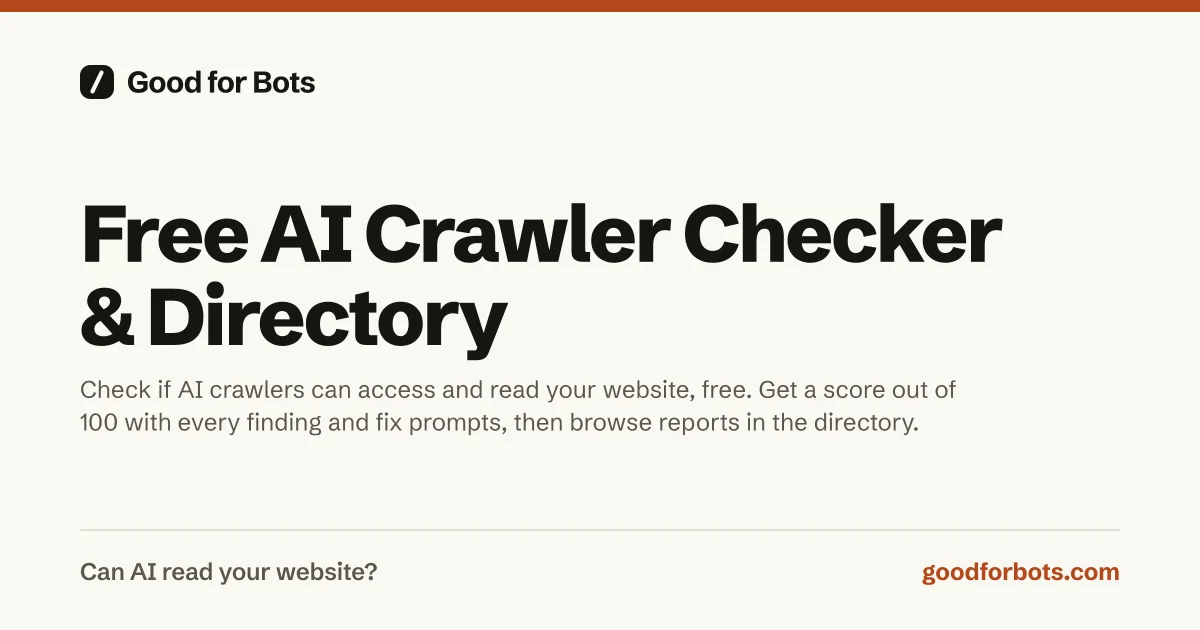
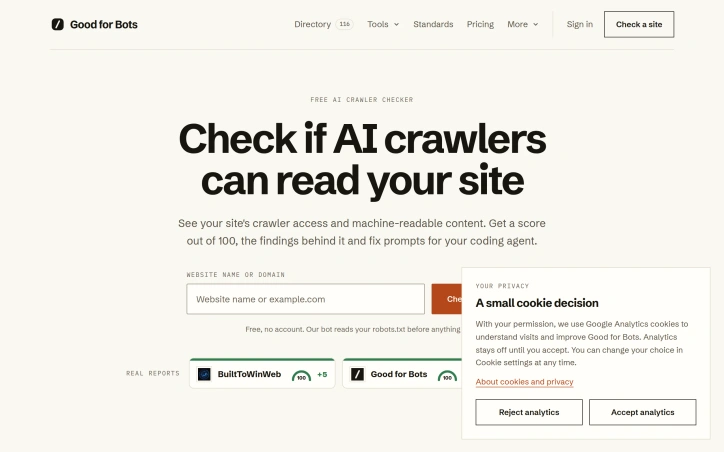
Good for Bots helps website owners check how well their sites can be read by AI crawlers and agents. Enter a domain to run a free scan and get a report with a score out of 100, the findings behind it, and prompts you can give to your coding agent.
The scanner checks crawler rules, llms.txt, sitemaps, Markdown access, structured data, and the HTML it receives. Reports show where content is available, where access fails, and which fixes could recover points. A live badge lets you display your latest score on your website.
The directory brings these reports together so you can explore sites by category, platform, and detected standards. Free tools also check llms.txt and robots.txt separately.
Pro adds weekly monitoring, email alerts, score history, and prompts for every fix. Free and Pro use identical scoring rules. The scan measures technical readiness; it does not promise mentions, rankings, or citations in ChatGPT, Claude, or any other AI assistant's answers.
AI Overview
AI-generatedWebsite owners increasingly need to control how AI crawlers access their content. Good for Bots addresses this by offering a free scanner that measures a site's technical readiness for AI agents, then delivering a public directory of results that lets both owners and potential AI applications understand what content is accessible.
The scanner operates transparently, checking the files that crawlers read first: robots.txt rules, llms.txt declarations, sitemaps, and raw HTML. It evaluates structured data, Markdown rendering, and overall crawler access, then assigns a score out of 100. The product doesn't promise anything vague—the founder explicitly notes that the scan measures technical infrastructure, not rankings or mentions in any AI assistant. This honesty is rare and credible.
What distinguishes Good for Bots is its integration with modern development workflows. Every fix recommendation includes a prompt that developers can feed directly to Claude Code, Cursor, or Codex. Rather than asking website owners to manually implement scoring rubrics, the tool supplies ready-to-use prompts that coding agents can interpret and apply. This bridges the gap between measurement and remediation, turning a diagnostic tool into something actionable.
The free tier is generous. Anyone can scan a site, see the detailed findings, view existing reports in the directory, and access the interactive score breakdown showing what changed between scans. The free plan also grants a dofollow backlink once the live badge appears on the scanned website—a meaningful incentive for participation without forcing payment.
The Pro tier ($20 per month for featured directory listings, with the monitoring product separate) adds weekly rescans and email notifications when scores drop or bot access changes. The Pro reports maintain permanent scan history and include prompts for every fix, not just the highest-impact ones. The product clearly separates concerns: the scanning and scoring are identical whether free or Pro, but the monitoring and convenience features require the paid plan.
The directory itself fills a gap in the current landscape. As more websites think strategically about AI crawler access, having a categorized registry of how sites actually perform—searchable by platform and detected standards—provides transparency that individual scans alone cannot. It creates a public artifact of technical readiness and turns compliance or optimization into a visible, comparable metric.
Founder Diary
DevlogThe maker hasn't posted a diary entry yet.
Key Features
Free Scanner
Measures a site's technical readiness for AI agents with a score out of 100
Public Directory
Searchable registry of website scan results organized by platform and detected standards
Developer Prompts
Every fix recommendation includes ready-to-use prompts for Claude Code, Cursor, or Codex
Comprehensive Evaluation
Checks robots.txt, llms.txt, sitemaps, structured data, HTML, and Markdown rendering
Monitoring Alerts
Pro tier includes weekly rescans and email notifications when scores or bot access changes
Use Cases
-
1
Website owners
Understand and optimize their site's technical readiness for AI crawler access
-
2
AI application developers
Discover which websites are accessible and compatible with their crawlers
-
3
Development teams
Use AI-generated prompts to quickly remediate crawler access issues
-
4
Directory browsers
Research how specific websites perform in AI crawler readiness across different standards
FAQ
What does Good for Bots scan on my website? ▾
Does the tool help fix issues it finds? ▾
What does the free plan include? ▾
What is the Pro plan and how much does it cost? ▾
Pricing
Free tier includes one scan and public directory access; Pro tier adds weekly monitoring and permanent history.
Tech Stack & Tags
Discussion
No comments yet — be the first!
Join the conversation — sign up to comment.
Sign up freeCommunity Support
Boost this project on Sell With boost
Meet the Founder

More in SEO tools
LinkNest
I noticed SEO professionals and independent blog...
Daybreaker.ai
Stop tracking random prompts. Find the exact pro...
Ai Visibility Audit
Businesses increasingly appear in AI-powered sea...
EnjoySEOS
I built EnjoySEOS because SEO professionals were...

AI Visibility Audit
We are building INITE to help businesses simplif...
LaunchRadar
LaunchRadar is a growth tool that helps indie an...