Inventoryaccounting
- No match
Machine translation — the English original is authoritative.
The Story
small industry software
AI Overview
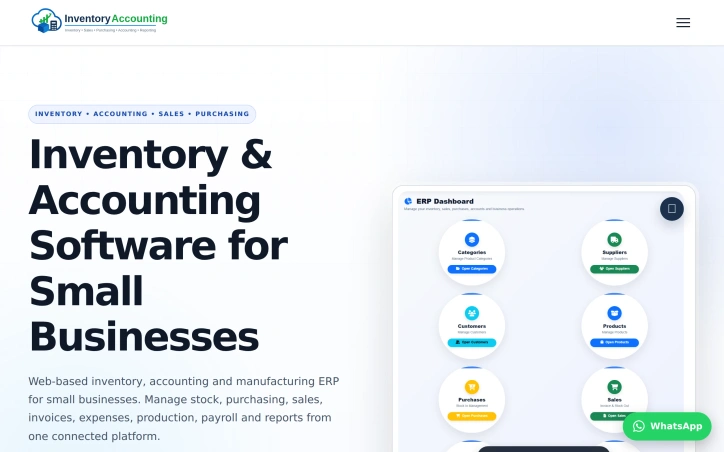
AI-generatedDisconnected spreadsheets and siloed point solutions plague small business operations, particularly for companies managing inventory alongside financial records. Inventory Accounting addresses this fragmentation by consolidating stock management, purchasing, sales, invoicing, accounting, and manufacturing workflows into a single web-based platform designed specifically for small to mid-sized businesses.
The platform targets companies managing physical goods—manufacturers relying on bill-of-materials workflows, wholesalers coordinating suppliers and customer sales, retailers tracking products and transactions, and warehouses monitoring stock levels and movement. Multi-company operators gain the additional benefit of maintaining separate operations within one system while controlling user access through role-based permissions.
What distinguishes this offering is its emphasis on genuine operational integration rather than bolted-together modules. The connection between stock activity and financial records flows throughout the system: inventory movements automatically impact accounting records, customer invoices remain tethered to stock deductions, and manufacturing processes chain raw materials through production to finished goods. Rather than asking users to manually reconcile inventory spreadsheets against accounting ledgers, the platform enforces consistency at the transaction level.
The feature set covers the operational cycle comprehensively. Stock visibility includes real-time quantity reporting and low-stock alerts. Sales workflows connect customer activity, product selection, and invoice generation. Purchasing tracks suppliers, incoming stock, and payment obligations. The manufacturing module handles bill-of-materials definitions with quantities and waste allowances. Accounting delivers traditional ledger and reporting capabilities including profit-and-loss statements, balance sheets, and cash-flow workflows. Role-based access ensures appropriate visibility across departments without exposing sensitive financial data to line staff.
The product positions itself against enterprise ERP platforms by eliminating unnecessary complexity while delivering genuine integration. The company showcases real implementation screens from working deployments rather than relying on mockups or heavily scripted demonstrations, suggesting confidence in practical usability.
One notable gap: the website materials omit explicit pricing information, forcing prospective customers to book demos to understand cost structure. For businesses evaluating multiple solutions, this opacity represents a friction point in the evaluation process.
Inventory Accounting fills a legitimate gap for growing businesses drowning in spreadsheet complexity but not yet ready for enterprise software. Its success depends on execution—whether the integrations work smoothly in real business environments and whether customers actually reduce manual work rather than simply replacing one system with another.
Founder Diary
DevlogThe maker hasn't posted a diary entry yet.
Key Features
Unified Platform
Consolidates inventory, purchasing, sales, invoicing, accounting, and manufacturing into a single web-based system designed for small to mid-sized businesses.
Real-Time Stock Visibility
Provides real-time quantity reporting and automatic low-stock alerts to prevent stockouts.
Automatic Financial Sync
Inventory movements automatically impact accounting records and customer invoices remain tethered to stock deductions.
Bill-Of-Materials Manufacturing
Handles manufacturing workflows with bill-of-materials definitions including quantities and waste allowances.
Multi-Company Management
Allows operators to maintain separate business operations within one system using role-based access control.
Use Cases
-
1
Manufacturers
Manage bill-of-materials workflows and track raw materials through production to finished goods.
-
2
Wholesalers
Coordinate suppliers and customer sales while tracking inventory and payment obligations in a unified system.
-
3
Retailers
Monitor product inventory and sales transactions with real-time visibility and stock alerts.
-
4
Growing SMBs
Eliminate manual spreadsheet reconciliation between inventory and accounting records.
FAQ
Does inventory automatically update my accounting records? ▾
Can I run multiple companies in one system? ▾
What accounting reports does it provide? ▾
How much does Inventory Accounting cost? ▾
Discussion
No comments yet — be the first!
Join the conversation — sign up to comment.
Sign up freeCommunity Support
Boost this project on Sell With boost