
Jam SQL Studio
- No match
Machine translation — the English original is authoritative.
The Story
We built Jam SQL Studio because Microsoft retired Azure Data Studio, leaving developers without a modern SQL IDE. We created an AI-native alternative for macOS, Windows, and Linux that combines essential SQL editor features with cutting-edge AI agent tooling through MCP integration.
AI Overview
AI-generatedA significant shift in the SQL IDE landscape materialized when Microsoft retired Azure Data Studio in February 2026, creating an immediate need for a robust alternative. Jam SQL Studio has positioned itself directly into this market gap, offering a modern SQL development environment purpose-built for an AI-first workflow rather than as a retrofitted legacy tool.
What distinguishes this product from traditional SQL IDEs is its native integration with AI agents through the Model Context Protocol (MCP) framework, combined with an embedded Claude Code CLI. For database engineers and DevOps professionals who increasingly rely on AI-powered coding assistance, this foundation represents a meaningful departure from competitors still bolting on AI as an afterthought. The product supports an impressively broad database ecosystem—SQL Server, PostgreSQL, MySQL, MariaDB, Oracle, and SQLite—making it genuinely cross-platform in capability.
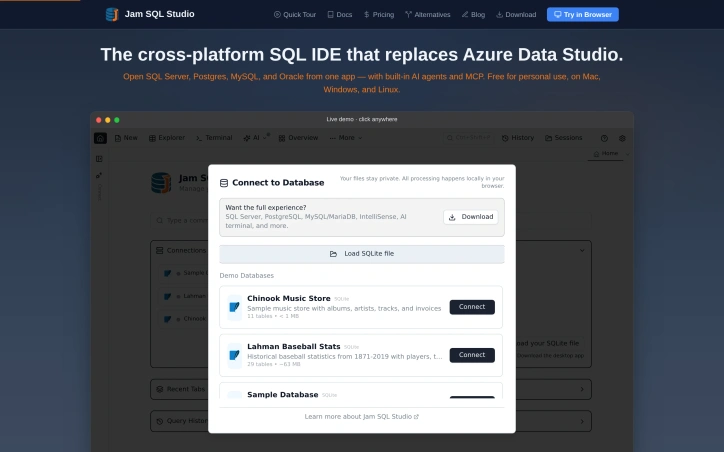
The feature set covers core IDE expectations: SQL notebooks with .ipynb compatibility, intelligent code completion, visual execution plan analysis, built-in charting, and schema comparison. Beyond these fundamentals, Jam SQL Studio includes DBA-focused tooling like session management and performance monitoring across multiple database engines. For teams transitioning from Azure Data Studio, the migration path is straightforward since existing query files, notebooks, and credentials transfer directly.
The pricing model emphasizes accessibility. The tool is free for personal use with no registration requirement, which is particularly significant for developers evaluating alternatives or maintaining home lab environments. This freemium approach removes friction from adoption and creates a clear upgrade path for organizations needing advanced capabilities.
Where the product strategy becomes clear is in its timing and positioning. Rather than competing head-to-head on feature parity with established tools like DataGrip or DBeaver, Jam SQL Studio has recognized an underserved segment: developers who need SQL IDE functionality integrated with modern AI-agent development workflows. The MCP support and Claude integration specifically target this audience, while maintaining compatibility with traditional SQL development for those who don't need AI-enhanced features.
The main question for potential adopters is whether a relatively new entrant can maintain feature parity across such a broad database support matrix while simultaneously developing its AI capabilities. Nevertheless, by capturing users displaced from Azure Data Studio's retirement, Jam SQL Studio has secured an initial user base with genuine switching motivation rather than relying purely on feature advantages.
Founder Diary
DevlogThe maker hasn't posted a diary entry yet.
Key Features
AI Agent Integration
Native support for AI agents through the Model Context Protocol (MCP) framework with an embedded Claude Code CLI.
Multi-Database Support
Compatible with SQL Server, PostgreSQL, MySQL, MariaDB, Oracle, and SQLite in a single IDE.
SQL Notebooks
Supports SQL notebooks with .ipynb compatibility for interactive development.
Code Completion
Intelligent code completion to accelerate SQL development.
Execution Plan Analysis
Visual analysis of query execution plans for database optimization.
Performance Monitoring
DBA-focused tools including session management and performance monitoring across multiple database engines.
Use Cases
-
1
Database Engineers and DevOps Professionals
Those who increasingly rely on AI-powered coding assistance need an IDE natively built for AI agent workflows.
-
2
Azure Data Studio Users
Teams displaced by Azure Data Studio's retirement can migrate existing query files, notebooks, and credentials directly.
-
3
Home Lab Developers
Developers evaluating alternatives or maintaining personal environments benefit from free personal use without registration requirements.
-
4
AI-Integrated Development Teams
Organizations building with AI agents need SQL IDE functionality that natively integrates with modern AI-agent workflows.
FAQ
Can I migrate from Azure Data Studio to Jam SQL Studio? ▾
What databases does Jam SQL Studio support? ▾
How much does Jam SQL Studio cost? ▾
Does Jam SQL Studio integrate with AI? ▾
Pricing
Free for personal use with no registration, with paid organizational tiers available for advanced capabilities.
Tech Stack & Tags
Founder's Resources
Discussion
No comments yet — be the first!
Join the conversation — sign up to comment.
Sign up freeCommunity Support
Boost this project on Sell With boost
Meet the Founder

More in AI Code Editors

RightNow AI Code Editor
RightNow AI is the first CUDA-native code editor...
Nexion - For Windows & Open Source
🎉 Big news! Windows version + Open-source relea...

Strix
Strix is an open-source AI hacking agent that fi...

shadcn CLI 3.0 and MCP Server
shadcn/ui is the foundation for your design syst...

Merge Agent Handler
Securely connect AI agents to enterprise-ready t...

Cursor 1.7
Cursor 1.7 is here! Introducing autocomplete for...